|
|
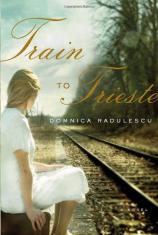
Train to Trieste
by Domnica Radulescu
List Price: $23.95
Pages: 320
Format: Hardcover
ISBN: 9780307268235
Publisher: Knopf
Mona Maria Manoliu is born in Bucharest in 1960 into a family struggling with the difficulties of life in Romania, with its constant food shortages and atmosphere of paranoia.
In the summer of 1977, Mona falls madly in love with handsome, elusive Mihai, a boy who lives in the city in the beautiful Carpathian Mountains where Mona spends her summers. She can think of nothing, and no one, else. But life under the dictator Ceausescu is difficult. Hunger and fear infect everyone. And one day Mona sees Mihai wearing the black leather jacket favored by the secret police. Could he be one of them?
Mona’s father, a university professor and political dissident, is involved in an opposition movement; his activities mean that the family is under constant surveillance. As food shortages worsen, as more and more of her loved ones disappear in “accidents,” it becomes clear that Mona herself could be in danger. After she is threatened by a member of the secret police, who suggests to Mona that some fates are worse than death, Mona’s parents decide that she must leave immediately, in secret. Following a last anguished night with Mihai, Mona is smuggled out of the country by an ex-student of her father’s. She escapes through Yugoslavia to Italy, and while in Trieste she learns that the most likely place to accept a political refugee is the United States.
And so Mona moves to Chicago, where she finds a job, attends graduate school, marries and has two children --- without ever forgetting Mihai, who she hasn’t seen since leaving. Decades later, she journeys back to Romania, determined to learn the truth about her one great love, bringing the novel to an intense and unforgettable conclusion.
Train to Trieste is a thrilling, evocative story about a young woman’s passionate first love, her flight from her native country, and her struggle to make a new life alone in America.
top of the page

1. Mona falls in love with Mihai despite having learned that he “killed” his girlfriend, Mariana, in a mysterious hiking accident. “All I care about is that this man who is grieving for his dead lover turn his eyes on me . . . The smell of earth and death coursing through his heart makes me wild with desire” (p. 7). Does the association of Mihai with death resonate with Mona throughout the novel? How does the element of the unknown influence her feelings for him?
2. Mona’s mind often turns to family members whose life stories were even more desperate than her own --- and who managed to survive --- during the years of famine, wars, and Soviet rule in Romania: her grandmother Paraschiva floated down a river during a flood holding a mirror and a music box, surviving to marry the man who rescued her; her great-uncle Ivan disappeared during World War II, only to reappear twenty-five years later. What does Mona’s story share with these family stories “handed down and retold many times over the years, to the point where they have become vague and misty like fairy tales” (p. 21)? How is her particular story different?
3. Mona describes her birth as follows: “I was born in the morning to the smell of linden trees, to the sound of my mother’s sobs. I was born in the wild disorder of pain and mourning in my family, greedy for life and for my mother’s breast” (p. 23). What is the effect of the style of narration here? What moods and images do pages 22–29 present as Radulescu sets up the life story of the narrator?
4. What does it mean, for Mona, to be Romanian? What seem to be the special characteristics of her culture and its people? How does she differ in her attitude toward her country from both Mihai and her father?
5. Mona’s immigration to America is sponsored by evangelical Christians who seek to convert her to their way of thinking and want her to help them spread their faith (pp. 182–83). How is this ironic? Compare their way of practicing charity, and its effect on Mona, with that of in the people who help her in Trieste, in Italy (pp. 156–75).
6. Mona leaves her sponsors and gets a job at a convenience store; Marta, her co-worker from Mexico, becomes a loyal friend. Later, as she works on her doctorate, Mona teaches English as a second language to students from many other countries. How does living in Chicago shape how Mona’s feelings about becoming an American? As a novel of the immigrant experience, how does Train to Trieste compare with others you have read?
7. After a brief period of happiness, Mona’s marriage to Tom goes badly wrong: she has an affair with Janusz, a Serbian man, which only ends when she becomes pregnant with her first child. Later, after she and Tom have reconciled and she is pregnant again, she realizes that she must get a divorce (pp. 247–49). Why has Mona’s marriage become unbearable to her? Does her situation reflect the difficulties of cross-cultural relationships, or is it a simple matter of incompatibility? Does the ghost of Mihai have any affect on Mona’s subsequent relationships?
8. When necessary, Mona can be a creative tale-spinner: she tells her evangelical sponsors, Gladys and Ron, that she is Jewish and has become pregnant by the black post-man (p. 184), and she later tells the social worker who comes to observe her and her children that she made the packaged Alfredo sauce herself (p. 258). How does humor help Mona not only survive but thrive, first in Romania and then in America?
9. Mona’s sensibility, her way of describing experience, is extremely sensual. To what degree do these powerful aspects of her character tend to determine what happens in her life?
10. After emigrating, Mona spends many years without her parents. When her parents finally join her in Chicago, it seems that her father feels somewhat lost in America. What is it like for the family to be reunited? Does her father lose his identity and purpose, in a sense, by not having to fight the fascist regime at home, and by coming to America (pp. 217–18)? When Mona’s cousin Miruna comes to America, they make their first stop at the zoo (pp. 239-241). What does the sight of pink flamingos --- in winter --- signify for Mona and her family?
11. Mona is on State Street in Chicago when she sees a television in a shop window broadcasting the execution of Ceausescu and his wife. Remembering her own fantasy of killing him, Mona thinks, “How odd --- instead of the bone-deep satisfaction, the limitless joy, I always thought I’d be feeling when this moment came, all I feel is pity and disgust” (p. 231). Why is this moment so strange for Mona? Why is the relationship between dictators and their subjects so personal?
12. Mona is astonished and confused when she learns the truth about Mihai. Her visit to Mihai’s close friend Radu in Romania (pp. 283–301) gives her some closure, but it also brings up new questions about her history. How does Mona’s visit to Radu reorient her sense of the past, of Mihai, and even of her own father? Were you surprised by the conclusion --- and, what do you think happens next?
top of the page

"This vivid debut novel [is] alive with the youthful awareness of the texture of the old world, the world left behind–in this case, Romania. Mona is just 17 when she falls in love with her ‘green-eyed mountain boy,’ Mihai. The adult world–Ceausescu’s government, secret police, parents in political peril–is closing in on them both. But for one beautiful summer, it’s linden trees and vodka made from fermented plums and stars and mountains and raspberries. . . . Drink in the gorgeous scenery, the Carpathians, Bucharest, the dark forests. Suspend all cynicism and believe in the possibility of this love story."
Susan Salter Reynolds, Los Angeles Times
"Like the heroine of her debut novel, Domnica Radulescu escaped from Romania in the early 1980s, studied literature at the University of Chicago, and is a smart, sensitive, passionate, and beautiful woman. Hungry for love and life, 17-year-old Mona falls deeply in love with Mihai. But living in Communist Romania, where everyone is suspicious of everyone else, she is unsure of who he is. . . . Despite her constant fears, she cannot stay out of his bed. But when her father is directly threatened and her own life is in danger, [Mona] is encouraged to flee the country. . . . She eventually arrives in Chicago . . . [Years later,] after her marriage ends and the Ceausescus are murdered in a bloody revolution, she returns to her homeland to find out who her first and only love, Mihai, really was. Radulescu’s novel, sprung from an autobiographical impulse, powerfully combines the intensity of first love, the confusion of politics, and the melancholy of exile."
Barbara Fisher, Boston Sunday Globe
"I was swept away by Domnica Radulescu’s debut novel. It’s at once a haunting journey to a faraway country, beautiful and terrifying, and an odyssey straight to the heart of a young girl and the remarkable woman she becomes. Deeply moving and deeply felt, Train to Trieste is an unforgettable story that introduces a new and astonishingly fresh voice."
Arthur Golden, author of Memoirs of a Geisha
"I never thought I’d have cause to refer to life behind the Iron Curtain as ‘magnificent’ or ‘evocative,’ but there’s a first time for everything. Train to Trieste is Domnica Radulescu’s debut, and it’s a sweeping, gorgeous book about a young woman’s quest for freedom and safety in Soviet-ruled Romania during the late 1970s. Mona Maria Manoliu is 17, beautiful and has a boyfriend, Mihai, who adores her. [But] Romania is in the throes of Nicolae Ceausescu’s communist reign, political dissidents (Mona’s father is one) are being arrested or killed every day . . . Mona lives in constant fear that her father’s contraband typewriter will be found in its hiding place in the oven, or worse, that Mihai himself will be revealed as a member of the secret police. Eventually, the only thing left to do is escape. Mona–alone, bereft, terrified and without saying goodbye to Mihai–turns up briefly in Trieste, moves on to Rome, and finally reaches Chicago, where she begins her life as a refugee. . . . When a cousin visits from Romania and dredges up memories of the past, Mona knows she must return to her homeland, to find Mihai and learn the truth. Every page in this elegant, sophisticated novel drips with detail, from the bittersweet taste of walnut preserves to the sheen of the mahogany wardrobe where a young Mona hides, wondering if it will ever be safe to come out."
Tiffany Lee-Youngren, San Diego Union-Tribune
|
|
|