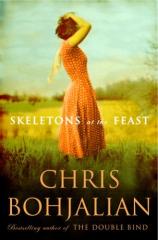
Skeletons at the Feast


Review
Skeletons at the Feast




Chris Bohjalian is the author of 11 previous novels, and in every effort he has tackled serious ethical, moral and social issues that challenge his characters in different ways. Two of his prior works --- PAST THE BLEACHERS and MIDWIVES --- were turned into successful made-for-TV movies. His latest, SKELETONS AT THE FEAST, was inspired in part by an actual diary a friend asked Bohjalian to read in 1998; it had been kept by his friend’s East Prussian grandmother from 1920 to 1945.
Taking place during the final six months of World War II, SKELETONS AT THE FEAST follows the evacuation of the Emmerich family from their estate in East Prussia to points west of Berlin, Germany. These aristocrats must make the tough decision of abandoning an estate their family has owned for generations in an effort to stay well ahead of the fast-approaching Soviet army. Tales of atrocities to which the Soviet army has subjected their prisoners are enough to force the Emmerichs to act quickly and begin their hasty retreat west.
Rolf Emmerich, the father of this clan, is called into battle by the German army along with his two eldest sons, and they are not able to accompany the rest of their family on their harrowing trek. This leaves his wife, “Mutti” (as she is called by her loved ones), and her children, Anna and Theo, to travel on their own, following others from their area who are also embarking on a journey west. Joining the Emmerichs is Callum Finella, a 20-year-old Scottish POW who had been captured hours before the Normandy invasion and forced into labor on the Emmerichs’ estate. Complicating matters is the fact that Callum must hide beneath sacks of grain on the Emmerichs’ wagon so as to not be seen by German forces they may encounter in the area. Additionally, Callum and 18-year-old Anna have secretly fallen in love.
Shortly into their trek, the group meets “Manfred,” a 26-year-old German officer. Unbeknownst to the Emmerichs and Callum, “Manfred” is actually Uri Singer, a Jew who managed to escape from a transport train heading to Auschwitz, abandoning his family in the process. During his time in disguise, Uri has continually sabotaged the Nazi war effort wherever he can and found himself driven to murderous heights that only such traumatic and life-preserving situations could call for. His hope is also to head west and be taken in by the Allied forces of the British and American armies that are entering Germany from the west.
The riveting journey the group takes leads them through ravaged countryside, where they confront the horrors of a dying world while trying to find reasons to believe in the fundamental goodness of people. For the Emmerich family, it is an eye-opening trip as they come to the full realization of the horrors and atrocities to which their own people have subjected millions of innocent Jews --- a realization that changes them forever. To make matters worse, they are traveling during the winter months of 1945 and must battle the cruel elements as well as the uncertainty of what may happen should they encounter either the Soviets or their own German army (who they now must avoid because of both Callum and Uri).
The novel takes the reader through all of this, as well as depicting the face of war via the experiences of these personal encounters with fear and loss. It jumps between different narrators and also includes the story of a small group of Jewish women who are trying to survive in a Nazi concentration camp that is being evacuated. The lives of all the central characters eventually cross during an unforgettable finale.
Bohjalian handles the context of this story effortlessly and has created characters so engaging that any reader will find themselves connecting with these very real people. I particularly enjoyed the fact that he chose to tell it from a point of view rarely seen in WWII tales --- that of the families within Nazi territory. While the Soviet army may very well have been responsible for some war crimes of their own, the Emmerich family sees through the eyes of Callum and Uri that this was nothing in comparison to what their own army was responsible for.
The novel takes its title from a remark made by the Emmerichs’ Uncle Karl, who finds himself unwilling to vacate his home during this mass exodus. Uncle Karl states: “These days, you and I --- our families, our world --- are nothing more than skeletons at the feast anyway.” This simple statement of helplessness in the face of things beyond one’s control is a poignant symbol of the sentiment felt by many of the survivors of WWII.
Some have compared SKELETONS AT THE FEAST to THE ENGLISH PATIENT. While there is definitely the element of romance here, the unflinching depiction of sexual degradation and murderous war escapades far exceeds the romantic ideals of stories like THE ENGLISH PATIENT. It is for this reason that I hail Bohjalian’s new novel and its fearless account of one of the greatest tragedies of the 20th century.
Reviewed by Ray Palen on January 23, 2011


Skeletons at the Feast
- Publication Date: May 6, 2008
- Genres: Fiction, Historical Fiction
- Hardcover: 384 pages
- Publisher: Crown
- ISBN-10: 0307394956
- ISBN-13: 9780307394958