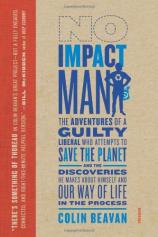
No Impact Man
The Adventures of a Guilty Liberal Who Attempts to Save the Planet, and the Discoveries He Makes About Himself and Our Way of Life in the Process
by Colin Beavan
List Price: $25.00
Pages: 288
Format: Hardcover
ISBN: 9780374222888
Publisher: Farrar, Straus and Giroux
What would your life look like if you made a commitment to have zero impact on the environment? Self-proclaimed guilty liberal Colin Beavan tackled this question in his own life, embarking on a yearlong experiment that affected his wife, their toddler, and even the family dog. They nixed takeout food to avoid reams of wasteful packaging; walked or rode bicycles; used no electricity in their apartment—no TV, no home Internet access, no air-conditioning, no refrigerator, no brightly lit living room late at night; bought seasonal, local groceries that carried the smallest possible carbon footprint; switched to cloth diapers; and otherwise reinvented twentieth-century living. By turns poignant and provocative, No Impact Man reports on the surprising results of this journey, with inspiring words for anyone who has ever wondered what difference “just one person” can make.
top of the page

1. At the beginning of the No Impact experiment, Colin Beavan asks, “Is it true that a guy like me can’t make a difference? Or am I just too lazy or frightened to try?” What answers to these questions did he come up with by the end of the book? Which of the family’s actions made the most significant impact?
2. Beavan’s experiment took green living to an extreme. If you were to choose just a few of his actions to implement in your own life, what would they be? Which conveniences or behaviors should society change in order to reduce our collective environmental impact?
3. Is there such a thing as a lifestyle that makes no impact on the environment? How much impact is too much? How much personal obligation do we each have in reducing our individual carbon footprints? For great ideas on ways to leave a smaller carbon footprint, visit 1Sky at www.1sky.org and Carbon Shredders at www.carbonshredders.org.
4. Beavan traces much of our wasteful culture back to consumerism and the “hedonic treadmill,” the notion that there is always something better out there than what was just purchased. Can you identify purchases or habits in your own life that fit this psychological profile? What consumer products truly improve your life? What are the true necessities? What could you do without altogether? To learn more about the relationship between consuming responsibly and enhancing overall quality of life, visit the Center for a New American Dream (http://newdream.org) and take a look at Buy Nothing Day (www.buynothingday.org) and the Alternative Gift Registry (www.alternativegiftregistry.org).
5. Food plays a major role in this story. How much of the food you eat is locally grown? Organic? Processed? Did No Impact Man inspire you to change your eating and drinking habits? Learn more about food health and safety issues at Food and Water Watch.
6. Beavan runs into many situations in No Impact Man regarding the profusion of packaging waste: paper or plastic at the grocery store, paper plates at the pizza joint, delivery in Styrofoam clamshells. How much packaging waste do you accumulate? How does your community manage landfills and recycling programs? Should it be up to individuals, businesses, or governments to reduce waste? One way to help is to take the Pledge to Break the Bottled Water Habit, organized by the Center for a New American Dream (http://water.newdream.org).
7. At first, Beavan’s wife, Michelle, is a reluctant partner in the No Impact experiment. Discuss her transformation. Why do her attitudes change over the course of the year? How would the project have been different if Beavan had tried it solo?
8. Did Isabelle have a harder or easier time than her parents in adjusting to the No Impact lifestyle? Did the perspective of a child make the project more challenging, or less? Would you consider transporting your child by bike or on foot? What would the world be like for Isabelle’s generation if all parents set the No Impact example?
9. The Beavan family spends a lot of time considering where all their stuff—especially packaging and anything disposable—comes from and goes to during manufacturing and after it gets tossed away. How much do you know about the origins of your stuff? Has this knowledge caused you to change your buying habits?
10. Colin and Michelle run into friction with their respective families for proposing that flying for twice-yearly visits is too carbon intense. Colin’s sister is especially rankled to learn that her brother won’t be at her baby shower. Are they right to be mad? Have your own actions and principles, environmental or otherwise, ever gotten you in trouble with people you care about? How have family expectations changed since the rise of interstate highways and the airline industry?
11. For most people, giving up a car would be a complicated life change. No Impact Man aspires to give up all fossil-fuel transportation. What would be your biggest adjustments if you sold your car, gave up taxis, buses, trains, and planes, and commuted entirely by bike or on foot? What would spur you to do this? What would the drawbacks be? The Alliance for Biking and Walking (www.peoplepoweredmovement.org) has great tips for making this change, including how to create communities that are practical and safe for bicyclists and pedestrians.
12. Happiness forms a theme in No Impact Man. Would you be happier if you slowed down, dispensed with the instant conveniences, and did more things the old-fashioned way? What are your options for slowing down? What holds you back?
13. Colin Beavan’s experiment is similar to Henry David Thoreau’s sojourn to Walden Pond in the mid-nineteenth century. Is it human nature to want a simpler life (Thoreau craved it before the Industrial Revolution), or is it natural to want to be a consumer? What difference did it make when Thoreau decided to remove himself from society, while Beavan consciously remained an active part of his community? How would the No Impact experiment look in a rural location? What were the challenges and benefits of performing the experiment in New York City?
14. Who has the greater responsibility in addressing climate change and pollution: the government or individuals? How can individuals most effectively help usher in change, locally and at the federal level? What does No Impact Man teach us about persuading naysayers?
15. Although Beavan’s previous books have nothing to do with saving the planet, there is a common thread in all his work: it showcases extensive research. Browse the notes at the back of No Impact Man. What do they indicate about the amount of information currently available on the importance of environmentalism? Does the Information Age make it easier or harder to learn the facts and promote the cause?
top of the page

"A riveting account of the year in which Colin Beavan and his wife attempted to do what most of us would consider impossible. What might seem inconvenient to the point of absurdity instead teaches lessons that all of us need to learn. We as individuals can take action to address important social problems. One person can make a difference."
Marion Nestle, author of What to Eat
"From their first baby steps (no takeout) to their giant leap (no toilet paper), the Beavans’ experiment in ecological responsibility was a daunting escapade in going green... So fervent as to make Al Gore look like a profligate wastrel, Beavan’s commitment to the cause is, nonetheless, infectiously inspiring and uproariously entertaining."
Booklist
"An inspiring, persuasive argument that individuals are not helpless in the battle against environmental degradation and global warming."
Kirkus Reviews
"There’s something of Thoreau in Colin Beavan’s great project --- but a fully engaged, connected, and right-this-minute helpful version. We’re at a moment when we need to have as little impact in our own lives as possible --- and as much impact in our political lives as we can possibly muster. Beavan shows how!"
Bill McKibben, author of Deep Economy