Reading Group Guide
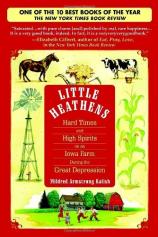
Little Heathens
Hard Times and High Spirits on an Iowa Farm During the Great Depression
by Mildred Armstrong Kalish

List Price: $12.00
Pages: 304
Format: Paperback
ISBN: 9780553384246
Publisher: Bantam

Click here to buy this book from Amazon.com.
Click here to buy this book from Amazon.ca.


About This Book


I tell of a time, a place, and a way of life long gone. For many years I have had the urge to describe that treasure trove, lest it vanish forever. So, partly in response to the basic human instinct to share feelings and experiences, and partly for the sheer joy and excitement of it all, I report on my early life. It was quite a romp.

So begins Mildred Kalish’s story of growing up on her grandparents’ Iowa farm during the depths of the Great Depression. With her father banished from the household for mysterious transgressions, five-year-old Mildred and her family could easily have been overwhelmed by the challenge of simply trying to survive. This, however, is not a tale of suffering.

Kalish counts herself among the lucky of that era. She had caring grandparents who possessed --- and valiantly tried to impose --- all the pioneer virtues of their forebears, teachers who inspired and befriended her, and a barnyard full of animals ready to be tamed and loved. She and her siblings and their cousins from the farm across the way played as hard as they worked, running barefoot through the fields, as free and wild as they dared.

Filled with recipes and how-tos for everything from catching and skinning a rabbit to preparing homemade skin and hair beautifiers, apple cream pie, and the world’s best head cheese (start by scrubbing the head of the pig until it is pink and clean), Little Heathens portrays a world of hardship and hard work tempered by simple rewards. There was the unsurpassed flavor of tender new dandelion greens harvested as soon as the snow melted; the taste of crystal clear marble-sized balls of honey robbed from a bumblebee nest; the sweet smell from the body of a lamb sleeping on sun-warmed grass; and the magical quality of oat shocking under the light of a full harvest moon.

Little Heathens offers a loving but realistic portrait of a “hearty-handshake Methodist” family that gave its members a remarkable legacy of kinship, kindness, and remembered pleasures. Recounted in a luminous narrative filled with tenderness and humor, Kalish’s memoir of her childhood shows how the right stuff can make even the bleakest of times seem like “quite a romp.”

top of the page


rgg_discuss.gif (1294 bytes)


1. Little Heathens recounts an adult woman’s memories of a childhood long past. What is the difference between a child's perspective and an adult’s? How did Kalish’s understanding of the world change as she grew older? Are there some ways in which her approach to life is still the same now as when she was a child?

2. How did Kalish’s memoir enhance your understanding of the Great Depression? What differences existed between farmers and city dwellers who lived through it? What legacies of this time period exist in your family?

3. Which of Kalish’s relatives was most memorable to you? Was there an Aunt Belle in your childhood? Who plays that role for the next generation?

4. How would you characterize the dynamics within Kalish’s large family? How was peace kept? What accounted for the contrasts between her relatives who were indulgent and those who were frugal?

5. What comparisons can you make between men’s and women’s roles during this period in American history? What did Kalish’s mother teach her about what a woman could expect of life?

6. Discuss the economic realities that defined this era. What determined who would manage to get by and who, like the families she describes, would lose their farms altogether? What attitudes toward money was Kalish taught to develop?

7. Kalish describes the longevity of many of her ancestors, who relied on home remedies rather than emergency rooms for treatment. She also describes the presence of cream in most of her family’s meals, and the availability of glorious fresh-baked desserts that would be strictly forbidden on a contemporary weight-loss plan. What keys to health and wellness does her memoir provide?

8. What did it take to fit in within this Iowa community? Which children and adults were accepted, and which ones might be subject to pranks or gossip? How did Kalish’s experience at school compare to that of a student at one of the large public schools that now replace her classroom?

9. How did you react to the discussions of food preparation featured in the book–from regulating the stove temperature to slaughtering–and cleaning–the main course? What were the benefits and shortcomings of such a labor-intensive use of fresh ingredients, and of life without supermarkets? Did any aspects of Kalish’s Depression-era cuisine surprise you?

10. In the end, Kalish tells us how she was able to journey far from the farm and build a life in urban areas. What distinguishes those who remained on the farm from those who left it?

11. Had you realized that the rural electrification bill was not passed until Roosevelt’s presidency? How did it shape a community to live at the mercy of the seasons, without electricity or indoor plumbing? What was Kalish’s relationship with the natural world like?

12. Discuss the role of religion in this community. What did the hierarchy of religions described by Kalish indicate about the populations who lived in her area? What were the foundations of faith within her family?

13. Early on, Kalish tells us that her mother was a single parent, and that the story of her absent father was rarely mentioned. How did her family compensate for her absent parent? How did her mother’s experience of single motherhood compare to that of parents in similar situations today?

14. Could your family endure the way of life described in the book?

15. What is gained and lost in a world that favors technology over manual labor?

16. Discuss the title of Kalish’s memoir. Which of her extended family’s antics made you laugh the most? How have the standards for naughty “little heathens” changed since she was a child?

17. What stories would you include in your memoir? What aspects of history does your life capture?

top of the page

Critical Praise

“This lovely book, so unaffected and so generous, opens the door to a past I knew as a child in Iowa, and I wept with joy and recognition as I read it. It deserves a distinguished place next to Hamlin Garland’s Son of the Middle Border but, with its deep humility, it would also fit, without a single word of protest, next to the Betty Crocker Cookbook.”
Ted Kooser, U. S. poet laureate, 2004-2006


Little Heathens is an enchanting but thoroughly unsentimental look at rural life in the Great Depression. In clear clean prose we are offered the grit, struggle, and also the joy of hard work on a farm. I cherish this book for its quite naked honesty and quiet lyricism about a time which makes our current problems nearly childish. This is a fine book.”
Jim Harrison, author of Legends of the Fall


“Now that cell phones are a way of life, you won’t find a better way to participate in the Good Old Days. Whether you are of farm origins or not, Little Heathens is a bit of history begging to be borrowed. Like a neighborly cup of sugar, it will sweeten your modern-day life.”
MaryJane Butters, author of MaryJane’s Ideabook, Cookbook, Lifebook for the Farmgirl In All Of Us


“Using this book alone, one could reconstruct, with glorious exactness, a lost time and place. Mildred Kalish has a novelist's eye for detail and a beautiful understanding of what the gestures of daily life mean. A lovely, wise, transporting memoir.”
Joan Silber, author of Ideas of Heaven: A Ring of Stories

 
Back to top.   


Privacy Policy | Contact Us | Advertising | About Us

© Copyright 2001-2008, ReadingGroupGuides.com. All rights reserved.