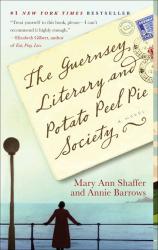
The Guernsey Literary and Potato Peel Pie Society
by Mary Ann Shaffer and Annie Barrows
List Price: $14.00
Pages: 304
Format: Paperback
ISBN: 9780385341004
Publisher: Dial Press Trade Paperback
“I wonder how the book got to Guernsey? Perhaps there is some sort of secret homing instinct in books that brings them to their perfect readers.”
January 1946: London is emerging from the shadow of the Second World War, and writer Juliet Ashton is looking for her next book subject. Who could imagine that she would find it in a letter from a man she’s never met, a native of the island of Guernsey, who has come across her name written inside a book by Charles Lamb….
As Juliet and her new correspondent exchange letters, Juliet is drawn into the world of this man and his friends --- and what a wonderfully eccentric world it is. The Guernsey Literary and Potato Peel Pie Society --- born as a spur-of-the-moment alibi when its members were discovered breaking curfew by the Germans occupying their island --- boasts a charming, funny, deeply human cast of characters, from pig farmers to phrenologists, literature lovers all.
Juliet begins a remarkable correspondence with the society’s members, learning about their island, their taste in books, and the impact the recent German occupation has had on their lives. Captivated by their stories, she sets sail for Guernsey, and what she finds will change her forever.
Written with warmth and humor as a series of letters, this novel is a celebration of the written word in all its guises, and of finding connection in the most surprising ways.
top of the page

1. What was it like to read a novel composed entirely of letters? What do letters offer that no other form of writing (not even emails) can convey?
2. What makes Sidney and Sophie ideal friends for Juliet? What common ground do they share? Who has been a similar advocate in your life?
3. Dawsey first wrote to Juliet because books, on Charles Lamb or otherwise, were so difficult to obtain on Guernsey in the aftermath of the war. What differences did you note between bookselling in the novel and bookselling in your world? What makes book lovers unique, across all generations?
4. What were your first impressions of Dawsey? How was he different from the other men Juliet had known?
5. Discuss the poets, novelists, biographers, and other writers who capture the hearts of the members of the Guernsey Literary and Potato Peel Pie Society. What does a reader’s taste in books say about his or her personality? Whose lives were changed the most by membership in the society?
6. Juliet occasionally receives mean-spirited correspondence from strangers, accusing both Elizabeth and Juliet of being immoral. What accounts for their judgmental ways?
7. In what ways were Juliet and Elizabeth kindred spirits? What did Elizabeth’s spontaneous invention of the society, as well as her brave final act, say about her approach to life?
8. Numerous Guernsey residents give Juliet access to their private memories of the occupation. Which voices were most memorable for you? What was the effect of reading a variety of responses to a shared tragedy?
9. Kit and Juliet complete each other in many ways. What did they need from each other? What qualities make Juliet an unconventional, excellent mother?
10. How did Remy’s presence enhance the lives of those on Guernsey? Through her survival, what recollections, hopes, and lessons also survived?
11. Juliet rejects marriage proposals from a man who is a stereotypical “great catch.” How would you have handled Juliet’s romantic entanglement? What truly makes someone a “great catch”?
12. What was the effect of reading a novel about an author’s experiences with writing, editing, and getting published? Did this enhance the book’s realism, though Juliet’s experience is a bit different from that of debut novelist Mary Ann Shaffer and her niece, children’s book author Annie Barrows?
13. What historical facts about life in England during World War II were you especially surprised to discover? What traits, such as remarkable stamina, are captured in a detail such as potato peel pie? In what ways does fiction provide a means for more fully understanding a non-fiction truth?
14. Which of the members of the Society is your favorite? Whose literary opinions are most like your own?
15. Do you agree with Isola that “reading good books ruins you for enjoying bad ones”?
top of the page

"I can’t remember the last time I discovered a novel as smart and delightful as this one, a world so vivid that I kept forgetting this was a work of fiction populated with characters so utterly wonderful that I kept forgetting they weren’t my actual friends and neighbors. Treat yourself to this book please—I can’t recommend it highly enough."
Elizabeth Gilbert, author of Eat, Pray, Love
"Mary Ann Shaffer and Annie Barrows have written a wondrous, delightful, poignant book— part Jane Austen, part history lesson. The letters in The Guernsey Literary and Potato Peel Pie Society aren't addressed to you, but they are meant for you. It's a book everyone should read. An absolute treasure."
Sarah Addison Allen, author of Garden Spells
"Here's who will love this book: anyone who nods in profound agreement with the statement, "Reading keeps you from going gaga." The Guernsey Literary and Potato Peel Pie Society is a delight. Tart, insightful and fun."
Mary Doria Russell, author of The Sparrow, A Thread of Grace and Dreamers of the Day
"Charming…. [Heroine] Juliet finds in the letters not just inspiration for her next work, but also for her life—as readers will."
Publishers Weekly