IndieBound Independent Bookstores

Barnes & Noble

Loading
Reading Group Guide
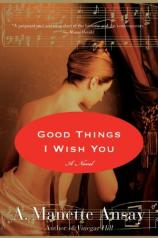
Good Things I Wish You
by A. Manette Ansay

List Price: $13.99
Pages: 272
Format: Paperback
ISBN: 9780061239953
Publisher: Harper Perennial

Click here to buy this book from Amazon.com.
Click here to buy this book from Amazon.ca.


About This Book

The acclaimed author of Vinegar Hill returns with a story of two unlikely romances --- one historical, the other modern-day --- separated by thousands of miles and well over a century.

Battling feelings of loss and apathy in the wake of a painful divorce, novelist Jeanette struggles to complete a book about the long-term relationship between Clara Schumann, a celebrated pianist and the wife of the composer Robert Schumann, and her husband’s protégé, the handsome young composer Johannes Brahms. Although this legendary love triangle has been studied exhaustively, Jeanette --- herself a gifted pianist --- wonders about the enduring nature of Clara and Johannes’s lifelong attachment. Were they just “best friends,” as both steadfastly claimed? Or was the relationship complicated by desires that may or may not have been consummated?


Through a chance encounter, Jeanette meets Hart, a mysterious, worldly entrepreneur who is a native of Clara’s birthplace, Leipzig, Germany. Hart’s casual help with translations quickly blossoms into something more. There are things about men and women, he insists, that do not change. The two embark on a whirlwind emotional journey that leads Jeanette across Germany and Switzerland to a crossroads similar to that faced by Clara Schumann --- also a mother, also an artist --- more than a century earlier.


Accompanied by photographs, sketches, and notes from past and present, A. Manette Ansay’s original blend of fiction and history captures the timeless nature of love and friendship between women and men.


top of the page


rgg_discuss.gif (1294 bytes)

1. What meaning does the title Good Things I Wish You hold for the two main couples in the book?

2. Throughout the novel there is much speculation about the relationship between Clara Schumann and Johannes Brahms. Do you think they consummated their relationship? Why or why not? Could they have just been good friends? What do you think accounted for their break?

3. At the beginning of the story, Jeannette reveals that she has had two rushes of déjà vu in her life. What were they? She describes it as the “steep inevitability one feels at the start of a steep accidental fall.” Is this an apt description for the events she describes? Have you ever felt déjà vu? What was your experience like?

4. Clara Schumann was an extraordinarily accomplished artist. “My Clara wasn’t raised to waste her life on domestic bliss,” her father, Friedrich Wieck, proclaimed. Yet her life --- and her father’s ambition for her --- was overshadowed when she met Robert Schumann. Why do you think she chose love over her artistry?

5. Describe Clara’s relationship with Schumann and Brahms. How did each man view her? What was her significance to each and to their music?

6. Over the course of the novel, we learn of three men in Jeannette’s life: her piano teacher when she was a teenager, her husband Cal, and the elusive doctor, Hart. Compare and contrast the men and the relationship they shared with Jeannette. How do they compare to Clara’s relationships with her husband and her friend, Brahms?

7. Why do you think Jeannette’s piano teacher told her about Clara Schumann? For her sixteenth birthday he gave her a portrait of Clara at 35, telling her, “it would help her understand things about men and women most people don’t figure out until after it’s too late.” What advice was the piano teacher trying to convey to Jeannette?

8. Neither Jeannette nor Hart believe in coincidences. Do you? Why or why not?

9. Hart tells Jeannette that there are things about men and women that do not change and that men and women can never be friends. Why does Hart tell her this? Yet another man who loves Jeannette ---L___--- agrees with her that true friendship is not only possible, but necessary. Examine the issue from both sides. How is each man’s position supported and belied by his bond with Jeannette? What elements can forge a platonic relationship? Which character do you sympathize with more in terms of the question, Hart or L___.

10. In a diary written for her children, Clara admonished them not to “heed those small and envious souls who make light of my love and friendship, trying to bring up for question our beautiful relationship which they do not understand nor ever could.” Why do you think she felt that so few could understand her “beautiful relationship”? Why do so many people have difficulty with the subtleties that infuse a relationship such as that which she shared with Brahms?

11. Passion versus rationality and freedom versus the bonds of commitment are two of the novel’s themes. Discuss how each is manifested in the story. Speaking of passion, how important is it to romantic love? Does one sex have a monopoly on passion --- feel deeper or more sincerely --- than the other? What about romanticism? Would you call Brahms and Hart romantics in the classical sense? What about Clara and Jeannette? How would you describe them?

12. Ansay also touches on the themes of art and desire. How does desire fuel creativity throughout the book? Does contentedness stifle creativity? What did Clara desire? Brahms? Hart? Jeannette?

13. In the novel, the author imagines that Clara and Brahms consummate their love, an action that leads to their separation. Why do some people, like the character portrayed by Brahms, seem to prefer the chase to the prize? Have you known anyone like this?

14. Jeannette’s young daughter draws a picture of her mother. “Why is your mother frowning? The teacher asked her. “Because she is lonely. My mommy likes to be lonely.” Does this capture Jeannette’s personality? Heidi also uses the word “lonely” to mean “different.” Are the two words interchangeable? How so?

15. Why do you think the author chose to include photos and excerpts from Clara and Brahms’s letters? Did the photos and excerpts add to your reading experience? How might the novel have been different without them?

16. What role does Jeannette’s friend Ellen play in the story? When they discuss prospective love interests they are quick to dismiss for a variety of reasons. Do you think they are too picky? Are people too demanding when it comes to love?

17. Ellen pushes Jeannette to define her relationship with Hart. Should relationships always be defined? Can’t they just be enjoyed for the moment’s sake? How does the act of defining impact a relationship?

18. Talk about Hart and Jeannette. What kind of couple do they make? Were you surprised at the turns their relationship takes? What attracts them to each other? Are they good together? Could marriage ever work between them?

19. Where you satisfied by the novel’s ending? Çan work and art sustain us through our loneliness? Does it offer and solace and hope --- fill a void? How so --- and for how long?

20. While writing her book, Jeannette asks herself, “What could I take from the life of Clara Schumann as a working artist, living in the world today? As a mother? As somebody’s former wife? As somebody standing on the edge of what must be a whole new life?” How would you answer these questions? What lessons did you take from Clara’s life? What about Jeannette’s?

top of the page

Critical Praise

"“[Ansay] successfully tries her hand at metafiction in her latest novel, a poignant and arresting duet of the historic and the contemporary… Ansay sprinkles bits of letters, photographs, and drawings throughout the novel, a deft touch that adds to the book’s evocative moods of past and present…The remarkable thing about Good Things I Wish You is its ability to mine those feelings and emerge shining with life’s possibilities."
Miami Herald


"Reminiscent of The French Lieutenant’s Woman, Good Things I Wish You employs a rich and daring metafictional spin on one of the great romances in history to investigate passion and love --- and what doesn’t change between women and men. Manette Ansay takes great risks to deliver great rewards."
Stewart O'Nan

 
Facebook Fan Page  Follow us on Twitter


Add Your Guide to ReadingGroupGuides.com!

Bookreporter.com Bets On...: Books We're Betting You'll Love


Privacy Policy | Contact Us | Advertising | About Us

© Copyright 2001-2012, ReadingGroupGuides.com. All rights reserved.
The Book Report, Inc. • 250 West 57th Street • Suite 1228 • New York, NY • 10107
Ph: 212-246-3100 • Fax: 212-246-4640

Bookreporter.comReadingGroupGuides.comGraphicNovelReporter.comFaithfulReader.com
Teenreads.comKidsreads.comAuthorsOnTheWeb.com