Reading Group Guide
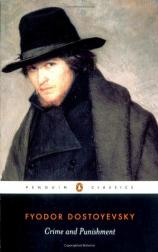
Crime and Punishment
by Fyodor Dostoyevsky

List Price: $13.00
Pages: 718
Format: Paperback
ISBN: 0140449132
Publisher: Penguin Classics

Click here to buy this book from Amazon.com.
Click here to buy this book from Amazon.ca.


About This Book


When Dostoyevsky started work on Crime and Punishment in the summer of 1865 he was depressed and in serious financial straits. A recent gambling spree had depleted his savings, and he owed money for personal expenses as well as bills for Epokha, the journal he founded and had been forced to discontinue. Threatened with debtors' prison, he was approached by an unscrupulous publisher who offered a ridiculously exploitative contract under which Dostoyevsky signed over the copyrights to all his existing works and agreed to write a work of fiction by the end of the following year. For all this he was paid the sum of three thousand rubles, most of which was quickly swallowed up by promissory notes; what little remained was squandered at the gaming tables. Destitute once again, Dostoyevsky forced himself to concentrate on his writing, and by that fall had conceived of the idea for a novel-length work about a family ruined by alcohol.

The roots of Crime and Punishment can be found in various episodes in Dostoyevsky's life. His original idea, a murderer's first-person confession, came to him during his prison term in Siberia-an experience that profoundly changed his political views and instilled in him a life-long respect for order and authority. There is also evidence that he conceived of the Marmaledov family as the basis for a novel to be titled "The Drunkards," but which was never published. Finally, Dostoyevsky was reacting to the political climate in St. Petersburg, where the impulses of the revolution could be found in the nihilist and radical movements, which Dostoyevsky abhorred. Regardless of its origins, Dostoyevsky meant the novel to be as close to perfect as possible. He took extensive-now famous-notes regarding its structure, toying with different points of view, character, structure, plot, and a variety of thematic strains.

The efforts paid off. Crime and Punishment is a superbly plotted, brilliant character study of a man who is at once an everyman and as remarkable as any character ever written. It poses a simple question, "Can evil means justify honorable ends?" and answers it convincingly without didacticism or naiveté. Dostoyevsky intimates himself so closely with Roskolnikov's consciousness, and describes his turmoil and angst so precisely and exhaustively, that it is easy to forget that the events take place over the course of a mere two weeks. He encourages us to identify with Roskolnikov: the painstaking descriptions of the student's cramped, dingy quarters; the overpowering sights and sounds of a stifling afternoon on the streets of St. Petersburg; the excruciating tension of Porfiry's interrogation-all serve to place the reader at the heart of the action: Roskolnikov's fevered, tormented mind.

The murder itself is almost incidental to the novel; Dostoyevsky devotes no more than a few pages to describing its execution, although he details the painful vacillations that precede the incident and, of course, exposes every aspect of its aftermath. Similarly, Roskolnikov's punishment, in the literal sense, is put off until the epilogue, with his sentence-reduced to seven years due to the accused's apparent temporary insanity-to a Siberian labor camp. Thus Dostoyevsky brilliantly invites readers to put forth their own notions of Crime and Punishment, and engages us in an irresistible debate: Who is the real criminal? Marmeladov, for abandoning his family? Luzhin for exploiting Dunya? Svidrigailov for murdering his wife? Sonya for prostituting herself? The greedy pawnbroker whom Roskolnikov murdered? Or, to turn the question around: Who among us is not a criminal? Who among us has not attempted to impose his or her will on the natural order? Furthermore, we are made to understand that Roskolnikov's true punishment is not the sentence imposed on him by the court of law, but that imposed on him by his own actions: the psychological and spiritual hell he has created for himself; the necessary sentence of isolation from his friends and family; the extreme wavering between wanting to confess his crime, and desperately hoping to get away with it. Compelled, ultimately, to confess his crime-and the confession scene is the only incident in which Roskolnikov actually admits to the crime-we feel that Roskolnikov has suffered sufficiently. Indeed, the epilogue with its abbreviated pace and narrative distance feels like a reprieve for the reader as well as for the criminal. Finally, in Siberia, Roskolnikov has found space.

The public reception of Crime and Punishment was enthusiastic-if a little stunned. There was much discussion about the novel's overwhelming power and rumors of people unable to finish it. Readers were shocked by Dostoyevsky's gruesome descriptions and enthralled by his use of dramatic tension. Perhaps the most virulent, and unexpected, criticism came from readers who felt that Dostoyevsky's portrait of the nihilist movement was an indictment of Russian youth and that its premise was inconceivable. For more than a century, critics have argued about the book's message: Is it a political novel? A tale of morality? A psychological study? A religious epic? As Peter McDuff points out in his Introduction to the Penguin Classics edition, interpretations may be more revealing of the critic than of the text. Whatever Dostoyevsky's purpose-political, moral, psychological, or religious (and most likely he meant to touch on each of these themes)-one thing is certain. In Roskolnikov, Dostoyevsky has created a man who is singular yet universal. He is someone with whom we can sympathize, empathize, and pity, even if we cannot relate to his actions. He is a character we will remember forever, and whose story will echo throughout history.

top of the page


rgg_discuss.gif (1294 bytes)


1. How does Dostoyevsky achieve and sustain the suspense in his novel? Which scenes strike you as being particularly suspenseful? How does he use description to enhance the turmoil in Roskolnikov's mind?

2. What role does chance play in the development of the novel? In which scenes does coincidence figure heavily in the outcome? Is Dostoyevsky interfering too much with the natural course of events in order to move his story along, or is he making a point about the randomness of life, free will, and divine intervention?

3. Compare the characters of Roskolnikov, Luzhin, and Svidrigailov. How is each of these men a "villain," and to what extent are they guilty? How does each man face his guilt, and how does each suffer for it?

4. Compare the major female characters: Sonya, Dunya, Katerina Ivanovna. Do you think they are well-rounded characters or stereotypes? How does each figure in Roskolnikov's actions?

5. Discuss the scene in which Roskolnikov meets Sonya in her room and he asks her to read the story of Lazarus. What makes this scene so effective? What does Roskolnikov mean when he tells Sonya she is "necessary" to him? (p. 388)

6. Later, in confessing the murder to Sonya, Roskolnikov claims, "Did I really kill the old woman? No, it was myself I killed.... And as for the old woman, it was the Devil who killed her, not I." (p. 488) What does he mean by this? What motive does Roskolnikov give for his murder? Why does he confess to Sonya? Why doesn't the confession ease him of his inner torment?

7. Discuss Roskolnikov's theory of the ordinary versus the extraordinary man. What is Dostoyevsky's attitude toward this theory? Can you think of modern-day examples of this theory put into practice?

8. Does the fact that Roskolnikov never uses the money he stole from the pawnbroker make him less-or more-guilty? Why do you think he never recovers the stolen items or cash?

9. Why does Roskolnikov reject his family's and Razumikhin's attempts at solace and comfort? Why, when they are at their most loving, does he have feelings of hatred for them? What is Dostoyevsky saying about guilt and conscience?

10. Roskolnikov emerges as a dual character, capable of cruelty and compassion, deliberation and recklessness, and alternating between a desire for solitude and companionship. Why has Dostoyevsky created such a complex psychological portrait?

top of the page

 
Back to top.   


Privacy Policy | Contact Us | Advertising | About Us

© Copyright 2001-2008, ReadingGroupGuides.com. All rights reserved.