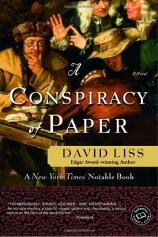
A Conspiracy of Paper


Review
A Conspiracy of Paper




"For Great Britain in the early eighteenth century, stocktrading, government issues, and lotteries were all relatively new, and the uncertainty that comes with newness created an exciting culture within Exchange Alley." In David Liss's first novel, A CONSPIRACY OF PAPER, inspired by the author's Columbia University doctoral dissertation on personal finance in the 18th-century, is set amidst the South Sea Bubble, an event in 1720 that is considered the first stock market crash in the English-speaking world.
With remarkable acuity regarding the secret dealings of financiers when finance was a new concept in a new world, Liss brings us the historically rich and plot-heavy tale of one Benjamin Weaver, a retired boxer who spends his days tracking debtors and thieves. A CONSPIRACY OF PAPER is a thrilling piece of historical fiction in the newly minted tradition of THE ALIENIST: half-truth, half-fiction, business secrets and family secrets threaten to destroy both the financial and emotional worlds that Weaver straddles.
Like the underground movie hit Pi, which follows another Jewish financial wizard through a maze of intellectually challenging and financially advancing temptations, A CONSPIRACY OF PAPER finds a way to combine the world of high-stakes money with the details of both a deep and abiding interest in British history and the specific requirements of the thriller genre. Liss seems to be quite confident, from the interviews he's given since the publication of the book, that he can help to usher in a new generation of writers who will change the face of historical fiction. Clearly, A CONSPIRACY OF PAPER is an outstanding first try at putting this dream into action.
Although dense, the book never kowtows its financial astuteness to the less knowledgeable of us readers and never sacrifices the heart-revving necessities of maintaining a thrilling pace for extra scholarly details. It is a well-balanced, enlightening, exciting, and murderously captivating book. A CONSPIRACY OF PAPER is a no-(over)load fun(d) for everybody.
Reviewed by Jana Siciliano on January 30, 2001