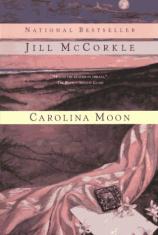
Carolina Moon
by Jill McCorkle
List Price: $12.00
Pages: 288
Format: Paperback
ISBN: 0449912809
Publisher: Fawcett Columbine
Energetic, voluptuous,
and well past sixty, Queen Mary Purdy opens a smoke-enders clinic in the
resort town of Fulton, North Carolina. Her unorthodox approach (aroma
therapy? Massage?) provides much grist for the rumor mill.
But Quee's new venture is
the least of the many scandals brewing in Fulton: a happily married woman
entrusts her illicit secrets to a dead letter file; a mad-as-hell property
owner seeks revenge for his recently-submerged investment; a radio talk
show host longs to hit the big time, by any means. Quee knows these folks
need help with more than their nicotine fits, and their troubles are all
tied to that resilient little muscle known as the heart....
top of the page

1.This book has been called a story told by lonely and misplaced people. Which characters do you think are lonely, and which are misplaced? Why are the lonely people lonely? And where do you think the misfits belong?
2.Quee can be seen as a godlike creature who rewrites the rules of what is ethical in life. Discuss some of the ways in which her behavior is ethically questionable, and consider whether or not her actions nonetheless seem right. How do the circumstances of people's lives affect our perceptions of what is right or wrong? What kinds of decisions can we make for other people? And how involved in others' lives can or should we be before we can make those decisions?
3. Quee is a familiar type of character that frequently appears in literature. Can you identify any similar characters in any of the other books or plays you have read? How is she similar to them, and how do they differ? What do you believe is the purpose of these characters in their stories?
4. There is a real absence of emotionally balanced, physically surviving men in the book's location, Fulton, North Carolina. Do you think this is a reflection of our society as a whole? Is this a realistic depiction of men in modern society? If so, what do you think has caused this social trend, what types of problems does it create, and how might it be reversed?
5. Cecil Lowe, Tom's father, has committed suicide long before the events of Carolina Moon take place, yet his presence is quite strong in the book. Discuss the importance of death and suicide in the novel. What are the implications for those left behind? How might suicide affect survivors differently than another type of death?
6.Many young adults and teenagers have already had to cope with the death or loss of someone important in their lives. Discuss how their feelings and experiences of loss compare to those presented in the novel. Does McCorkle depict such experiences in a believable way? How so, or why not?
7. The narrator tells us that "People act like [TomCat's] lack of a love life is far stranger than that he spends his time walking the boundaries of his underwater property and adopting behavior problem dogs." Why do you think people would make such a judgment? Why do we find certain behaviors strange and others socially acceptable, even when they hurt nobody? Why do people care or even notice about Tom's love life? Do you think small towns are more likely than larger ones to breed intolerance of social differences?
8. Do you consider the author's intertwined plot structure to be a successful narrative device or a confusing one?
9. Quee Purdy is a figure who enjoys playing God. Compare this zealously motivated, enterprising busybody with the angry, vulnerable, abandoned lover we see in her letters. Which self do you think is her "real" self?
10. Do you think Mack and Sarah's story belonged in the book? Should McCorkle have killed off Sarah, or allowed her to wake up, before the novel ended? Why do you think the author left that story unresolved?
11. Early in the novel, the narrator, Wallace Johnson, muses, "There's a need for the anchors and the cogs, a need for those who stay in place and mind the shop. How else is there such a thing as history? How else can a child come home if he should need to?" Who are the anchors and cogs in your life? Why are they important? How do the thoughts in this quote connect with the other pieces of the novel? To whom might they apply? Who is preserving history in Fulton, and how are they going about it?
12. Discuss the importance of water in the novel. What does the ocean mean for the book's characters, both in literal and figurative terms? What about the river?
13. Fertility is another theme of this book, as seen in the story of Mack and Sarah, as well as in Quee's past role as a performer of abortions. Are there other ways in which this theme surfaces in the novel? What about the fact that Quee has never had children? Why do you think she spends so much energy making up stories about the people on her "Ghost Wall"?
14. There is a huge lapse of time between the current period of the novel and the history it gradually reveals. In spite of the passage of over twenty years, it seems many of the book's characters cannot let go of the past. Which characters are trapped in or by the past, and what could have caused them to be so? Can any of them ever hope to be free of the past? Do you think any of them actually do break free during the course of the novel? How is this accomplished?
15. Do you think that overall this is a book about hope and growth or about despair and stagnation? Explain why?
16. Why do you think Quee wrote all those letters to her dead lover? And why do you think Wallace Johnson, the postal worker, read them and kept them?
17. How does the fragmented suicide note left by Cecil drive the lives of Tom and Quee? The piecing-together of the note is one-sided--that is, only Quee ultimately realizes what it really said. How do you think this made her feel? Did it make you as a reader perceive her differently? What does it say about her life? How do you think it would have affected Tom had he known everything it said?
top of the page

"Once again, Jill McCorkle works her wizardry as she drags the Southern novel kicking and screaming into the late 20th century....McCorkle blends traditional story elements with contemporary twists. "
WinstonSalem Journal
"The behavior and speech of Carolina Moon's cast of characters is so spontaneously human that we can't fail to recognize through them that we're all a little crazy, all engaged in little breakdowns all the time. It's just that some people are more noticeable than others. "
The ClarionLedger
"McCorkle skillfully intertwines characters and narrative styles in a way that propels the story along quickly....She can squeeze reams of meaning, emotion, and humor into deceptively short, clear stories. "
Salisbury Post (NC)
"What distinguishes Carolina Moon from an ordinary mystery is how well it holds up on second reading....The reader can appreciate the craft of the book. "
San Francisco Examiner & Chronicle
"It is a rare book that spurs the reader from its last page back to the first, and then straight through again, telling a different story this time, full of new complexities and unanswerable questions. "
Milwaukee Journal Sentinel
"Has the elements of a mystery, a comedy and a small town soap opera. In fact, it's all three and more, a book about loss and recovery, grief and resolution, meddling and responsibility. "
San Francisco Chronicle