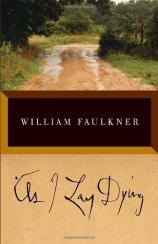
As I Lay Dying
by William Faulkner
List Price: $11.00
Pages: 272
Format: Paperback
ISBN: 067973225X
Publisher: Vintage
Faulkner drafted As I Lay Dying in six weeks while he was working the night shift at a power plant. He later said, "I set out deliberately to write a tour-de-force. Before I ever put pen to paper and set down the first word I knew what the last word would be and almost where the last period would fall." He clearly succeeded in what he set out to do: As I Lay Dying is a work in which Faulkner's talent is fully within his control, and the result is one of the twentieth century's finest and most beloved novels.
Unlike The Sound and the FuryAs I Lay Dying has a clearly delineated plot line: it is the tale of a journey, and despite the many delays in that journey, nothing impedes the straightforward movement of the plot toward its destination--the arrival in Jefferson and the burial of Addie Bundren's body. However, the way the story is presented embodies an experiment in narrative technique that is brilliantly achieved. Removing himself completely as an author-narrator figure, Faulkner breaks his story into fifty-nine separate monologues, each spoken or thought by one of fifteen characters. There is no exposition, no description of character or action outside of the way the characters see themselves, one another, and the events in which they are involved.
Like The Sound and the Fury, As I Lay Dying centers upon a single family. It is the often comic, often grotesque story of their singleminded effort to carry out their father's promise to his dying wife: Addie Bundren wishes to be buried with her family in the town of Jefferson, forty miles away. This journey, delayed by flood and fire and attended by a growing flock of buzzards, takes nine days. Throughout their absurd and quixotic ordeal, the family members exhibit a deep respect for their mother's desire, but they also have desires of their own that might be fulfilled by this chance at visiting the town. The father, Anse, wants a new set of teeth; the only daughter, Dewey Dell, is pregnant and hopes to get a pill to bring on a miscarriage; Cash wants a gramophone; Vardaman, the youngest, wants a toy train. The two remaining brothers, Jewel and Darl, want nothing for themselves, but the journey brings to its crisis a rivalry that has deep roots in their relationship with their mother.
At once ludicrous and profound, the novel shows us a group of people responding to grief and to the loss of the most important person in their lives. At the same time, it illuminates the nature of love within the family and the responsibility that family members have to one another and to themselves.
top of the page

1. Which are the most intelligent and sympathetic voices in the novel? With whom do you most and least identify? Is Faulkner controlling your closeness to some characters and not others? How is this done, given the seemingly equal mode of presentation for all voices?
2. Even the reader of such an unusual book may be surprised to come upon Addie Bundren's narrative on page 169, if only because Addie has been dead since page 48. Why is Addie's narrative placed where it is, and what is the effect of hearing Addie's voice at this point in the book? Is this one of the ways in which Faulkner shows Addie's continued "life" in the minds and hearts of her family? How do the issues raised by Addie here relate to the book as a whole?
3. Faulkner allows certain characters--especially Darl and Vardaman--to express themselves in language and imagery that would be impossible, given their lack of education and experience in the world. Why does he break with the realistic representation of character in this way?
4. What makes Darl different from the other characters? Why is he able to describe Addie's death [p. 48] when he is not present? How is he able to intuit the fact of Dewey Dell's pregnancy? What does this uncanny visionary power mean, particularly in the context of what happens to Darl at the end of the novel? Darl has fought in World War I; why do you think Faulkner has chosen to include this information about him? What are the sources and meaning of his madness?
5. Anse Bundren is surely one of the most feckless characters in literature, yet he alone thrives in the midst of disaster. How does he manage to command the obedience and cooperation of his children? Why are other people so generous with him? He gets his new teeth at the end of the novel and he also gets a new wife. What is the secret of Anse's charm? How did he manage to make Addie marry him, when she is clearly more intelligent than he is?
6. Some critics have spoken of Cash as the novel's most gentle character, while others have felt that he is too rigid, too narrow-minded, to be sympathetic. What does Cash's list of the thirteen reasons for beveling the edges of the coffin tell us about him? What does it tell us about his feeling for his mother? Does Cash's carefully reasoned response to Darl's imprisonment seem fair to you, or is it a betrayal of his brother?
7. Jewel is the result of Addie's affair with the evangelical preacher Whitfield (an aspect of the plot that bears comparison with Hawthorne's The Scarlet Letter). When we read Whitfield's section, we realize that Addie has again allied herself with a man who is not her equal. How would you characterize the preacher? What is the meaning of this passionate alliance, now repudiated by Whitfield? Does Jewel know who his father is?
8. What is your response to the section spoken by Vardaman, which states simply, "My mother is a fish"? What sort of psychological state or process does this declaration indicate? What are some of the ways in which Vardaman insists on keeping his mother alive, even as he struggles to understand that she is dead? In what other ways does the novel show characters wrestling with ideas of identity and embodiment?
9. This is a novel full of acts of love, not the least of which is the prolonged search in the river for Cash's tools. Consider some of the other ways that love is expressed among the members of the family. What compels loyalty in this family? What are the ways in which that loyalty is betrayed? Which characters are most self-interested?
10. The saga of the Bundren family is participated in, and reflected upon, by many other characters. What does the involvement of Doctor Peabody, of Armstid, and of Cora and Vernon Tull say about the importance of community in country life? Are the characters in the town meant to provide a contrast with country people?
11. Does Faulkner deliberately make humor and the grotesque interdependent in this novel? What is the effect of such horrific details as Vardaman's accidental drilling of holes in his dead mother's face? Of Darl and Vardaman listening to the decaying body of Addie "speaking"? Of Vardaman's anxiety about the growing number of buzzards trying to get at the coffin? Of Cash's bloody broken leg, set in concrete and suppurating in the heat? Of Jewel's burnt flesh? Of the "cure" that Dewey Dell is tricked into?
12. In one of the novel's central passages, Addie meditates upon the distance between words and actions: "I would think how words go straight up in a thin line, quick and harmless, and how terribly doing goes along the earth, clinging to it, so that after a while the two lines are too far apart for the same person to straddle from one to the other; and that sin and love and fear are just sounds that people who never sinned nor loved nor feared have for what they never had and cannot have until they forget the words" [pp. 173-74]. What light does this passage shed upon the meaning of the novel? Aren't words necessary in order to give form to the story of the Bundrens? Or is Faulkner saying that words--his own chosen medium--are inadequate?
13. What does the novel reveal about the ways in which human beings deal with death, grieving, and letting go of our loved ones?
top of the page