IndieBound Independent Bookstores

Barnes & Noble

Loading
Reading Group Guide
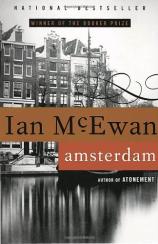
Amsterdam
by Ian McEwan

List Price: $12.00
Pages: 193
Format: Paperback
ISBN: 0385494246
Publisher: Anchor Books

Click here to buy this book from Amazon.com.
Click here to buy this book from Amazon.ca.


About This Book


On a chilly February day, two old friends meet in the throng outside a crematorium to pay their last respects to Molly Lane. Both Clive Linley and Vernon Halliday had been Molly's lovers in the days before they reached their current eminence. Clive is Britain's most successful modern composer; Vernon is editor of the quality broadsheet The Judge. Gorgeous, feisty Molly had had other lovers, too, notably Julian Garmony, foreign secretary, a notorious right-winger tipped to be the next prime minister.

In the days that follow Molly's funeral, Clive and Vernon will make a pact with consequences neither has foreseen. Each will make a disastrous moral decision, their friendship will be tested to its limits, and Julian Garmony will be fighting for his political life.

In Amsterdam, a contemporary morality tale that is as profound as it is witty, we have Ian McEwan at his wisest and most wickedly disarming. And why Amsterdam? What happens there to Clive and Vernon is the most delicious climax of a novel brimming with surprises.

top of the page


rgg_discuss.gif (1294 bytes)


1. Talk about the tone of this novel. Is it ironic? Humorous? Menacing?

2. Think about Clive and Vernon and your feelings about each at different stages of the novel. Did those feelings change? If so, at what key points?

3. In a relatively short novel, the author devotes many pages to Clive's creative process. What do you think of the author's description of the process itself and of his decision to give it so much space?

4. At one early point in the novel, Vernon Halliday thinks this about himself, "[H]e was infinitely diluted; he was simply the sum of all the people who had listened to him, and when he was alone, he was nothing at all" (page 31). Discuss this prescient statement, in light of Vernon's fate.

5. Discuss the role of lucky (and unlucky) coincidence in the novel: Vernon's rise in his profession due to "Pategate" or the story in the Judge about euthanasia in Holland that leads Clive and Vernon there.

6. Talk about the author's skill in showing the workplace; the composer's process and studio; the newspaper editor's office.

7. This novel is funny--the Siamese twins story, the sub-editor who could not spell--talk about the role of humor in the novel.

8. At different points in the novel, both Clive and Vernon think that Clive has given more to their friendship than Vernon has. Talk about the form and course of their friendship. Can friendships ever be equal?

9. The author suggests that years and success narrow life. Is this true to your experience?

10. The author withholds information throughout the novel, offering bits that are only fully developed later (the photographs of Garmony, the importance of the "medical scandal in Holland"). Talk about the author's use of suspense.

11. How shaky is Clive's moral foundation? Should he be allowed to condemn his fellow artists who "assume the license of free artistic spirit" and renege on commitments, even as Clive ignores the plight of a woman he witnesses being attacked?

12. Vernon wants to crucify Garmony for the greater good of the republic. Is this ever a valid reason to go after a politician? Do you agree with Clive that Vernon is betraying Molly's trust? Or do you side with Vernon in his wish to stop a vile leader from gaining power?

13. Talk about the parallels between the fictional political scandal the author creates and the real one that has occupied Washington, D.C., for the past year. Is the author commenting on U.S. politics and media with this novel?

14. Is everybody in Amsterdam a hypocrite?

15. Clive thinks he's a genius. How do you define genius? Does Clive fit the definition?

16. Talk about Molly and the importance of her role in the novel. Are there other examples in literature of characters who carry great weight and importance even though they never appear?

17. At Allen Crags where Clive watches the woman and man struggle, the author writes, "Clive knew exactly what it was he had to do....He had decided at the very moment he was interrupted" (page 95). Was there any question in your mind at that point about what Clive's decision was? Were you correct?

18. What do you make of the author's choice to have Clive die happy, that is, unaware that he's been poisoned, but to have Vernon grasp in his last seconds "...where he really was and what must have been in his champagne and who these visitors were" (pages 187-188).

top of the page

Critical Praise

Winner of the 1998 Booker Prize

"Amsterdam is a pitiless study of the darker aspects of male psychology, of male paranoia, emotional frigidity, sexual jealousy, professional rivalry and performance anxiety....Despite the darkness of the themes, or perhaps because of them, Amsterdam is extremely funny in a black sort of way....Ghoulishly compelling."
Alain de Botton, Independent on Sunday

 
Facebook Fan Page  Follow us on Twitter


Add Your Guide to ReadingGroupGuides.com!

Bookreporter.com Bets On...: Books We're Betting You'll Love


Privacy Policy | Contact Us | Advertising | About Us

© Copyright 2001-2013, ReadingGroupGuides.com. All rights reserved.
The Book Report, Inc. • 250 West 57th Street • Suite 1228 • New York, NY • 10107
Ph: 212-246-3100 • Fax: 212-246-4640

Bookreporter.comReadingGroupGuides.comGraphicNovelReporter.comFaithfulReader.com
Teenreads.comKidsreads.comAuthorsOnTheWeb.com