Reading Group Guide
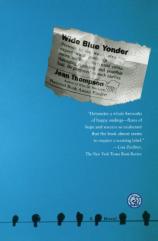
Wide Blue Yonder
A Novel
by Jean Thompson

List Price: $13.00
Pages: 368
Format: Paperback
ISBN: 0743229584
Publisher: Scribner

Click here to buy this book from Amazon.com.
Click here to buy this book from Amazon.ca.


About This Book


From National Book Award-finalist Jean Thompson comes a compelling, highly charged novel about a family ruled by the weather, the drastic changes that hit their atmosphere, and a midwestern town where chaos doesn't reign -- it pours.

Something big is headed for Springfield, Illinois, a place where weather of all kinds -- climatic, emotional, and even metaphysical -- tends to come in extremes. It is the summer of 1999, and through the long months of blazing heat and fearsome tempests, a quirky quartet of locals will try to ride out the stormy season, each in their own way.

Uncle Harvey believes he is the embodiment of the Weather Channel's "Local Forecast," even though all meteorological evidence points to the contrary. His niece, Josie, is fixed with a different predicament -- she's young and pretty, with nowhere to go except into deep trouble. Her mother, Elaine, lives under a façade of cheerful efficiency, desperately masking a far more urgent quest. And all of them are caught in the path of the loner Rolando -- a human cyclone from the West, fueled by a boundless rage and determined to make Springfield the focal point of his wrath.

top of the page


rgg_discuss.gif (1294 bytes)


1. "There was always Weather. And every minute there was a new miracle," we learn in the opening passage of Wide Blue Yonder. What does the novel have to say about changeability of natural elements and the human condition?

2. Harvey has an unusual relationship with the Weather Channel. What sustenance does Harvey find in its programming? What purpose does it serve in his life? How do others perceive Harvey's interaction with the Weather Channel? Do these perceptions change at all? If so, how?

3. We witness characters in Wide Blue Yonder struggling with avoidance -- of reality, responsibility, even mortality. What are they afraid of and how, if at all, do they come to terms with these fears over the course of the novel?

4. Spoken word and silence each figure prominently in Wide Blue Yonder. Which characters rely most heavily on verbal expression? Is this tactic successful for these individuals? Discuss the role that silence plays throughout the book. Who is silent, and what consequences follow from this state of being? How do the silent people communicate with others?

5. The novel explores the connection between communication and love, both filial and romantic. As we meet the various characters and watch their relationships evolve, how does communication function in each instance?

6. Examine how Thompson has structured the novel. How does its structure relate to its various themes? Consider the narrative point of view.

7. "You know, Frank, I don't think of Harvey as crazy. More like he's on this different plane where there aren't any good or bad people, just good or bad weather," Elaine comments. What light do the characters Harvey, Mitch, and Rolando shed on the question of morality? What other moral issues does Wide Blue Yonder address? In the world Thompson has created, what determines if someone is good or bad? Is it possible for an individual to change?

8. Discuss the significance of Josie's relationship with the Abraham Lincoln statues in Springfield, Illinois. What cultural connotations does Lincoln carry for Americans? How do these ideas intersect with the themes of the novel?

9. Talk about the varying portraits of women (Josie, Elaine, Rosa, Teeny) in Wide Blue Yonder.

10. Family is an important corollary to the discussion of women. Describe the different families that we meet throughout the novel. Would you consider them emblematic of American society? How does each of the female characters influence the nature of her family and how the unit fares as part of a larger social structure?

11. Wide Blue Yonder contrasts the role of people as individuals and as members of society. On many levels power defines our society. What power hierarchies has Thompson set up within the novel? What forms does power take? Discuss the importance of race and class to the story. What significance, if any, does Elaine's factory in India have?

12. How is intelligence defined and perceived in Wide Blue Yonder? Discuss the different forms it takes and how each of these forms is valued.

13. Discuss how Wide Blue Yonder challenges us to reexamine our assumptions about several core paradigms: sanity and insanity, happiness and discontent, love and hate.

top of the page

Critical Praise

"Detonates a whole fireworks of happy endings -- flares of hope and success so exuberant that the book almost seems to require a warning label. "
— Lisa Zeidner, The New York Times Book Review


"Wide Blue Yonder offers precisely the kind of beautifully crafted, intelligent, imaginative writing that serious readers crave....Each sentence deserves to be appreciated. "
— Deirdre Donahue, USA Today


"Wide Blue Yonder reaffirms Thompson's stature as one of our most lucid and insightful writers."
— Andrew Roe, San Francisco Chronicle

 
Back to top.   


Privacy Policy | Contact Us | Advertising | About Us

© Copyright 2001-2009, ReadingGroupGuides.com. All rights reserved.
The Book Report, Inc. • 250 West 57th Street • Suite 1228 • New York, NY • 10107
Ph: 212-246-3100 • Fax: 212-246-4640

Bookreporter.comReadingGroupGuides.comGraphicNovelReporter.comFaithfulReader.com
Teenreads.comKidsreads.comAuthorsOnTheWeb.comAuthorYellowPages.com