IndieBound Independent Bookstores

Barnes & Noble

Loading
Reading Group Guide
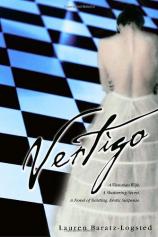
Vertigo
by Lauren Baratz-Logsted

List Price: $12.00
Pages: 368
Format: Paperback
ISBN: 0385340311
Publisher: Delta

Click here to buy this book from Amazon.com.
Click here to buy this book from Amazon.ca.


About This Book


The picture of Victorian domestic perfection, Emma Smith is an ideal daughter, wife, and mother. However, gliding down marble halls to dinner parties eventually proves empty for Emma and one New Year’s Eve, in pursuit of becoming a “better” person, Emma resolves to have an affect on society. At her novelist husband’s suggestion she begins to write to Chance Woods, a man incarcerated at the local prison for the murder of his wife.

What begins as an innocent correspondence takes a startling and darkly erotic turn as Chance becomes an obsession for Emma; an obsession which will have momentous repercussions on Emma’s entire world.

The questions, discussion topics, and author biography that follow are intended to enhance your reading of Lauren Baratz-Logsted’s Vertigo. We hope they will enrich your experience of this seductive novel.

top of the page


rgg_discuss.gif (1294 bytes)


1. Could this novel have convincingly taken place in a contemporary setting? How would it change? How would it remain the same? 2. How might Chance, Emma, and John each define love? Are they truthful to themselves about how they feel concerning love? Through which of their actions do you draw your opinions and why?

3. Was Emma's desire to become a "better person" a sincere and altruistic resolution? In its inception could it have been sincere but also selfish?

4. Did you identify with any of the characters while reading Vertigo? Were you sympathetic to them?

5. Does Emma own her choices? When making decisions, does she act independently or unknowingly as a puppet? How much of the course of her life and her identity is a result of manipulation (by her father, husband, lover…)?

6. Discuss the role of identity in Vertigo. How do identities evolve or develop? How are they disguised or revealed? Is identity something that is self-created or does it exist externally? Are personality and an individual's character autonomous developments or the result of reflected perception?

7. Is Emma a victim? What role does she play in victimization? If she herself is not a victim, what is it about her character that makes her guilty of victimizing others?

8. Katherine, Emma's niece, runs away to live in poverty with a man whom she loves in order to escape the limitations placed on her by her family. Do you think that the social pressures placed on women during the Victorian era were unique?

9. Do you believe that Emma's childhood trauma was a justification for her actions later in life? Do you think she believed this was so?

10. Constance's husband deals with their marital problems by banishing her from their social circle. John largely ignores the problems in his marriage to Emma, but also punishes her through manipulation. What are the fundamental similarities and differences between Constance and Emma in their reactions to their husbands' domination?

11. Why do the other women in this novel seem so content with their lives despite their complaints and gossip? Do you think they really are?

12. What are the motivations behind Chance's late confession to Emma?

13. What is the basis of the relationship between Emma’s father and John? Why doesn’t Emma’s father stand up for his daughter in court? What would you have done if you were in his shoes?

14. Do John's actions partially lead to his own downfall?

15. The last line of the novel, "After all, we each of us make our own chances," is obviously a play on words. What do you think: Do we make our own chances, or does chance make us?

16. The novel is open-ended. What do you imagine happens to Emma and Chance after the last chapter?

top of the page

Critical Praise

“An erotic novel that unfolds in a claustrophobic emotional landscape bound by Victorian convention…. [Builds] layer upon layer of tension in a plot reminiscent of Ruth Rendell's novels of psychological suspense.”
Boston Globe


"Entertaining… keeps the readers guessing up to the end."
Publishers Weekly


"Lauren Baratz-Logsted creates captivating characters and spins a cunning plot in Vertigo. I couldn't stop turning the pages of this fascinating novel."—Margot Livesey, author of
Banishing Verona


"Lauren Baratz-Logsted has tapped into the Victorian fascination with the social monster, and in Vertigo she concocts an ingenious chamber opera of a novel. But whether the monster is to be found behind bars or deep within the protagonist herself is ultimately a question for the reader to decide."
Dave King, author of The Ha-Ha


Facebook Fan Page  Follow us on Twitter


Add Your Guide to ReadingGroupGuides.com!

Bookreporter.com Bets On...: Books We're Betting You'll Love


Privacy Policy | Contact Us | Advertising | About Us

© Copyright 2001-2012, ReadingGroupGuides.com. All rights reserved.
The Book Report, Inc. • 250 West 57th Street • Suite 1228 • New York, NY • 10107
Ph: 212-246-3100 • Fax: 212-246-4640

Bookreporter.comReadingGroupGuides.comGraphicNovelReporter.comFaithfulReader.com
Teenreads.comKidsreads.comAuthorsOnTheWeb.com