Reading Group Guide
Ten Circles Upon the Pond
Reflections of a Prodigal Mother
by Virginia Tranel

List Price: $14.00
Pages: 336
Format: Paperback
ISBN: 1400031214
Publisher: Anchor

Click here to buy this book from Amazon.com.
Click here to buy this book from Amazon.ca.


About This Book


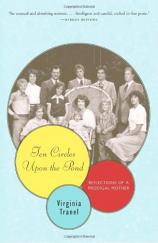
Ten Circles Upon the Pond is a book for anyone who's ever lived in that unwieldy group called family --- a story of passion, intimacy, work, religion, puberty, love and loss, and the struggle to be steadfast in times of enormous social change. Rooted in real-life experience, this unique, beautifully written collection of essays reads like a novel --- full of lively characters, spirited dialogue, and a landscape that takes you from Iowa to the high country of Wyoming and Montana. As the chapters unfold, one focused on each child, Virginia Tranel and her husband search for the ideal place to raise the five daughters and five sons born to them between 1957 and 1978.

Tranel artfully weaves daily moments with world events as she reflects on how our culture affects our decisions. She offers candid observations on everything from her reproductive choices and feminism's influence on her thinking to sibling rivalries and her family's emotional response when an architect son emails firsthand reports of the horrors of September 11. Whether considering the issues intrinsic to marriage and child-raising, or questioning her own common sense, her insights are always provocative and deeply moving.

top of the page


rgg_discuss.gif (1294 bytes)


1. Although the essays in this collection are arranged in birth order of the children, this is the only chronology imposed on the book. Why do you think Tranel chose this structure --- circling around people and events and back and forth in time --- instead of a linear presentation? What effect does this achieve? How might a chronological structure change the reader's experience?

2. Ten Circles Upon the Pond is part memoir and part reflection on how our culture affects our choices and shapes the relationship between parents and children. How does Tranel develop these themes? What specific cultural issue were you aware of in each essay, and how did it affect the parent/child relationship? What are the main cultural influences confronting parents today, both positive and negative? Is parenting different today than in Tranel's generation? What insights into parenting did you gain from reading these essays?

3. In chapter eight, Tranel is in Madrid observing two Spanish women on the street. One is a young professional woman on her way to work, the other, a cleaning woman leaning on her broom watching, as if comparing her own circumstances. Her daydreaming sets off Tranel's. "What might I have been?," she asks herself [p. 252]. Does Tranel regret any decisions in her life? Does her ruminating set off questions for you and the choices you have made? What aspect of her life do you find most appealing? Least appealing?

4. Did reading these essays make you feel intimately acquainted with Tranel's family? Were there some members you knew better than others? Why?

5. In chapter five, Tranel writes that her husband's "child-care methods differ from [hers]" [p. 143]. She then refers to a Mayan adage advising a mother to hold the baby close so he knows the world is his and a father to take the child to the highest hill and show him how broad his world can be. What do you think of this division of roles? Compare these ideas to contemporary expectations of fathers.

6. In the first chapter, Tranel asks herself if she is a self-determining agent responsible for the authenticity of her choices or an unconscious accessory to an ordained plan. How would you answer this question --- for her, and for yourself? Do the essays reveal any serious aspirations beyond mothering on her part?

7. How did the strong Catholic influence in the author's upbringing affect her adult life? How did the roles and rules she was taught manifest themselves in her mothering? In what ways did feminism influence the life she had created for herself as a wife and mother? Did the circumstances of her life --- the demands of family, the isolation --- allow her to develop her own interests and abilities? Did you perceive any effect from her long-term commitment to mothering on her character and personality?

8. Motherhood is fertile ground for writers. Poets Sylvia Plath and Anne Sexton were unsettled by the challenges of raising children. Erma Bombeck and Jean Kerr focused more on the humor and complexity of bringing up kids. Where would you place Tranel's book on this spectrum?

9. In chapter five, Tranel's five-year-old daughter tells her during an outing, "I've never been alone with you before" [p. 145]. The remark stuns her and triggers concern that she hasn't given her middle daughters enough attention. Does Tranel show favoritism toward any of her children, or does she do her best to treat them all equally? What are the positive and negative aspects of life as a large family?

10. How does the title express the theme of the book? How would you characterize the tone of Ten Circles Upon the Pond? What is the book's lasting effect on the reader?

11. Although the book is nonfiction, there are many traditional fiction techniques used --- scenes, dialogue, storytelling. Some critics think contemporary essayists limit themselves too much to the tools of fiction, and fail to exploit the permissions of the essay --- to think out loud, to draw conclusions, to disturb us with ideas and opinions. Instead of being bold and brash, essayists are too modest and too cute and too afraid to presume that they speak for others. How does Ten Circles Upon the Pond exemplify these traits? Does Tranel borrow techniques from both fiction and nonfiction writing?

12. An underlying theme of Ten Circles Upon the Pond is the search for home. Do you think it's practical --- or even a good idea --- to try to preserve childhood innocence by finding a sheltered place to raise a family? The author weaves her strong desire to find a utopian retreat from the ills of the world through many of the chapters, but she presents an equally strong opinion about the need to commit, to plunge into the stream of life. How does she reconcile these conflicting desires?

top of the page

Critical Praise

"An unusual and absorbing memoir. . . . Intelligent and candid, crafted in fine prose."
--- Kirkus Reviews


"Could not be more timely. . . . Tranel's book will offer a good deal of solace to readers made anxious by current doom-and-gloom headlines. . . . [She] is upbeat, imparting parental wisdom in peppy aphorisms, but she also confides her doubts about her own parenting and her faith."
--- Booklist


"Tranel's simple and poetic prose...combined with her refreshingly open thoughts on life . . . make this portrait accessible to all readers. Highly recommended."
--- Library Journal


"[Tranel] has managed to find a precious connection with all ten of her sons and daughters. That is the beauty of Ten Circles Upon the Pond. . . . [She] shows that she is at once so old-fashioned, yet so wise to the world she raised her brood in."
--- Frank Deford, NPR Commentator

 
Back to top.   


Privacy Policy | Contact Us | Advertising | About Us

© Copyright 2001-2008, ReadingGroupGuides.com. All rights reserved.