IndieBound Independent Bookstores BRC Facebook Fan Page
Coming Soon
Reading Group Guide
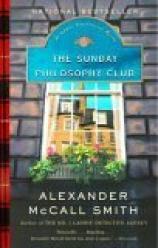
The Sunday Philosophy Club
by Alexander McCall Smith

List Price: $12.95
Pages: 256
Format: Paperback
ISBN: 1400077095
Publisher: Anchor

Click here to buy this book from Amazon.com.
Click here to buy this book from Amazon.ca.


About This Book


Introducing Isabel Dalhousie the heroine of the latest bestselling series from the author of the No. 1 Ladies' Detective Agency. Isabel, the editor of the Review of Applied Ethics and an occasional detective, has been accused of getting involved in problems that are, quite frankly, none of her business.

In this first installment, Isabel is attending a concert in the Usher Hall when she witnesses a man fall from the upper balcony. Isabel can't help wondering whether it was the result of mischance or mischief. Against the best advice of her no-nonsense housekeeper Grace, her bassoon playing friend Jamie, and even her romantically challenged neice Cat, she is morally bound to solve this case. Complete with wonderful Edinburgh atmosphere and characters straight out of a Robert Burns poem, The Sunday Philosophy Club is a delightful treat from one of our most beloved authors.

top of the page


rgg_discuss.gif (1294 bytes)


1. Isabel Dalhousie is a single, wealthy, literary woman of settled habits with a strong interest in moral behavior. In what ways is she a model female sleuth, and in what ways is she a surprising one? How does she compare with Precious Ramotswe of The No. 1 Ladies' Detective Agency? How does she compare with other female detectives in literature?

2. Geoffrey McManus is a person with terrible manners. He interrogates Isabel, wanting to know how the face of the dead man looked as he was carried out on a stretcher, then he insults her, calling her "spinster of this parish" [p. 34]. Toby, too, according to Isabel, has bad manners; she notes that he reaches eagerly for the largest pieces of the smoked salmon at dinner. Isabel speaks of "the decline of civility" [p. 108]. Why are people's manners a point of interest for Isabel [pp. 140–41]? Should The Sunday Philosophy Club be considered a novel of manners, in the tradition of Jane Austen and Henry James? How are manners indicative of a person's moral philosophy?

3. Judging by her realization that even though she wants John Liamor back he will never return to her [p. 47], it seems that Isabel is the kind of person who loves only once in life. However, there are hints that her affection for Jamie might develop further. Does the story suggest that Isabel and Jamie are better suited to each other than Cat and Jamie?

4. Consider the description of John Liamor [pp. 40–43] in light of "the best interests test and the personal chemistry test" [p. 73]. Is he a good choice for Isabel? What do we learn about him from Isabel's description of their visit to Ireland [p. 81]? Is her continuing love for him purely irrational? What drives it?

5. Cat is annoyed at Isabel's tendency to get involved in things that are none of her business [p. 69]. Isabel insists, on the other hand, that the man who fell from the balcony entered her "moral space" --- and that she therefore has a moral obligation to him. Is Isabel correct in arguing for proximity as a basis for moral claims [p. 70]? If she is right in sensing that part of the reason she wants to pursue the matter is that she is simply curious [p. 71], how different is she in moral terms from the reporter Geoffrey McManus?

6. Isabel's friendships with her housekeeper Grace and her niece Cat are reliable comforts in her daily life. What qualities does each woman bring to the partnership? What do their conversations reveal about the bonds of female friendship?

7. Isabel raises the question of unequal desire in love when she reflects, "We do not like those who are completely available, who make themselves over to us entirely" [p. 74]. Do you feel this accurately reflects Cat's emotional reaction to Jamie? Does this explain Isabel's continuing interest in John Liamor?

8. Why is the novel called The Sunday Philosophy Club, if the club seems to be purely notional, never having met? Are readers the members of this club, as if by reading the novel they are entering into Isabel's mind, which is constantly engaged in philosophical questioning?

9. Having discovered, by following an impulse of "vulgar curiosity" [p. 111], that Toby is involved with another woman, Isabel wonders whether she should tell Cat about what she saw. Does she arrive at the most reasonable conclusion [pp. 111–12]? Do you agree with her decision?

10. Consider the list of possible suspects: who seems most likely to have murdered Mark --- Neil? Johnny Sanderson? Minty Auchterlonie? How reliable is Isabel's intuition about these characters?

11. It is Neil who comes to Isabel and tells her of Mark Fraser's knowledge of insider trading at his firm [p. 117], thus turning the case into an investigation of a murder. How surprising is the ultimate revelation of how Mark died, and why? How is the crime's solution linked to the theme of truth and honesty?

12. What sexual undertones are revealed in Isabel's thoughts about Jamie [pp. 127, 133], her thoughts about the reason for Cat's preferring Toby to Jamie, and her helpless attraction to John Liamor? Why are these undercurrents so prevalent, and how are they tied to the ongoing threads of the story?

13. The Edinburgh setting is a crucial element of The Sunday Philosophy Club. It is a city where respectability is highly valued, but, according to Isabel, is also built on hypocrisy: "Respectability was such an effort though, and there were bars and clubs where people might go and behave as they really wanted to behave, but did not dare to do so publicly" [p. 55]. Edinburgh is also associated with philosopher David Hume, who wrote An Enquiry Concerning the Principles of Morals, among other books. Is Isabel an exemplary product of Edinburgh's Protestant bourgeoisie, or not? What aspects of her life, or her character, place her in the position of outsider [p. 206–7]? Who in the text best represents traditional Scots respectability?

14. How would you characterize Isabel's sense of humor? Is she a companionable narrator? If so, what qualities make her sensibility satisfying for a reader?

15. How is The Sunday Philosophy Club not typical of the mystery genre? How central to the reading experience is the mystery of how and why Mark Fraser died? Are other aspects of the plot equally interesting?

16. Readers of The Sunday Philosophy Club, the first novel in a new series, have the pleasure of speculating on how the characters and plots introduced here may be developed in the books that follow. What would you like to see happen in the future? If you have read Smith's No. 1 Ladies' Detective Agency novels, how might the Isabel Dalhousie series follow similar lines? How might the very different characters and settings influence the development of this new series?

top of the page

Critical Praise

"Genial.... Wise.... Glows like a rare jewel."
Entertainment Weekly


"The literary equivalent of herbal tea and a cozy fire. . . . McCall Smith's Scotland [is] well worth future visits."
The New York Times


"In Mma Ramotswe, [McCall Smith] minted one of the most memorable heroines in any modern fiction. Now, with the creation of Isabel Dalhousie . . . he's done it again. . . . She's such good company, it's hard to believe she's fictional. You finish this installment greedily looking forward to more."
Newsweek


"Charmingly told. . . . Its graceful prose shines, and Isabel's interior monologues--meditations on a variety of moral questions--are bemused, intelligent and entertaining."
The Seattle Times


Privacy Policy | Contact Us | Advertising | About Us

© Copyright 2001-2010, ReadingGroupGuides.com. All rights reserved.
The Book Report, Inc. • 250 West 57th Street • Suite 1228 • New York, NY • 10107
Ph: 212-246-3100 • Fax: 212-246-4640

Bookreporter.comReadingGroupGuides.comGraphicNovelReporter.comFaithfulReader.com
Teenreads.comKidsreads.comAuthorsOnTheWeb.comAuthorYellowPages.com