IndieBound Independent Bookstores BRC Facebook Fan Page
Coming Soon
Reading Group Guide
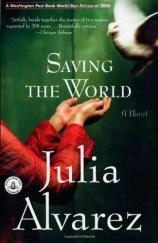
Saving the World
by Julia Alvarez

List Price: $13.95
Pages: 400
Format: Paperback
ISBN: 1565125584
Publisher: Algonquin Books

Click here to buy this book from Amazon.com.
Click here to buy this book from Amazon.ca.


About This Book


Alma, the narrator of Saving the World, discovers a small historical footnote while doing research for a novel: In 1803, a Spanish doctor crossed the Atlantic with twenty-two orphan boys—live carriers of the small-pox vaccine—to inoculate the population of Spain’s American colonies. Accompanying them on the two-year voyage was a mysterious woman, Isabel Sendales y Gómez, the rectoress of the orphanage. Captivated by Isabel’s courage, Alma decides to tell the grueling story of their journey.

Meanwhile, Alma’s husband, working with an organization committed to eradicating AIDS in developing countries, travels to the Dominican Republic. When his life is threatened, it is Isabel’s strength and resolve that arouse Alma’s unexpectedly heroic action.

This novel within a novel presents the radiant stories of two women swept up in campaigns against the scourges of their day.

top of the page


rgg_discuss.gif (1294 bytes)


1. The two stories in this novel—Alma Huebner’s contemporary story and Isabel Sendales y Gómez’s nineteenth-century story—are narrated from strikingly different points of view. Alma’s is told in third person (she did this, she thought that). Isabel’s is told in first person (I did this, I thought that). Why do you think the author chose these particular points of view for her two characters?

2. Alma is inspired by Isabel’s story. Isabel’s courage and strength of character help Alma cope with her own fears and with the frightening situations she ultimately encounters. What in Alma’s character might have impressed and inspired Isabel?

3. Both women are attracted to and influenced by men with visions of helping mankind. What are the other clear parallels between these women’s lives and struggles?

4. Which character do you most identify with and why? Would you make the same decisions as that character?

5. After Don Francisco finishes dictating a letter addressed to his wife, Doña Isabel begins to cry, moved by his gentle words (page 204). “Some day,” he says to Isabel, “someone will write you such a letter, Doña Isabel. And you will think of me, perhaps.” Why do you suppose he says that to her, and how would you describe their relationship?

6. Helen is the only person to whom Alma confides about being unable to finish the novel. Why do you think Alma is able to entrust Helen with her doubts and fears? Is there something special about Helen that allows Alma to divulge her secrets?

7. What motivates people to try to “save the world”? What has/would motivate you to take up a humanitarian cause?

8. Is there a right way to carry out our humanitarian urges? In this novel, many characters try, in their own ways, to better the lives of the people around them. How did Tara, Mickey, and Hannah, the “terrorist” boys at the clinic, and Helen try to bring about change? Did these characters accomplish their goals in the end? Did Don Francisco, who forged humanitarianism with ego and ambition, achieve his true objective?

9. Saving the World suggests that there is a distinction between storytelling in our culture (the publishing business) and storytelling in our personal lives: as Alma worries about the significance of literature today—about modern publishing’s emphasis on fame and selfpromotion—she also uses Isabel’s story as a kind of mantra or guide as she navigates tricky, scary waters in her own life. How do you think the business of publishing affects the role of storytelling in our culture? What role can stories play in helping us change our own lives?

10. How would you characterize Don Francisco and Richard Huebner? Are there any similarities between them? Any glaring differences? What role does ambition play in the lives of the male characters? Does ambition take the same form for the female characters?

11. The first epigraph is taken from T. S. Eliot’s “Gerontion”: “Unnatural vices / Are fathered by our heroism. Virtues / Are forced upon us by our impudent crimes.” Why do you think the author chose those particular lines from Eliot?

12. Is it possible to save the world, or do you think the title Saving the World is meant to be ironic? If you had been asked to help in selecting the title of this novel, what would you have suggested?

top of the page

Critical Praise

“Subtle, nuanced and deeply compassionate. . . . A remarkable examination of conscience.”
The Washington Post Book World


“Alvarez [has] skillfully concocted a fascinating life story. . . . Fresh and unusual, and thought-provokingly sensitive.”
The Boston Globe


Saving the World is wise and spellbinding as it ponders the difficulty of the human condition in any era, and the ways the actions and decisions of a few individuals can make things better or worse.”
Minneapolis Star Tribune


“Entertaining and enlightening. . . . An elegant novel in which the two stories—so far apart in years—nevertheless meld smoothly, due to [Alvarez’s] ability to masterly interweave their similar ethical, cultural and human issues. Grade A.”
Rocky Mountain News


Privacy Policy | Contact Us | Advertising | About Us

© Copyright 2001-2010, ReadingGroupGuides.com. All rights reserved.
The Book Report, Inc. • 250 West 57th Street • Suite 1228 • New York, NY • 10107
Ph: 212-246-3100 • Fax: 212-246-4640

Bookreporter.comReadingGroupGuides.comGraphicNovelReporter.comFaithfulReader.com
Teenreads.comKidsreads.comAuthorsOnTheWeb.comAuthorYellowPages.com