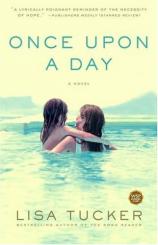
Once Upon a Day
A Novel
by Lisa Tucker
List Price: $24.00
Pages: 368
Format: Paperback
ISBN: 0743492781
Publisher: Washington Square Press
Nineteen years ago, a famous man disappeared from Los Angeles, taking his two children, Dorothea and Jimmy, to a rocky, desolate corner of New Mexico where he raised them in complete isolation in a utopian "Sanctuary." The children grew up with books and encyclopedias, records and a grand piano, but no television, computer, radio, or even a newspaper. Now Dorothea, at twenty-three, is leaving this place in search of her missing brother -- and venturing into the wide world for the first time.
Dorothea's search will turn into an odyssey of discovery, leading to the truth of her family's past and the terrifying day that changed her father forever. But Dorothea's journey will also introduce her to an unusual cast of characters, including a homeless girl from Missouri who becomes a jazz singer and a social worker whose mistake in judgment changes her best friend's life. And she will meet Stephen, a doctor turned cabdriver who, after suffering his own losses, has lost his ability to believe in a meaningful world. Together, they have a chance to make a discovery of a different kind: that though a heart can be broken by the tragic events of a day, a day can also bring a new chance at love and a deeper understanding of life's infinite possibilities.
top of the page

1. Charles Keenan is described differently by every character in the book: Lucy says he's a "good person," Janice calls him "controlling," Jimmy pegs him as a "liar," and in Dorothea's eyes he can do no wrong. What do you think of Charles? Is he a sympathetic character?
2. What is the "angel moon" and how does it relate to Dorothea's idea that "life is about what you believe as much as what seems to be reality"? At which points in the book are there disparities between an imagined world and the cold hard facts?
3. In all of their joint film projects, Charles casts Lucy in saintly roles such as Joan of Arc and Helena Lott. He makes the case in one interview that Lucy is a good match because, like the character, "Lucy is such a principled person." Do you agree with this sentiment? In what ways do Charles' filmmaking choices reflect his views on women?
4. Dorothea's trip to St. Louis affords her the opportunity to encounter many things for the first time, most of which she approaches with a childlike wonder and fascination. Is this innocence or ignorance, and what do you make of it? What do you perceive as the author's attitude toward pop culture?
5. Discuss your thoughts about Dorothea's relationship with the older and world-weary Stephen. In what ways does it mirror young Lucy's relationship to Charles? In what ways is it different? Discuss Lucy and Charles's marriage. When did it start to deteriorate and why? What could they have done -- if anything? What do you make of Lucy's second marriage?
6. Why do you think Dorothea is so devoted to her father, even after she finds out the truth about the past? How is this similar to or different from Lucy's devotion to Charles?
7. Following the loss of his wife and child, we learn that for Stephen Spaulding, "it was only in his cab, talking to strangers, that he seemed to be able to bring it all to life." Later, Dorothea unveils her story to Stephen, Stephen reveals his secret to Charles, and eventually Charles to Stephen, despite knowing very little about each other. Do you think this compulsion to confess to strangers is a realistic phenomenon? Why is there such comfort in anonymous disclosure?
8. As the title Once Upon a Day suggests, there are several "days" in this story - some tragic, some "charming" as Dorothea would say - that serve as crucial turning points in the lives of the characters. Identify 4-5 of these days and discuss their significance. Why is Once Upon a Day a more appropriate title than Once Upon a Time? Do you agree that the story hinges on these pivotal days or do you think that what occurs in between these days is more interesting?
9. Throughout the entire book, Jimmy strays from Charles, questioning everything from his father's identity, to his past, to Charles' motivations for keeping the children sequestered at the Sanctuary. Why, then, when he discovers Charles' secret shrine to Lucy and declares him "crazy" does Jimmy say he's "never felt closer to him"? Are there any other moments of craziness or insanity in the book? If so, what do you think drives the characters to such extremes?
10. Read aloud the epigram from Don Quixote. Which character can you best imagine speaking these words? Does the same sort of nostalgia for a better time run throughout the book as well? What does the passage say about fate and human existence? Do these lines strike you differently now that you've read the book than when you first encountered them?
top of the page

"Tucker's outstanding novel is as structurally dextrous as it is emotionally satisfying, boasting a chorus of extraordinary voices. An exceptionally empathetic storyteller, Tucker has created a haunting, gripping novel that brims with graceful writing and fragile characters. Devour it as a page-turner about parenting and family or discuss its subtle meditations on fate and coincidence, wealth and poverty, fairy tales and American dreams."
Publishers Weekly (starred review)
"The spirit of Jane Eyre looms over Once Upon a Day. Lisa Tucker keeps the plot of this gothic novel bubbling with tons of juicy family secrets."
Stewart O'Nan
"Lisa Tucker gives me what I want most from fiction: compassion and provocation. Once Upon a Day is her most impressive novel to date."
John Dufresne, author, Louisiana Power & Light and Love Warps the Mind a Little
"Once Upon a Day is a smart, compelling story about the ungainliness of familial and romantic love. Tucker's quietly and yet wildly ambitious novel is a subtle, witty deconstruction of fairy tales and a graceful tour de force of storytelling."
Mark Winegardner, author, Crooked River Burning and The Godfather Returns