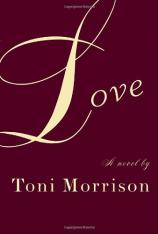
Love


Review
Love




In the magical mélange that informs Toni Morrison's creative talent, she transforms her stories into masterpieces. LOVE is her first novel in five years. It follows on the heels of PARADISE, her masterful story of free slaves, driven across the country until they were able to settle and build their own town. All was as it should be in their "paradise" until over time it became a painful form of hell. Like an alchemist she takes words, ideas, events and characters through an ingenious array of juxtapositions and transmogrifications, which transcend their mundane use by others. All of her work is rich in myth, metaphor, mirth, wisdom, humanity and biblical references.
Love in its many heartfelt forms --- seductive, romantic, obsessive, misplaced, conjugal, courtly, honorable, devotional, intimate, affectionate, sentimental, abiding and faithful --- are catalogued in a concatenation of elegant structure. Love in its other forms --- unresolved, unrequited, betrayed, brokenhearted, faithless, critical, cold, misplaced, forbidden, jealous and degraded --- turns into hate. Love and hate emerge as mysterious "characters" imbued by their inherent inexplicability, and this adds depth to her newest provocative novel.
LOVE is an exploration into the deepest regions of these most complicated of human emotions. Culture and society are rich in examples of how mere mortals have always attempted to understand the animal attraction between two people and, in doing so, to rationalize the essences of passion and romance. Ancient myths, poems, plays, novels, songs, folklore, fairy tales, film, advertising and popular culture in general all reflect peoples' preoccupation with love and its dizzying impact on the human psyche; both lover and beloved are equally bewildered by its bewitching spell. In a recent interview Morrison said, "I was interested in the way in which sexual love and other kinds of love lend themselves to betrayal. How do ordinary people end up ruining the thing they most want to protect? And obviously the heart of that is really the effort to love."
Bill Cosey, around whom the story is written, has been dead for twenty-five years. But he is still a very real presence to the women who shared his life. During the 1940s he became a millionaire as the owner of Cosey's Hotel and Resort, "the best and best known vacation spot for colored folk on the East Coast. Everybody came … guests from as far away as Michigan and NY couldn't wait to get down here. [The] resort was more than a playground; it was a school and a haven where people debated death in the cities, murder in Mississippi, and what they planned to do about it other than grieve and stare at their children."
The women who inhabit Cosey's world are Heed, his second wife, the girl he married when she was eleven and now is a recluse determined to keep the family's legacy; Christine, his granddaughter, who was Heed's best friend until she married Cosey and became an enemy; May, Christine's mother, Cosey's daughter-in-law and widow of his only son Billy Boy; Vida, a former employee who, while grateful to Cosey, was never fooled by him, nor did she believe he died a natural death; Celestial, his pleasure woman, the only one who asks to be his equal and who was able to inspire his romantic love; Junior, recently released from Correctional who talks herself into a job as "assistant" to the aging Heed, who needs help with a nefarious plan; and the "humming" voice of L, the hotel's former cook --- her presence is quite ghostly but her words wise as she opens and then closes the story.
At one point Celestial strides into the sea. "She's unfettered and unencumbered," Morrison says. "I wanted that scene. She goes into the water, she goes into the night. She's fluffing her hair. I wanted the notion of a free female, or a licensed one, anyway." Morrison has strived in all of her books to infuse this kind of power, self-awareness and confidence in at least one of her major female characters.
Both before and after the civil rights movement, African American women were/are aware of everything they do --- mostly because their actions are defined by a primarily white world. Of this Morrison has said that while the movement was absolutely necessary, vital elements of the black community were lost, which parallels the meteoric decline of the resort from its halcyon days. As African Americans had more money and more opportunities, they gave up the lives they had before and that meant changes in the perception of blacks among themselves and then slowly in the wider community. They moved on and moved away; their institutions, hangouts and most familiar meeting centers were abandoned. Thus, asks Morrison, was it all good?
In one of her moving and ghostly soliloquies, L says, "It comforts everybody to think of all Negroes as dirt poor, and to regard those who were not, who earned good money and kept it, as some kind of shameful miracle. White people liked that idea because Negroes with money and sense made them nervous. Colored people liked it because, in those days, they trusted poverty, believed it was a virtue and a sure sign of honesty ... Mr. Cosey didn't care. He wanted a playground for folk who felt the way he did, who studied ways to contradict history."
LOVE is a complicated story, the kind of multi-themed, multi-layered, multi-generational novel Morrison is known for. In this book she pushes readers to think about the kinds of love people experience and how that love can be destroyed; she expounds on the nature of change and how it can both nourish and poison. On this Morrison opines, "To reduce it to its simplest and most common denominator, race is at the heart of democracy … these are not the struggles of minority groups … that's the canvas of this book, upon which I hoped to paint these people who grew up around [Cosey's] resort, a kind of apogee of black entrepreneurship that could be self-contained. Everyone who could afford it went, and those who couldn't listened or were proud of it."
Morrison won the Nobel Prize in 1993. Her contribution to the world's literary canon is enormous and invites enrichment, spirited discussion, scholarship and pleasure. Each of her books deals primarily with black women and how their lives are defined by aspects of American culture, the circumstances of their birth, their roles with the men who are drawn to them, and --- of course --- their color.
This reviewer has never spoken personally about a writer, but in this case I feel compelled to share my impressions of her from the two times I was honored to have been in her presence. When she reads from her work the room is utterly silent and the audience breathes as one. She is soft-spoken, gracious, charming, down-to-earth, curious about her readers, and patiently answers questions. On the continuum of her work, LOVE is the next logical leap in her immutable search for the answers to the questions of life that interest her.
 So you can see why families make the best enemies," writes Toni Morrison in her eighth novel, LOVE. "They have time and convenience to honey-butter the wickedness they prefer."
LOVE is about a man named Bill Cosey and the women who jostle for his affections and whose enmity perseveres through several decades of backstabbing and recriminations. Such quarreling, LOVE makes clear, is "shortsighted, though. What good does it do to keep a favorite hate going when the very person you've poisoned your life with is the one (maybe the only one) able or willing to carry you to the bathroom when you can't get there on your own?"
A successful black entrepreneur who runs a popular beach resort on the East Coast --- most likely North or South Carolina --- Bill Cosey has a gregarious personality and a natural talent for attracting the wealthiest clientele and the jazziest musicians to his hotel. He also possesses a more destructive tendency for surrounding himself for more than half a century with "needy, wild women." Whether they were needy and wild before they met him, however, or whether he made them so with his easy talk and errant attention is left purposefully vague and slyly suggestive. How good a man is Bill Cosey? Or is he as brazen as the women who surround him, his reputation protected by his gender?
A novel about the past, LOVE begins closer to the present, with a young woman, Junior Viviane, long a resident of juvenile correctional halls, applying for a job in the big house at One Monarch Street, inhabited by two warring women: Heed Cosey, Bill's much younger second wife, now his widow, and Christine, his granddaughter.
"Each woman," Morrison writes, "lived in a spotlight separated --- or connected --- by the darkness between them." While Heed, the beneficiary of her husband's contested will, lives a lonely life in the house's richly appointed upper floors, Christine resides in the small, spare basement apartment near the kitchen. Confined to the same house, they still stay as far away from each other as possible, their silence erupting into violent arguments once every year or so.
As LOVE progresses, Morrison reveals the interconnectedness of their lives, the strange ways they are related and the strong bond they maintain despite their mutual hostility. In doing so she depicts a large cast of mostly compelling characters who haunt the novel's periphery: Christine's mother, May Cosey, whose husband died early and left her the thankless job of running her father-in-law's hotel; L, the gifted cook who provides a balanced commentary against the hysterical grievances of the main characters; and Sandler Gibbons, Bill's fishing buddy whose grandson, Romen, now works for the Cosey women and is Junior's lover.
As she reveals new depths of connection between them, Morrison brings these characters together to squabble over Bill Cosey and his estate, giving LOVE the tone of a soap opera --- "just another story made up to scare wicked females and correct unruly children, a story that shows how brazen women can take a good man down." And too often Morrison seems too willing to let LOVE descend to the level of "pointless malice," which infects her prose and her themes with soap-opera formulas.
Certain phrases stand out against the well-crafted mellifluousness of Morrison's otherwise remarkably restrained prose. Hackneyed clichés pop up and stand out, like "When Christine opened the door she found Ernie locked in the arms of the staff sergeant's wife." Elsewhere, Morrison painfully overstates the novel's meaning, such as when one character remarks, "it's like we started out being sold, got free of it, then sold ourselves to the highest bidder." It doesn't help that another character responds, "Who you mean 'we'? Black people? Women? You mean me and you?" This is certainly true and well observed, but already apparent to even a casual reader.
Such missteps reveal just how forcefully Morrison is straining to make LOVE work, to stretch a threadbare family saga to cover such large ideas about race and gender. That she does make it work at all, that her insights more often than not hit their targets, and that LOVE is readable and fascinating seem like an extreme act of will, and there is a certain purity in such literary labor. Morrison works so hard in LOVE, and her hard work pays off for her and for the reader --- mostly.
Reviewed by Stephen M. Deusner on January 22, 2011


Love
- Publication Date: October 28, 2003
- Genres: Fiction, Literary Fiction
- Hardcover: 208 pages
- Publisher: Knopf
- ISBN-10: 0375409440
- ISBN-13: 9780375409448