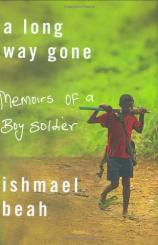
A Long Way Gone: Memoirs of a Boy Soldier


Review
A Long Way Gone: Memoirs of a Boy Soldier




You might not be able to read this book if you didn't know it had a hopeful ending. The violence is unstaged, described in a matter-of-fact way that gives it a haunting quality; wounds bleed, women scream, babies are burned in their cribs, grown men are shot after being tortured. And it is violence perpetrated in many cases by boys, young teenagers who in their own culture are usually not considered old enough to date or wise enough to make tough decisions.
Ishmael Beah was born in Sierra Leone and grew up in a time of relative stability, before open rebellion began. One day he and his close buddies went to a nearby town to enter a music contest. They'd been listening to rap, imitating the poetic lyrics and the dance moves. They had a couple of home-recorded cassette tapes. While they were away, rebels swept into their home village, killing many inhabitants and forcing the rest to flee. Everyone disappeared from Ishmael's home in a few short hours, and he was never again to see most members of his close family. With no preparation, he was cut off from the life he had known and forced, with his companions, to begin a long period of constant flight, near-starvation and terror.
The boys knew that their time was limited. The rebels were recruiting boys to fight, raping the young girls and enslaving the elders. They were stealing all usable items and all food, burning the villages as they left. The army was likewise recruiting boys, after men were slain by rebel forces. Boys so young as to be barely able to carry a weapon were given AK-47s and told to avenge their family's deaths. They were drugged with marijuana and cocaine until their minds were as ragged as their clothes, and sent out to kill.
After living from day to harrowing day, Ishmael was forced to join the army. He not only shot many boys and men on the enemy side, but prided himself on being able to cut throats quickly and efficiently as part of a contest staged by the army officers. Such exercises toughened the children and inured them to the evils they were both witnessing and perpetrating every day.
By chance, Ishmael was among a group of boys who were taken out of the army ranks and rehabilitated, slowly, by UN and other workers who kept telling their orphan charges, "What you did was not your fault." It took many months for Ishmael to understand and begin to believe this. At first he fought cynically and sometimes savagely against his benign captors, initially in the throes of drug withdrawal and then gripped by insane rage and a sense of powerlessness. At least as a soldier Ishmael had been esteemed a man and given responsibility. It was hard to become a boy again, to obey the kindly orphanage staff. It was harder to believe that his life had meaning or that there might be reason to hope for future happiness.
After a long series of reunions and a fortuitous visit to the UN in New York, Ishmael was adopted by an American aid worker and given the chance to finish high school and college. He now serves as a member of various committees and councils and speaks eloquently for the need to stop conscripting children as killers wherever such outrages occur. His talent as a lyricist grew into a talent for storytelling. A LONG WAY GONE is a story that needed to be told.
Reviewed by Barbara Bamberger Scott on August 5, 2008


A Long Way Gone: Memoirs of a Boy Soldier
- Publication Date: February 13, 2007
- Genres: Nonfiction
- Hardcover: 240 pages
- Publisher: Farrar, Straus and Giroux
- ISBN-10: 0374105235
- ISBN-13: 9780374105235