Reading Group Guide
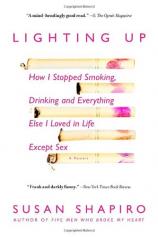
Lighting Up
How I Stopped Smoking, Drinking, and Everything Else I Loved in Life Except Sex
by Susan Shapiro

List Price: $10.00
Pages: 320
Format: Paperback
ISBN: 0385338341
Publisher: Delta

Click here to buy this book from Amazon.com.
Click here to buy this book from Amazon.ca.


About This Book


In the critically acclaimed Five Men Who Broke My Heart, Manhattan journalist Susan Shapiro revisited five self-destructive romances. In her hilarious, illuminating new memoir, Lighting Up, she rejects five self-destructive substances. This difficult quest for clean living starts with Shapiro's shocking revelation that, at forty, her lengthiest, most emotionally satisfying relationship has been with cigarettes.

A two-pack-a-day smoker since the age of thirteen, Susan Shapiro quickly discovers that it's impossible to be a writer, a nonsmoker, sane, and slender in the same year. The last time she tried to quit, she gained twenty-three pounds, couldn't concentrate on work, and wanted to kill herself and her husband, Aaron, a TV comedy writer who hates her penchant for puffing away. Yet just as she's about to choose her vice over her marriage vows, she stumbles upon a secret weapon.

Dr. Winters, "the James Bond of psychotherapy," is a brilliant but unorthodox addiction specialist, a former chain-smoker himself. Working his weird magic on her psyche, he unravels the roots of her twenty-seven-year compulsion, the same dangerous dependency that has haunted her doctor father, her grandfather, and a pair of eccentric aunts from opposite sides of the family, along with Freud and nearly one in four Americans. Dr. Winters teaches her how to embrace suffering, then proclaims that her months of panic, depression, insecurity, vulnerability, and wild mood swings win her the award for "the worst nicotine withdrawal in the history of the world."

Shapiro finally does kick the habit --- while losing weight and finding career and connubial bliss --- only to discover that the second she's let go of her long-term crutch, she's already replaced it with another fixation. After banishing cigarettes, alcohol, dope, gum, and bread from her day-to-day existence, she conquers all her demons and survives deprivation overload. But relying religiously on Dr. Winters, she soon realizes that the only obsession she has left to quit is him. . . .

Never has the battle to stem substance abuse been captured with such wit, sophisticated insight, and candor. Lighting Up is so compulsively readable, it's addictive.

top of the page


rgg_discuss.gif (1294 bytes)


1. What was your first reaction to Dr. Winters? What did he see in the relationship between Aaron and Susan that they had trouble recognizing on their own?

2. Was Claire the "tipping point" that made Susan decide to try to quit smoking again? What brings most addicts to the point of seriously wanting to quit? Why do you suppose Dr. Winters was so quick to dismiss the reasons Susan initially gave?

3. Early on, Susan tells Dr. Winters that she feels as if the things she wants most are the things she can't get. Then she surprises herself by telling him that getting published is what she wants most. Discuss this relationship between addictions and creativity. What does Lighting Up indicate about the romantic stereotype of writers whose brilliance relies on their addictions?

4. Susan comes to believe Dr. Winters's claim that "Underlying every substance problem I have ever seen is a deep depression that seems unbearable." What proves to be the source of Susan's depression? Do you agree with his belief that addiction-cessation programs won't deliver lasting results if they don't address underlying psychological issues?

5. Susan is proud of her abilities as a teacher; she is dedicated to her students and is constantly helping to advance their careers. Is she able to admit this readily? Why does she initially want to cut back on teaching rather than freelancing? Does her teaching personality extend to her personal life --- her interactions with Aaron, her family, and her friends?

6. Chapter seven ends with a list of instructions from Dr. Winters, including "Don't trust any impulse, your impulses are always wrong." Is Dr. Winters implying that everyone's impulses are always wrong? In terms of impulsiveness, how does this phase of Susan's life compare to her earlier years? What shaped her earliest impulses?

7. Three men have especially prominent roles in Lighting Up: Aaron, Dr. Winters, and Susan's father, whose Chesterfields she recalls vividly. Do these three figures have much in common? Do they complement various parts of Susan's identity? What bonds her to each of them?

8. What accounts for Blake's crisis? Does his experience mirror episodes in Susan's life, or does he represent a risky place to which she would never venture?

9. Susan tells the story of her botched joint shipment with perfect deadpan humor. Why do you suppose she hadn't realized she was addicted to pot, and hadn't anticipated how hard it would be to do without the dealers after she coated their phone numbers in white-out?

10. Did it affect Susan for better or for worse when Dr. Winters let her in on his childhood and personal life? How was their doctor/patient relationship affected by her ability to generate media coverage for him? Should therapists conceal their private lives from their patients?

11. How would you have responded to Dr. Winters's scheduling snafus? How did Susan react when Irene said she had stopped seeing Dr. Winters because she found him to be too sexist?

12. What determines whether we take advice or ignore it? Why was Susan willing to follow Dr. Winters's tough instructions, while other patients dropped out of therapy? Who were the other healers in her life, such as poet Joseph Brodsky? What is the significance of Susan's brief period of treatment with Dr. Steiner?

13. What did you make of the conservatism Susan describes as she becomes less dependent on substances? As her perceptions of the world and herself change, what realities remain?

14. Discuss the scenes in which Susan faces large family gatherings. What are the stressful aspects of her family dynamic? What parts of it are comforting?

15. As Susan anguished over her author photo, what fears became apparent? When she became upset with Aaron over the envelope from Naomi, were similar fears emerging? What is Dr. Winters's approach to feelings like these?

16. The book's subtitle is a reminder that sex remained Susan's only source of intense pleasure. How does the role of sex evolve throughout Lighting Up?

17. What does Lighting Up indicate about the role of writing, particularly humorous writing, in processing difficult aspects of life?

18. What parallels did you find between Lighting Up and Shapiro's earlier memoir, Five Men Who Broke My Heart? Were the changes taking place in Susan's life reflected in the storytelling tone of the two works?

top of the page

Critical Praise

"Shapiro's wit and honesty elevate the work."
Publishers Weekly

 
Back to top.   


Privacy Policy | Contact Us | Advertising | About Us

© Copyright 2001-2008, ReadingGroupGuides.com. All rights reserved.