Reading Group Guide
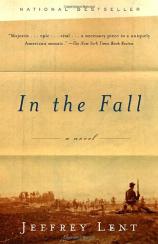
In the Fall
by Jeffrey Lent

List Price: $14.00
Pages: 528
Format: Paperback
ISBN: 037570745X
Publisher: Vintage Books

Click here to buy this book from Amazon.com.
Click here to buy this book from Amazon.ca.


About This Book


In the last days of the Civil War, Vermonter Norman Pelham receives a head wound that leaves him unconscious and separated from his regiment. He is found and nursed back to health by Leah, an escaped slave. When the war ends they travel north, back to his family's farm. Though the community thinks it strange that a native son has returned with a mulatto wife, Norman and Leah don't care much about what others think. In true Yankee fashion they keep to themselves, too busy with tending their animals and fields to bother with their neighbors. Leah gives birth to three children: beautiful Abigail, sturdy Prudence, and an emotional, impulsive boy named Jamie. For all her outward contentment, though, Leah is tormented by questions in her past that eventually compel her to journey back to Sweetboro, North Carolina, the town from which she had fled. Returning home a few weeks later, she is dejected, silent, and utterly changed. Incapable of sharing her experience with anyone, including her husband, she devastates her family by committing suicide.

Constantly teased by other boys about his mixed blood and his mother's death, Jamie leaves home as a teenager and cuts off all ties with his family. In the granite town of Barre, Vermont, he falls in love with a French-Canadian torch singer named Joey and works briefly for a Mafia bootlegger. During one incident, while collecting money that is owed to him, Jamie commits an act of violence that will return to haunt him later in life. He and Joey settle in a resort town in New Hampshire's White Mountains, where they marry and have two children. Jamie builds a bootlegging business of his own, and, when his wife and daughter die in the influenza epidemic of 1918, Jamie is left alone to raise his young son, Foster. When Jamie dies, Foster finds letters between his father and his aunt Abigail, prompting him to visit his aunts in Vermont. Having been told nothing about his father's past or his own family history, Foster is driven to uncover the mystery behind Leah's suicide, eventually traveling to North Carolina and confronting the man and the lies that caused his grandmother's death.

As in the novels of William Faulkner and Toni Morrison, In the Fall is marked with the violence and betrayal, shame and self-hatred of slavery. And for those who have suffered from its taint, coming to terms with the past is a task both dangerous and necessary.

top of the page


rgg_discuss.gif (1294 bytes)


1. The novel begins with Foster Pelham watching his father bury several coffee cans in the woods, and then shifts back in time to Norman Pelham leaving for the Civil War. Why has Lent chosen to frame the narrative in this way? Are the coffee cans and the money they contain in some way symbolic of the family history that Foster eventually seeks out?

2. Comparing his war experience with Leah's slavery, Norman thinks, "the worst men could do to one another wasn't the clear gore of Marye's Heights or the wreckage of Petersburg but the relentless small decades of generations of Sweetboro, North Carolina. Which all the efforts of battle might change but not erase from the thinking walking talking breath of the woman down the valley before him. What was he to say, Rest easy now? With both of them knowing however far the distance and unlikely the location she would never, and so neither would he, assume that peace was theirs to hold the way others assume that peace could be held" [p. 32]. In view of what happens to Leah later in the novel, is Norman's distrust of the future prophetic? Or is this simply the projection of a mind that has witnessed great pain and suffering?

3. Leah is a strong and outspoken person, as evidenced in her first meeting with Norman's sister Connie. Why then does Leah fear that Norman's mother "would take one look and read the weakness there that trembled constant as water running, the pith of despair and turmoil of her soul" [p. 25]? Is this insecurity something that Leah hides from Norman? How well do they know each other? Why can't their marriage successfully protect Leah from her past?

4. In the following examples, what details make Lent's descriptive prose particularly effective? "They rode on to the strained creak of harness leather about the heavy wheels crumbling the road dust, the father's heart clattering as if loosed from a pivot in his chest and the heart of the boy also in fearsome ratchet" [p. 7]. "It was late in the day when the company crossed a small stream with the dogwoods blooming and the few spring leaves on the trees fine and pale, the size of mouse ears" [p. 11]. What is distinctive about the way he uses language? How does his prose writing style differ from his style when writing dialogue?

5. Abigail and Prudence remain unmarried because they are "too black"; Jamie, it seems, can "pass" for white. Does Jamie's life take a different path than his sisters' because he leaves the place where people know his story, or is it because he is more passionate about getting what he wants? Does Jamie's life show that it is possible to reinvent oneself?

6. As his story begins in Part II, Jamie seems to be a surprisingly amoral person. What is disturbing about his choices and actions? Given what we know of his psychology and his past, how might his actions be explained? As time passes, why does he become less inclined to lead a criminal life?

7. Joey, the narrator explains, was "absolutely without belief in love . . . she did not trust anything, least of all herself" [p. 265]. Given this, how do she and Jamie manage to settle into married life together? Is the happiness of their marriage surprising, given the storminess of their first years together? What ideas about themselves do they give up in order to stay together? Given that French-Canadians were also considered beneath contempt in New England society, why doesn't Jamie tell Joey the truth about his own racial background? Why doesn't he tell Foster?

8. Joey thinks of her mother, "she'd become a whore and life had whored upon her. . . . As if life had conspired against her more so than anyone else. Not fate but some abuse from God. . . . A grand fearsome kind her mother thought she deserved" [p. 266]. While a slave, Leah's mother is forced to bear the children of her white master. How closely do the lives of Joey's mother and Leah's mother reflect each other? Does it seem that women are more vulnerable to destruction than men in the context of this novel? If so, why?

9. In the Fall is a long novel, divided into three parts for its three generations. How does the reader experience the pace and the rhythms of the story as it unfolds? Is there a quickening of interest or empathy in certain sections? Does the reader feel drawn equally to each generation's protagonists?

10. Victor Fortini's long-awaited revenge against Jamie takes place on pages 357<ETH>366. Given the fact that Jamie has stated earlier in the novel, "Mostly, people are cruel, given the chance" [p. 300], why is he unable to see this coming? What is particularly disturbing about Amy Carrick's role in his death? What might her motivation be?

11. Expressing the stoic philosophy by which she lives, Prudence tells Foster, "The world is a great huge stone that don't care how many times you hurl yourself against it. It just sits there. You might's well sit back and laugh along aside it" [p. 385]. How does this statement reflect the view of history, and of fate, in the novel? Does Foster's temperament, or at least his innocence, indicate that he won't accept this reality without a struggle?

12. Why is it particularly tragic that Leah's search for understanding--her desire to come to terms with her past--leads directly to her death? Does her search and its outcome imply anything about the dangers of revisiting the past?

13. What is the significance of the title? Do major events in the novel happen at that time of year? After speaking with Alex Mebane, Foster thinks, "Slavery he knew then was not the whips and chains of the school history books, not the breaking apart of families or the unending driving labor but some stain far greater and deeper, something that had been unleashed and then bloomed up, between and within at once, both races, white and black, forever and without surcease, tenacious, untouchable and unchangeable. And wondered how a man might know this and go on" [p. 471]. Is "fall" also meant in the theological sense? If so, is there any possibility of redemption in the story?

14. Considering Mebane's explanation of how Leah's mother Helen was his father's half-sister [p. 469] and he himself was Leah's half-brother, his rape of Leah would have been a continuation of the same incestuous pattern. He tells Foster that he has loved Leah all his life [p. 497], yet how convincing is this declaration, given what he does to her? Does Lent lead us to believe that the love between Foster and Daphne, cousin and descendants of the Mebanes (one from the slave side, one from the master side), can transcend the tragic family history? How does the happiness of Foster and Daphne resonate with what has come before?

15. Why does Alex Mebane lie to Leah when she returns to Sweetboro after twenty-five years? Why does he choose the significant details of the story he fabricates for her--his own sexual relationship with Helen, an idiot child called Nell, Nell's murder, her mother's suicide? Mebane has told Foster, "We're getting close on to what is evil. . . . Evil is not a thing that just sums up in a man. No. It is a thread that begins to run in a small way and then falls down through the years and generations to gain weight as it goes" [p. 467]. Is Alex Mebane truly evil, or is he simply the product of circumstances in his environment?

16. The novel's ending juxtaposes Foster's--and the reader's--realization of the extent of Leah's tragedy with a hopeful beginning for Foster and Daphne. How does Foster react to Mebane's story? How does he decide to use this knowledge? What is the effect of the book's final pages?

top of the page

Critical Praise

"There are passages that are written so beautifully that they take your breath away. A moving tale of three generations in an American family, their lives shaped by a secret buried in the last days of slavery."
USA Today


"You can hear echoes of Faulkner and Cormac McCarthy in the prose. But the presiding geniuses of this dark novel's painterly, poetic scenes are Robert Frost and the artist Winslow Homer…flint-eyed Yankees who never saw a paradise that didn't have a snake."
Newsweek


"Finely observed and deeply felt. In the Fall is an absorbing novel and an auspicious debut."
San Francisco Chronicle Book Review


"A stunning success…builds like a thunderstorm over the horizon."
The Christian Science Monitor


"Contains wisdom, gravity, beauty, horror and grace. I've never read a novel where race mattered so little and so much at the same time. It is a tribute to Lent's skill and insight that he negotiates this shifting ground with such facility, delivering a denouement."
Minneapolis Star Tribune


"Lent takes the most calamitous period in American history and breathes sharp, vivid breath into it."
The Baltimore Sun


"A majestic, vital, book. In the Fall seems absolutely true."
The New York Times Book Review


"Lent is impressive in his storytelling…eloquent and articulate."
Milwaukee Journal Sentinel


"A book that will teach you about love, about death, about human nature and the stench of evil."
The Globe and Mail (Toronto)


"In the Fall heralds the emergence of a fully formed writer, seemingly from nowhere."
San Jose Mercury News

 
Back to top.   


Privacy Policy | Contact Us | Advertising | About Us

<© Copyright 2001-2008, ReadingGroupGuides.com. All rights reserved.