Reading Group Guide
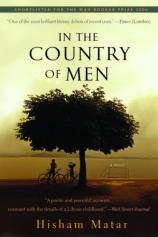
In the Country of Men
by Hisham Matar

List Price: $12.00
Pages: 256
Format: Paperback
ISBN: 9780385340434
Publisher: Dell Publishing

Click here to buy this book from Amazon.com.
Click here to buy this book from Amazon.ca.


About This Book


Libya, 1979. Nine-year-old Suleiman’s days are circumscribed by the narrow rituals of childhood: outings to the ruins surrounding Tripoli, games with friends played under the burning sun, exotic gifts from his father’s constant business trips abroad. But his nights have come to revolve around his mother’s increasingly disturbing bedside stories full of old family bitterness. And then one day Suleiman sees his father across the square of a busy marketplace, his face wrapped in a pair of dark sunglasses. Wasn’t he supposed to be away on business yet again? Why is he going into that strange building with the green shutters? Why did he lie?

Suleiman is soon caught up in a world he cannot hope to understand—where the sound of the telephone ringing becomes a portent of grave danger; where his mother frantically burns his father’s cherished books; where a stranger full of sinister questions sits outside in a parked car all day; where his best friend’s father can disappear overnight, next to be seen publicly interrogated on state television.

In the Country of Men is a stunning depiction of a child confronted with the private fallout of a public nightmare. But above all, it is a debut of rare insight and literary grace.

top of the page


rgg_discuss.gif (1294 bytes)


1. What is the effect of reading about this episode in history through a child’s point of view? What clarity does it bring? In what ways do a child’s impulses muddy the truth?

2. What does Suleiman learn about the roles of men and women as his mother continually reminds him of her arranged marriage? How have his impressions of gender been shaped by this knowledge? What determines whether she feels safe or victimized in her marriage?

3. How would you characterize Muammar al-Qaddafi’s political rhetoric as it is captured in the novel? How was he able to overthrow a monarch without offering any promise of democracy? What makes fiction an ideal format for depicting these headlines?

4. How does Suleiman perceive his mother’s alcoholism? What distinctions exist between experiencing this addiction in the West and facing it in a locale where religious law forbids drinking?

5. Discuss the title of the novel: In the Country of Men. Do the women in Suleiman’s life have any true power, and if so, from where is it derived? What does he come to understand about the power hierarchies of Libyan men, and the reasons his father lost his social rank?

6. What had you previously known about Muammar al-Qaddafi and the effects of Italian colonization on Libya? As a supplement to your reading of In the Country of Men, discuss articles tracing Qaddafi’s unusual story, from being suspected of involvement in the bombing of Pan Am flight 103 over Lockerbie, Scotland, to his recent denunciation of the 9/11 terrorists and the U.S. State Department’s May 2006 removal of Libya from a list of countries that sponsor terrorism. Could the novel’s characters ever have predicted such an outcome?

7. What does the story of Moosa’s useless Polish tires (chapter seven) indicate about economics and entrepreneurship at that time? How did the citizens’ economic power crumble so swiftly, to the point that they were swindled out of their savings through the currency scheme described in chapter twenty-four?

8. Did Suleiman’s perception of Bahloul change between his early memories (particularly in chapter ten) to the incident when Bahloul nearly drowned, just before Suleiman’s departure for Cairo?

9. In chapter ten, what persuasive tools does Sharief use to win the cooperation of children? What is Suleiman’s understanding of the events he sees on television, culminating in the execution of Ustath Rashid? When is he able to reconcile the innocent images of noble men–such as the small gifts he would receive after his father traveled for business–with the horrific ones that dominate his mind in the novel’s later chapters?

10. What were your impressions of Suleiman’s place within his circle of friends? What was it like to see Osama used as an ordinary name for an ordinary little boy? How had Suleiman’s feelings toward his friends changed when he was reunited with them years later?

11. How would you respond to the “what-if” thoughts Suleiman expresses toward the end of chapter twenty-four? What might have become of him, of his father, of his beloved Siham, if he had never emigrated?

12. Discuss the notion of living as an expatriate. How did Suleiman cope with the knowledge that he could not safely go home again? How do such circumstances affect identity and sense of self?

13. How did Suleiman’s religious training shape his character and his understanding of the world?

14. How has Suleiman’s opinion of his mother changed by the time he reaches the novel’s closing scenes?

15. Discuss the notion of storytelling woven throughout the book. How are the characters influenced by Scheherazade and A Thousand and One Nights? How would you characterize the storytelling style of Suleiman’s mother? How does a book–Baba’s lone, dangerous tome saved from the fire–drive the plot of Hisham Matar’s book?

top of the page

Critical Praise

“Matar is a careful, controlled writer. His restraint—the spaces and the light between his words —make reading his work a physical as well as an emotional experience.”
Los Angeles Times

 
Back to top.   


Privacy Policy | Contact Us | Advertising | About Us

© Copyright 2001-2008, ReadingGroupGuides.com. All rights reserved.