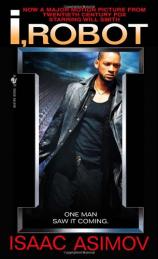
I, Robot
by Isaac Asimov
List Price: $7.99
Pages: 288
Format: Paperback
ISBN: 0553294385
Publisher: Spectra
The three laws of Robotics:
1) A robot may not injure a human being or, through inaction, allow a human being to come to harm
2) A robot must obey orders givein to it by human beings except where such orders would conflict with the First Law.
3) A robot must protect its own existence as long as such protection does not conflict with the First or Second Law.
With this, Asimov changed our perception of robots forever when he formulated the laws governing their behavior. In I, Robot, Asimov chronicles the development of the robot through a series of interlinked stories: from its primitive origins in the present to its ultimate perfection in the not-so-distant future--a future in which humanity itself may be rendered obsolete.
Here are stories of robots gone mad, of mind-read robots, and robots with a sense of humor. Of robot politicians, and robots who secretly run the world--all told with the dramatic blend of science fact & science fiction that became Asmiov's trademark.
top of the page

1. Do Asimov’s now-famous Three Laws of Robotics mirror humanity’s ethics code in any way? Whose orders are human beings required to obey? Do our definitions of "harm" ever lead to the same confounding dilemmas experienced in I, Robot?
2. Why was Gloria’s mother unable to accept Robbie as an excellent nursemaid? Was Robbie premonitory on Asimov’s part—a prediction that children in the twenty-first century might form intense emotional attachments to electronics?
3. Cutie (QT) questions his origins and finds it impossible to believe that a human created him. In what ways did Powell and Donovan reinforce this belief?
4. Does the case of Stephen Byerley indicate that robots might make better politicians? Would this only hold true if, as the novel envisions, nations dissolve into massive world regions?
5. What is the ultimate commodity produced by U.S. Robot & Mechanical Men, Inc.? Does our global workforce follow this model in any way? Were humor and compassion inevitable traits in the robots? Do these traits interfere with productivity in the world of I, Robot?
6. In the book’s closing lines, Dr. Susan Calvin tells the narrator, "You will see what comes next," as robots stand between mankind and destruction. How did her career lead up to such a precarious conclusion?
7. I, Robot has been turned into a major motion picture starring Will Smith. How does the movie compare with your book-reading experience? What do you think of the adjustments made and liberties taken when converting this collection of stories to one seamless film adaptation?
top of the page