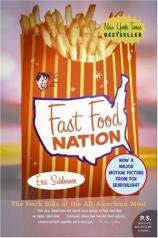
Fast Food Nation: The Dark Side of the All-American Meal


Review
Fast Food Nation: The Dark Side of the All-American Meal




A few weeks ago my husband and I decided to give in to a Saturday night craving for hamburgers and fries. Sounds simple enough, with more than half a dozen fast food restaurants within 2 miles of our home.
But we had to complicate things by wanting to get burgers from a non-chain, non-franchise, locally owned restaurant. We mentally surveyed the corners and shopping centers in the area and couldn't come up with one option that fit the bill. So we took our money to McDonald's, which has at least 3 restaurants near our home.
So what? We couldn't find a local hamburger joint --- who can and who cares? Well, the fact that we couldn't ought to make us all care. Our part of town has become like any other, dotted with subdivisions (we live in one), superstores, and drive-through windows. I cannot lie about my embrace of the convenience of our suburban shopping situation. However, I am increasingly concerned about what we've lost and destroyed. Our presence and consumption erases trees, local businesses, and character.
Eric Schlosser, author of FAST FOOD NATION, confirmed my suspicions about how the proliferation of fast food restaurants has impacted America. He writes about their influence on the way we pay workers, what we eat, and how business is done. Most disturbing is how fast food has changed the meat industry and the dangers those differences pose to workers and consumers. To paraphrase Schlosser, there is human waste in the meat.
That's more than enough information to help me steer clear of value meals, combos, and super sized lunches. What's a value meal worth if the meat is a potential killer? I know what's good for me, and this time I'm going to act on it. I'm officially on a fast food fast. I can't predict how long I can last, but each time I'm tempted I have to think about my other choices in town --- and that leads me to great experiences and delicious food. Not exactly a punishing regimen.
The other element of my chain fast that surprises me is how much one book has impacted my daily life. Every day I have an opportunity to think and act on all those words I've absorbed. But as Schlosser admits, fast food works because the food tastes good. So I'm sure my fast won't be perfect; it's simply a beginning and will steel me against the seduction of everything fast, fat, and franchised.
Reviewed by Bernadette Davis on January 8, 2002


Fast Food Nation: The Dark Side of the All-American Meal
- Publication Date: January 8, 2002
- Genres: Nonfiction
- Paperback: 383 pages
- Publisher: Harper Perennial
- ISBN-10: 0060938455
- ISBN-13: 9780060938451