IndieBound Independent Bookstores

Barnes & Noble


Loading
Reading Group Guide
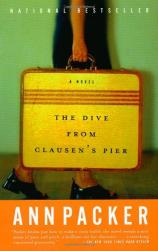
The Dive from Clausen's Pier
by Ann Packer

List Price: $14.00
Pages: 384
Format: Paperback
ISBN: 0375727132
Publisher: Vintage Books

Click here to buy this book from Amazon.com.
Click here to buy this book from Amazon.ca.


About This Book


A riveting novel about loyalty and self-knowledge, and the conflict between who we want to be to others and who we must be for ourselves.

Carrie Bell has lived in Wisconsin all her life. She's had the same best friend, the same good relationship with her mother, the same boyfriend, Mike, now her fiancé, for as long as anyone can remember. It's with real surprise she finds that, at age twenty-three, her life has begun to feel suffocating. She longs for a change, an upheaval, for a chance to begin again.

That chance is granted to her, terribly, when Mike is injured in an accident. Now Carrie has to question everything she thought she knew about herself and the meaning of home. She must ask: How much do we owe the people we love? Is it a sign of strength or of weakness to walk away from someone in need?

The Dive from Clausen's Pier reminds us how precarious our lives are and how quickly they can be divided into before and after, whether by random accident or by the force of our own desires. It begins with a disaster that could happen, out of the blue, in anybody's life, and it forces us to ask how we would bear up in the face of tragedy and what we know, or think we know, about our deepest allegiances. Elegantly written and ferociously paced, emotionally nuanced and morally complex, The Dive from Clausen's Pier marks the emergence of a prodigiously gifted new novelist.

top of the page


rgg_discuss.gif (1294 bytes)


1. Why is Carrie unable to cry until Mike awakes from the coma (p. 1)?

2. What effect does Rooster have on Carrie's emotional turmoil during part one? Is Rooster fair in his attack on Carrie outside the library (p. 76)?

3. When Carrie and Mike see the bride and groom on TV in the hospital, Carrie thinks: "If his next words were Let's get a minister over here and get married tomorrow, I would say yes" (p. 91) What feelings are driving her at this point? What might have happened to Carrie and Mike if Mike had persisted in getting married after the accident?

4. What does Mike mean when he says: "It was like we were already married–we'd gone too far" (p. 370)? What went wrong or changed in Carrie's and Mike's relationship? Did Carrie or Mike change, or did their circumstances change, or both?

5. Carrie tells the reader: "For him [Mike], it was all about the future. For me, the past" (p. 69). How does Carrie's past inform her present? What do each of the three memories of her father mean for Carrie (pp. 28-9)? What Carrie does not remember about her father is "nearly infinite . . . A whole book of things, an entire encyclopedia–a volume that I tried and tried to fill at the Mayers’" (p. 29). Might Carrie have stayed with Mike–and the Mayers–for longer than she would have because she was trying to fill the void left by her father? What influence does Carrie's memory of her father have on her decision to leave Madison–and then, ultimately, to return? By returning, is Carrie escaping her father's legacy?

6. When she leaves Madison, Carrie seems to believe that people are defined by the actions or perceptions of other people. She says: "Because we were caretakers of each other's habits and expressions, weren't we, witnesses who didn't just see but who gave existence?" (p. 128). Remembering Kilroy's touch, she says, "How extraordinary . . . that someone could touch you and make you into something" (p. 330). Carrie's mother asserts that "people aren't defined by what they do so much as they define what they do" (p. 318). Are people defined by what they do, or by how others perceive them, or by neither? Does Carrie's opinion on this topic change by the novel's end?

7. How does Mike's family react to his accident? How do his friends react? Are these reactions typical or expected in the face of such a tragedy? What about Carrie's outward behavior in reaction to Mike's tragedy makes her behavior so surprising to their families and friends? Are there typical or expected ways people react to tragedies generally, and what do deviations from this expected behavior signify?

8. Carrie explains her love for sewing: "It was the inexorability of it that appealed to me, how a length of fabric became a group of cut-out pieces that gradually took on the shape of a garment" (p. 11). How is the process of sewing, and Carrie's own projects with expensive silk fabrics, a metaphor for Carrie's emotional evolution? Does playing pool have a similar meaning for Kilroy?

9. Is it Jamie's call that propels Carrie to finally return home, or is some other event the catalyst for her return? Does guilt or obligation play a role in Carrie's decision to stay in Wisconsin? Is she trying to prove something to herself or to others? Is she acting truly selflessly? Is she settling, giving up or being true to herself?

10. Could Carrie properly be called a heroine? What would have been the heroic path for her to take?

11. Carrie poses the question: "How much do we owe the people we love?" When she leaves Madison, she seems to view the answer as an all or nothing proposition: "What I had discovered was that I couldn't give up my life for Mike–that's how I saw it at the time, that's the choice I thought I had to make. And because I couldn't give up everything, I also thought I couldn't give up anything" (p. 128). Does Carrie see her answer differently at the end of the novel? What does Carrie give up for Mike? Did she need Kilroy in order to have something other than herself to give up for Mike? What does Kilroy owe his parents? Can love be separate from obligation? How might Jamie's or Rooster's or Kilroy's definition of love differ from Carrie's definition?

12. How do the tones and styles of part one and part three reflect Carrie's different state of mind before her time in New York City and afterward?

13. What is Carrie looking for in a relationship? What characteristics of Kilroy attract Carrie that were or are absent in Mike?

14. Is Carrie's resolution of her relationship with Kilroy satisfying? By "being there" in Carrie's life, what does Kilroy teach Carrie about herself? What does Lane teach Carrie about herself?

15. Is the resolution to the mystery surrounding Kilroy satisfying? Is "the tragedy named Mike" different for Carrie than for Kilroy (p. 359)?

16. Why are the minor characters of Harvey (Mike's new roommate in the hospital) and Harvey's wife (pp. 199—200) so significant to the novel's themes of love, obligation and choices?

17. Mike and Rooster theorize about the irony in names such as the dentist, Dr. Richard Moler, or the orthopedist, Dr. Bonebrake (pp. 18—19). Do the names in the novel–e.g., Carrie Bell, Kilroy, Rooster–have any ironic meaning?

18. While Mike literally dives from Clausen's Pier, who figuratively dives from Clausen's Pier? What metaphoric images does the title conjure up for the reader before and after reading the novel?

19. Envision an inverted version of The Dive from Clausen's Pier written from Mike's point of view in which Carrie had been the one to have had the accident. How might their lives have played out differently? What does this exercise reveal about their relationship and Carrie's character?

top of the page

Critical Praise

"The Dive from Clausen's Pier is one of those small miracles that reinforce our faith in fiction. It does what the best novels so often do, making the largest things visible by its perfect rendering of life on the smaller scale. It is witty, tragic and touching, and beguiling from the first page."
—Scott Turow


"The novels it calls most to mind. . . . are Allegra Goodman's 'Kaaterskill Falls' and Sue Miller's 'The Good Mother'. . . .its most admirable trait -- and surely the one that will define Packer's future work -- is its moral authenticity."
—Gail Caldwell, Boston Globe


"A reflective and probing first novel...there's not a false note in the story's tentative resolution, which thwarts our initial expectations in order to satisfy more complex demands...Very fine fiction indeed."
Kirkus Reviews


"This is the sort of book one reads dying to know what happens to the characters, but loves for its wisdom: it sees the world with more clarity than you do."
Publishers Weekly


"Ann Packer's first novel has all the weight of reality, tooled with a jeweler's precision. The Dive from Clausen's Pier is a poignant and painstakingly rendered account of a woman in flight from catastrophe, in search of herself."
—Madison Smartt Bel

 
Facebook Fan Page  Follow us on Twitter


Add Your Guide to ReadingGroupGuides.com!

Bookreporter.com Bets On...: Books We're Betting You'll Love


Privacy Policy | Contact Us | Advertising | About Us

© Copyright 2001-2013, ReadingGroupGuides.com. All rights reserved.
The Book Report, Inc. • 250 West 57th Street • Suite 1228 • New York, NY • 10107
Ph: 212-246-3100 • Fax: 212-246-4640

Bookreporter.comReadingGroupGuides.comGraphicNovelReporter.comFaithfulReader.com
Teenreads.comKidsreads.comAuthorsOnTheWeb.com