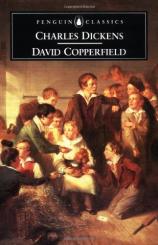
David Copperfield


About the Book
David Copperfield




Even now, famous and caressed and happy, I often forget in my dreams that I have a dear wife and children; even that I am a man; and wander desolately back to that time of my life."
Charles Dickens composed this passage between 1845 and 1848 referring to the dark times of his youth when his family moved to London in the early 1820s. The imprisonment of his father forced the family to send the twelve-year-old Dickens to work in a blacking factory. This disruption to Dickens's childhood and education remained a source of intense grief throughout his life. Dickens found these memories too painful to continue his autobiography; in fact, he jealously guarded the facts of his London youth. It was only after his biographer John Forster published his Life of Charles Dickens in 1872 that readers learned of Dickens's difficult youth and of the autobiographical nature of one of his finest creations, David Copperfield.
Originally published in serial form from May 1849 through November 1850, David Copperfield is the first of Dickens's novels written entirely in the first person. Converting his autobiographical impulse into fiction allowed Dickens to explore uncomfortable truths about his life. David Copperfield's time at Murdstone and Grinby's warehouse, his schooling at Salem House, and his relationship with Dora all have their bases in Dickens's own life. But, it may be Dickens's most autobiographical novel, David Copperfield is a work of fiction.
Dickens divides the life of Copperfield into two distinct parts, the first recounting the untimely loss of his innocence. In this orphan tale, Copperfield endures the hardships of his mother's death, a wretched education at Salem House, the toiling at Murdstone and Grinby's, and a desperate escape to his aunt's. Made aware of the vicissitudes of life, Copperfield also learns of the cyclical patterns of life as "David Copperfield of Blunderstone" is reborn at his aunt's as "Copperfield Trotwood"; the barbarous schooling of Mr. Creakle is replaced by the kind instruction of Mr. Wickfield and Dr. Strong; the callous neglect of his stepfather is replaced by the solicitude of his aunt. The practical lesson for Copperfield is to eschew the sternness of Murdstone as well as the carelessness of Micawber, the grandiloquent and improvident father figure who lodges Copperfield.
In the novel's second part, Copperfield establishes himself first as a legal clerk and parliamentary reporter, and later as a novelist. But his professional matters are of less importance than Copperfield's two emotional attachments that frame this part of the novel: his relationships with James Steerforth and Dora Spenlow. Both relationships are portrayed as the "mistaken impulses of an undisciplined heart," and we are meant to second Betsey Trotwood's comment, "Blind! Blind! Blind!" In retrospect, Copperfield confesses that he "loved Dora to idolatry." Dora, who resembles Copperfield's mother in looks and manner, lacks the maturity required to share actively in David's life or to take up the Victorian burdens of housekeeping. The relationship falters and Copperfield begins to see parallels with the marriage of the aging Dr. Strong and his "child wife" Annie. When the marriage dissolves, Dora dies in labor—quite conveniently, some critics have charged, for her death releases Copperfield of his conjugal obligations. Idolatry also characterizes his relationship with the Byronic James Steerforth, whom Copperfield unwittingly assists in the seduction of young Emily away from her uncle's care at Yarmouth.
The concluding chapters function as an epilogue to the first two parts. Copperfield, now a famous novelist, takes his sufferings to Europe in a listless journey. He eventually returns to London with renewed vigor to learn of the emigration to Australia of the Micawbers, Peggotty, Emily, and Martha, and of the imprisonment of Steerforth's servant, Littimer, and Uriah Heep. The novel concludes with Copperfield marrying Agnes.
Throughout the novel, Dickens addresses several important social issues of his time: the problem of prostitution in nineteenth-century London, lack of professional opportunities for women in Victorian England, need for humane treatment for the insane, the injustice of debtors' prison, and indictments against the rigidly conventional, purse-proud nineteenth-century English middle class. Against these dilemmas, Dickens offers the intuitive wisdom of Mr. Dick, the genuineness of the Micawbers, and, above all, the simple earnestness of Peggotty.
But Copperfield is foremost a novel about memory. Amidst the tumultuous rise and fall of the London cityscape (obsessively cataloged in the novel), Copperfield's memory preserves the links to his past and brings continuity and coherence to his life while the sudden recollection of the past charges the present with meaning. However, memory also proves to be a source of anguish. Copperfield prefaces the time he spent at Murdstone and Grinby by remarking: "I now approach a period of my life, which I can never lose the remembrance of, while I remember anything; and the recollection of which has often, without my invocation, come before me like a ghost, and haunted happier times." The act of remembrance, even uninvoked remembrance, dredges up early trauma to experience anew.
Given the intimate connection between the lives of Copperfield and his author, it is little wonder that Dickens considered this book his "favourite child." And it is little wonder, given its vast array of memorable characters and its brilliant treatment of the quest for self-knowledge, that Copperfield is Dickens's best loved and most quoted novel. The words of the great English critic G. K. Chesterton perhaps best summarize the experience of reading it: "In this book of David Copperfield, [Dickens] has created creatures who cling to us and tyrannise over us, creatures whom we would not forget if we could, creatures whom we could not forget if we would, creatures who are more actual than the man who made them."


David Copperfield
- Publication Date: September 1, 1997
- Mass Market Paperback: 912 pages
- Publisher: Penguin Classics
- ISBN-10: 0140434941
- ISBN-13: 9780140434941