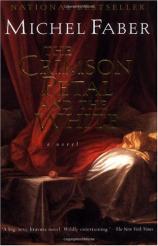
The Crimson Petal and the White


Review
The Crimson Petal and the White




Michel Faber's epic new bawdy and bold novel is a lusty romp through Victorian London. Full of sex, moral collapse and redemption, THE CRIMSON PETAL AND THE WHITE is a grand experience. Faber writes in prose worthy of Victorian England, with a dry humor simmering just beneath the surface. He pens with the propriety of the era --- and with detailed eroticism and sometimes flagrant prurience.
The story opens on the streets of 1874 London. Caroline, an aging prostitute just finished up with her business, makes her way through the filth of a seedy district where she hands the reader off to 19-year-old Sugar. A pretty, clever but boyishly built woman, Sugar makes her reputation by never saying "no" to a customer's request.
William Rackham, Society gentleman, perfume baron, and king of an industrial empire rivaling Pears Soaps, has a "special" appetite, and Sugar's willingness to do anything his vulgar heart desires wins him over. Her ambition takes her far. William's ribald enchantment with the prostitute leads him to purchase her exclusivity and shower her with every comfort he can think of. In exchange, she's open to his every whim, available at his leisure.
At home, ensconced in their substantial mansion, Agnes, William's ailing wife, continues on a downward spiral. Subject to fainting spells and fits of obscene ranting, she worries everyone and irritates her husband. Mother to Sophie, a child she ignores completely, Agnes sinks deeper and deeper into her madness. One day, however, she rallies and sets out to make a resurgence into the year's social Season. Soon, she has William too busy to make his trysts with Sugar as often as he'd like.
Sugar, not to be denied her ascent from the gutter, devises ever-more-creative ways to attract William's attentions. In a lapse of good judgment --- which William seems to have no great abundance of --- he accedes to Sugar's pleas to hire her as daughter Sophie's live-in governess.
In the middle of all this, William's brother Henry, an aspiring clergyman with too-frequent thoughts of an impure nature about his lady friend, Emmeline Fox, embarks on a mission to help prostitutes out of their plight. Emmeline, meanwhile, has her own thoughts about Henry, few bordering on chaste. Just when the whole cast seems too dark and unhappy, William's friends, Messrs. Ashwell and Bodley, a pair of irreverent authors and inveterate drunks, thrust themselves onto the pages. They demand the reader's attention long enough to banter nonsense back and forth, then disappear for a few chapters.
The characters --- and there are plenty of them --- undergo some surprising changes. But in the end, about a year has passed. Much upheaval has entered their lives, some good, some bad, and they live on with the consequences --- or rewards --- of their choices.
To behold a volume the size of THE CRIMSON PETAL AND THE WHITE may appear a daunting challenge, especially recalling Dickens' sagas of a few years earlier. But Faber's audience will undoubtedly be so swept up in the tale that, by the novel's somewhat abrupt end, they will look to the page after the last and wonder: Where's the rest?
Reviewed by Kate Ayers on January 21, 2011


The Crimson Petal and the White
- Publication Date: September 1, 2003
- Genres: Fiction
- Paperback: 944 pages
- Publisher: Mariner Books
- ISBN-10: 0156028778
- ISBN-13: 9780156028776