IndieBound Independent Bookstores BRC Facebook Fan Page
Coming Soon
Reading Group Guide
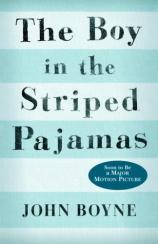
The Boy in the Striped Pajamas
by John Boyne

List Price: $8.99
Pages: 240
Format: Paperback
ISBN: 9780385751537
Publisher: Random House Children's Books

Click here to buy this book from Amazon.com.
Click here to buy this book from Amazon.ca.


About This Book

The cautionary tale is about two boys, one the son of a commandant in Hitler’s army and the other a Jew, who come face-to-face at a barbed wire fence that separates, and eventually intertwines their lives.

Set during the Holocaust, Bruno is only nine-years-old when his father, a commandant in Hitler’s army, is transferred from Berlin to Auschwitz. The house at “Out-With,” as Bruno calls it, is small, dark, and strange. He spends long days gazing out the window of his new bedroom, where he notices people dressed in striped pajamas and rows of barracks surrounded by a barbed wire fence. Bored and lonely, and not really understanding the circumstance of his new existence, Bruno sets out to explore the area and discovers Shmuel, a very thin Jewish boy who lives on the other side of the fence. An unlikely friendship develops between the two boys, but when Bruno learns that his mother plans to take her children back to Berlin, he makes a last effort to explore the forbidden territory where the boy in the striped pajamas lives.

top of the page


rgg_discuss.gif (1294 bytes)

1. Discuss the relationship between Bruno and Gretel. Why does Bruno seem younger than nine? In a traditional fable, characters are usually one-sided. How might Bruno and Gretel be considered one-dimensional?

2. At age 12, Gretel is the proper age for membership in the League of Young Girls, a branch of Hitler’s Youth Organization. Why do you think she is not a member, especially since her father is a high-ranking officer in Hitler's army?

3. What is it about the house at Out-With that makes Bruno feel “cold and unsafe”? How is this feeling perpetuated as he encounters people like Pavel, Maria, Lt. Kotler, and Shmuel?

4. Describe his reaction when he first sees the people in the striped pajamas. What does Gretel mean when she says, “Something about the way [Bruno] was watching made her feel suddenly nervous”? (p. 28) How does this statement foreshadow Bruno’s ultimate demise?

5. Bruno asks his father about the people outside their house at Auschwitz. His father answers, “They’re not people at all Bruno.” (p. 53) Discuss the horror of this attitude. How does his father’s statement make Bruno more curious about Out-With?

6. Explain what Bruno’s mother means when she says, “We don’t have the luxury of thinking.” (p. 13) Identify scenes from the novel that Bruno’s mother isn’t happy about their life at Out-With. Debate whether she is unhappy being away from Berlin, or whether she is angry about her husband’s position. How does Bruno’s grandmother react to her son’s military role?

7. When Bruno and his family board the train for Auschwitz, he notices an over-crowded train headed in the same direction. How does he later make the connection between Shmuel and that train? How are both trains symbolic of each boy’s final journey?

8. Bruno issues a protest about leaving Berlin. His father responds, “Do you think that I would have made such a success of my life if I hadn’t learned when to argue and when to keep my mouth shut and follow orders?” (p. 49) What question might Bruno’s father ask at the end of the novel?

9. A pun is most often seen as humorous. But, in this novel the narrator uses dark or solemn puns like Out-With and Fury to convey certain meanings. Bruno is simply mispronouncing the real words, but the author is clearly asking the reader to consider a double meaning to these words. Discuss the use of this wordplay as a literary device. What is the narrator trying to convey to the reader? How do these words further communicate the horror of the situation?

10. When Bruno dresses in the filthy striped pajamas, he remembers something his grandmother once said. “You wear the right outfit and you feel like the person you’re pretending to be.” (p, 205) How is this true for Bruno? What about his father? What does this statement contribute to the overall meaning of the story?

11. Discuss the moral or message of the novel. What new insights and understandings does John Boyne want the reader to gain from reading this story?

12. Ask students to discuss the differences in a fable, an allegory, and a proverb. How might this story fit into each genre?

top of the page


Privacy Policy | Contact Us | Advertising | About Us

© Copyright 2001-2010, ReadingGroupGuides.com. All rights reserved.
The Book Report, Inc. • 250 West 57th Street • Suite 1228 • New York, NY • 10107
Ph: 212-246-3100 • Fax: 212-246-4640

Bookreporter.comReadingGroupGuides.comGraphicNovelReporter.comFaithfulReader.com
Teenreads.comKidsreads.comAuthorsOnTheWeb.comAuthorYellowPages.com