|
|
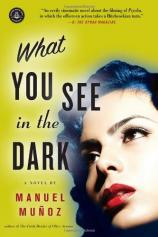
What You See in the Dark
by Manuel Muñoz
List Price: $13.95
Pages: 288
Format: Paperback
ISBN: 9781616201401
Publisher: Algonquin Books
Desire turns deadly in the small, dusty town of Bakersfield, CA circa 1959, with the arrival of a legendary director scouting locations for a film about madness and murder at a roadside motel. Though the story unfolds in much the same way that Hitchcock made Psycho – frame by frame, in camera pans, zooms, and close-ups – What You See In the Dark takes readers into places no cameras can ever go, venturing into characters’ petty jealousies, private thoughts, and unrealized dreams.
Following the intimate perspectives of four women – Teresa Garza, the young aspiring singer who works at a shoe store; Candy, the envious co-worker who covets Teresa's boyfriend, Dan; Arlene Watson, Dan's mother, head waitress at the local diner and owner of the roadside motel; and the Actress (read: Janet Leigh), preparing the role that will come to define her – Muñoz perceptively explores the shadowy dynamics of small town America and the dark side of the American dream.
This finely wrought novel is a masterpiece of tone and an unflinching examination of our fascination with violence, on-screen and off.
top of the page

1. Many books begin with an epigraph that sets a particular tone or introduces a theme. What does the epigraph by the poet Ai suggest to you about the novel’s larger concerns?
2. Most novels typically begin with first- or third-person narration. What You See in the Dark is mostly narrated in third person, but it begins in second person with a “you” who is later revealed to be Candy, Teresa’s coworker at the shoe store. Why do you think the novel opened and closed with this point of view? What might have been different about the novel if it had opened or closed with third-person narration?
3. Why do you suppose the author referred to Janet Leigh and Alfred Hitchcock as “the Actress” and “the Director,” rather than using their real names? Are there other instances in the novel in which people are addressed or referred to using pronouns rather than just their names?
4. Chapters 3 and 4 both begin with the same construction: “Around town, she was known as.” What might this construction be saying about recurrences in the novel? Are there other moments when events or phrases are echoed? Do they have anything in common?
5. Though readers already know what has happened to Teresa, chapter 4 details how she met Dan and how she made a choice to pursue him over her more loyal and persistent suitor, Cheno. Discuss why you think the novel delayed this introduction and what effect it had on the characterization of Teresa.
6. In the diner scene in chapter 5, the Actress touches the hand of Carter, the driver, who returns the gesture with a “light, downward feather of a touch, just once” (page 99) before bringing up his wife in conversation. What do you think is happening in this scene? Is the Actress just testing out her new role? Or is there an attraction between them?
7. Why do you think Teresa steals the boots from the storeroom?
8. Part 2 begins with Dan’s rush to leave town. Arlene is the central figure in that chapter, and she often thinks about her ex-husband Frederick and her long-lost brother. In the course of so much intense drama surrounding Dan’s getaway, why does the chapter bring up those other two men so often? Discuss what this does to shape the character of Arlene.
9. The famous Psycho shower scene is broken down, frame by frame, to close out part 2. How different is the effect on the page than on the screen? Why do you think the author chose this particular moment for the Actress’s last appearance in the novel?
10. “Things change, but she wasn’t ever going to” (page 214). Describe Arlene’s epiphany at the close of this novel. Is she really the central figure? Does she stand in as a parallel for Mrs. Bates in the film Psycho, or is she an entirely different character?
11. Chapter 11 is the only one with a man at the center: it’s Alfred Hitchcock returning from the Cannes Film Festival, and the film described is Frenzy. Discuss why the novel waits until then to showcase the Director. Why is the Director so troubled by the fact that he has been unable to produce a work comparable to Psycho?
12. Candy ends up marrying Cal, which also means she will no longer be privy to the gossip traded at the shoe store. Discuss why the novel features Candy so vividly imagining the murder of Teresa. Is Candy obsessed with the murder? What is the novel saying about our willingness and desire to witness such horrific scenes of violence? Is it a satisfying ending in this regard?
top of the page

"Manuel Munoz's debut mystery, What You See In the Dark, takes flight from one of the cleverest suspense conceits I've encountered in a long time: Two young lovers become entwined in a doomed affair, while, at the same time, Hitchcock and his minions begin setting up their equipment in sleepy Bakersfield. Munoz uses the noir form to meditate on the evil spell that murder on the big screen casts on susceptible minds "in the dark." This atmospheric tale of twisted minds and small-town murder would've put a demented gleam in The Master's eye."
Maureen Corrigan, NPR.org
"An eerily cinematic novel."
O: The Oprah Magazine
"Muñoz’s recreation of a famous movie scene from its participants’ perspective deliberately builds to a crescendo unmatched by any other word or gesture in What You See In the Dark, pulling in the townspeople’s disapproval and The Actress’ fears for her career and reputation, and blending them into a creation story more beautiful than terrifying, regardless of the result."
The Onion
"The making of Alfred Hitchcock's Psycho would seem out of place in a serious literary novel about small-town California, circa the late 1950s. But just as the groundbreaking director managed to pull off that oh-so-infamous shower scene, Manuel Munoz pulls off this strange juxtaposition with stunning success in What You See In the Dark, an audacious debut novel."
Cleveland Plain Dealer
"For this elegantly structured piece of noir, Whiting Award-winner Munoz has woven together multiple stories to tell a bigger tale about what we don’t see when we think we see everything … Like the terrors of psycho, the real wonder of this novel sits just outside the frame."
OUT Magazine
"Through exceptional details, Muñoz brings this biblical, Eve-eating-the-apple truth to light…[The] tension between wanting to see and wanting to stop seeing, to live a life of the imagination, keeps the novel suspenseful and fresh."
Culture Mob
"[A] stellar first novel...The author brilliantly presents the Actress’s inner thoughts, while he handles the violence with a subtlety worthy of Hitchcock himself. The lyrical prose and sensitive portrayal of the crime’s ripple effect in the small community elevate this far beyond the typical noir."
Publishers Weekly, starred review
"Muñoz has hit upon a killer premise: the making of Psycho set against the real-life murder of a young Latina singer in Bakersfield... Muñoz expertly evokes the way quiet desperation can explode into life-altering violence."
Booklist
"Muñoz offers a thoughtful, intelligent drama, while touching on characters' tragedies in understated ways. An eloquent novel sure to please readers of literary fiction."
Library Journal
"[A] refreshingly innovative first novel...Muñoz has upended the conventional crime novel, lauding a cinematic master while downplaying his own crime scene and concentrating on a secondary victim. Nice work."
Kirkus
"It strikes emotional chords so deep and with such precision, it almost makes you believe you’ve discovered a new art form"
The Austin Chronicle
"A performance in literary night vision … Drawing on tremendous empathy and an exacting eye for detail, Muñoz conjures up a vanished era in which the people nevertheless feel indelibly real. Through a small cast of characters, he gives the reader an intimate look into dark places both literal and metaphorical … Muñoz’s lean, graceful prose, shot through with quiet bursts of poetry, enlivens every page."
AARP VIVA
"Manuel Muñoz’s vividly suspenseful first novel is a fine blend of Hitchcock’s chilly elegance and the sordid passions of James M. Cain: a dark, intimate, heartbreaking tale about four very different women, each one longing to escape the confines of her everyday life through the romantic illusions concocted by Hollywood. Their voices will haunt me for some time to come."
Julia Glass, author of The Widower’s Tale and Three Junes
"A powerful portrait… What You See In the Dark is a gem, full of drama and keen social observation, worthy of a movie treatment of its own. It’s imbued with the noir sensibility of James Cain’s The Postman Always Rings Twice and Mildred Pierce."
Edmonton Journal
"What You See In the Dark strikes emotional chords so deep and with such precision, it almost makes you believe you’ve discovered a new art form."
Austin Chronicle
"Manuel Muñoz has written a novel that is gripping to read and illuminating in what it says. What You See In the Dark begins with a sweet romance and a dark surprise as it traces the winding path of violence in our dreamy American longings. How beautifully the pieces of this book fit together, and how radiantly original it is."
Joan Silber, author of Ideas of Heaven and The Size of the World
"In his dazzling debut novel, Manuel Muñoz takes into the heart of small-town 1950s California with pathos, sensitivity, and astonishing beauty. The book is a love story, a tragedy, and a cautionary Hollywood tale all in one. Be forewarned: once you pick up this gorgeously riveting book, you won’t be able to put it down until it’s done."
Cristina García, author of The Lady Matador’s Hotel
"A riveting work for any fan of intelligent suspense…truly one of the year’s most compelling and nuanced books."
Instinct
"What You See In the Dark is beautifully written and perfectly told, an irresistible novel about desire that will keep you reading through the night. It is a true romance and a True Romance, and Manuel Muñoz has the wisdom to know the difference."
Laura Furman, author of The Mother Who Stayed and series editor of the PEN/O. Henry Prize Stories.
|
Oprah's Book Club Selection
Tell us and you could win 12 copies of this book for your group!
Beautiful Ruins
by Jess Walter
Click here
for more details.

Contest
Win Copies for your Book Group

This month's prize:
City of Women by David R. Gillham
Click here
for more details


|