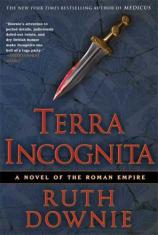
Terra Incognita
by Ruth Downie
List Price: $15.00
Pages: 400
Format: Paperback
ISBN: 9781596915183
Publisher: Bloomsbury USA
Ruso wanted to see the edge of the Roman Empire. Traveling through Britannia as a medic for the Twentieth Legion, Ruso slowly admits that his housekeeper, Tilla, has something to do with his decision to travel north. Since Ruso rescued her from slavery and abuse, Tilla has wanted to find out if anyone in her family survived tribal raids and Roman invasions.
A shocking murder in the town of Coria --- a beheaded Roman trumpeter, with rumors that a divine “Stag Man” is avenging the local tribes --- interrupts Ruso’s romance with his lovely servant. The local Roman medic, Thessalus, confesses to the murder, but nobody --- including Ruso --- can make sense of his crazed babblings. Ruso is determined to stay out of the murder investigation, but Tilla drags him into it: her former lover, Rianorix, stands accused of the crime and is joining the local tribes in rebellion against Roman rule. As the governor of Britannia makes his way to Coria, the Roman prefect is determined to restore order quickly by executing a native suspect. Once again, Ruso finds himself in the middle of a murder mystery and can’t seem to please anybody: the legionaries, the Batavians, the natives, or least of all, his beloved Tilla.
top of the page

1. Ruso is “thanked by nobody,” according to the list that opens the novel (v). Why is Ruso unappreciated at the end of the novel? Has he earned this thanklessness? Why or why not?
2. What is the significance of Tilla’s gift to Ruso at the beginning of the novel? What conflicts arise from this gift? Does Ruso seem to understand Tilla’s reasons for giving him money?
3. What are some attitudes toward the medical profession among the characters of Terra Incognita? Who seems to have the least faith in Roman medicine: legionaries, Batavians, or local tribes?
4. What did Ruso expect to see at the edge of the Roman Empire? Why does he feel “a faint slump of disappointment” when he views the border (58)? Does the border meet any of Ruso’s expectations? Why or why not?
5. When he first volunteers to conduct a postmortem report on Felix’s body, Ruso thinks confidently, “he was beginning to get the hang of this politics business.” (65). When does Ruso’s inability to juggle medicine and politics become apparent? What political skills does he lack? What are his professional strengths?
6. Discuss the character of Thessalus. What are the doctor’s complex motives for confessing to Felix’s murder? Is his deception justified? Why or why not?
7. Aemilia says of Ruso, “And he is rather good-looking, in a cross sort of way.” (283). Imagine and describe Ruso’s physical appearance, based on Aemilia’s comment and his character traits.
8. Romantic problems and family troubles abound in Terra Incognita, on both the Roman and British sides. Which characters seem to suffer the most from both difficulties? Which characters are free of romantic and family dilemmas?
9. Describe “Catavignus’s vision” of prosperity for Coria (377). What stands in the way of that vision? Which of Catavignus’s actions seem motivated by personal gain, and which by his concern for the future of his family and community?
10. Ruso never finds out if Metellus and Catavignus were working together to “help clear up undesirables” in Coria (370). Why does this question remain unresolved in the novel? Does it seem likely that the two men collaborated? Why or why not?
11. Tilla says to Ruso at the end of the novel, “But I do not want to marry you because you are foreign and you do not trust me.” (382). Under what circumstances could Ruso and Tilla ever marry? What might their marriage be like? Do you think it ever happen in this series? Why or why not?
12. Terra Incognita switches between Ruso’s and Tilla’s perspectives. What is the effect of their divided narration? Give an example of an incident narrated from both points of view. How do Ruso’s and Tilla’s perspectives differ? How are they similar?
13. The events of Terra Incognita take place over the span of a single week. How does Downie pack so much action into such a short period of time? Which day of Ruso and Tilla’s adventures feels the most eventful?
14. Terra Incognita means “unknown land” in Latin. What remains “unknown” by Ruso about Britannia? In what ways is the expanding Roman Empire a “terra incognita” for Tilla?
15. Tilla says of Ruso, “‘The family would have learned to like him.’ Perhaps.” (251). Is it likely that Tilla’s family would have accepted her relationship with Ruso? How do you think Ruso’s family will react when they meet Tilla in the next book in the series, Persona Non Grata?
Suggested reading
Ruth Downie, Medicus; Steven Saylor, Roman Blood and Roma; Robert Harris, Imperium; Lindsey Davis, The Silver Pigs; Ben Pastor, The Water Thief; John Maddox Roberts, SPQR I: The King’s Gambit; Colleen McCullough, The First Man in Rome; David Wishart, Ovid; Simon Scarrow, Under the Eagle; Michael Curtis Ford, Gods and Legions; David Anthony Durham, Pride of Carthage; Robert Graves, I, Claudius.
top of the page

"Downie’s attention to day-in-the-life period details, judiciously doled-out twists, and dry British humor make Incognita one hell of a toga party."
Entertainment Weekly
"This book, which is even better than the first, opens with the pair headed to northern outposts, where Ruso hopes to gain some advancement...This is a terrific series that historical mystery fans shouldn’t miss."
Globe and Mail (Toronto)
"This well-researched novel places Downie alongside such established masters of the Roman historical as Steven Saylor and Rosemary Rowe."
Publishers Weekly (starred review)
"Downie distributes the action throughout 91 brisk chapters, and heightens the narrative’s energy level by commenting sardonically on her characters’ (often very witty) conversational exchanges. The puzzle’s solution is immensely satisfying, and the story ends with Ruso and Tilla apparently prepared to part ways. But it isn’t set in marble, and we’re given reason to hope another sequel is in the works. Ruso rocks. Let’s hear it for those Romans."
Kirkus Reviews (starred review)