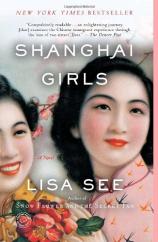
Shanghai Girls


Review
Shanghai Girls




Pearl and May, two beautiful Chinese teenagers, live a life of ease and privilege in an upper class neighborhood in pre-World War II Shanghai. Unlike their traditional parents, they are modern young women with well-paid jobs as models. While their father does not approve, there is little he can do to stop these headstrong girls who work and party by night and sleep by day in their well-appointed home, cared for by a faithful staff of family retainers. Their mother, who comes from the era of bound feet and obeisance to the males of the family, has little to do with her daughters, who lead lives of their own.
Their carefree lifestyle comes to a jarring halt as their father admits that he has lost his entire fortune to gambling and horses, and must marry them off to two “Gold Mountain Men” --- native Chinese who have gone to America to seek and find their fortune --- in order to save his home. They will be bartered away and wed to two strangers --- brothers, one only 14 years old --- in a stark civil ceremony at city hall. They are later to follow their new husbands to Los Angeles, but the building threat of war throws them into the path of the advancing Japanese army.
Thus begins the saga of two young women, trapped amidst the horrors of the modern world’s most tumultuous struggle as they fight to survive first the Japanese invasion of China, and then flee by sea to the imagined safety of America. Instead, held as immigrant detainees on Angel Island in Los Angeles Harbor, constantly threatened with deportation back to war-torn China, the promise of streets of gold and the glitter of Hollywood turn to dust as they experience the reality of Chinese refugees in America at the end of the Great Depression.
Once they are reunited with their stranger husbands, they experience the cloistered life of working-class Chinese in the crowded quarters of Little Chinatown. By day, they experience open public bigotry against their race if they venture outside the commercial district where they are employed by their father-in-law in a feudal family import business.
In SNOWFLOWER AND THE SECRET FAN and PEONY IN LOVE, bestselling author Lisa See explored the rich panorama, romance and cruelties of Chinese culture from 18th- and 19th-century feudal China. The deprivations and hardships of Asian émigrés in the mid-20th century is brought sharply into focus in SHANGHAI GIRLS and adds admirably to her status as a novelist. Once again, her rich characterizations, strong sense of time and place, and mesmerizing storytelling offers page-turning suspense, romance and drama.
Reviewed by Roz Shea on February 1, 2010


Shanghai Girls
- Publication Date: February 2, 2010
- Genres: Fiction
- Paperback: 336 pages
- Publisher: Random House Trade Paperbacks
- ISBN-10: 0812980530
- ISBN-13: 9780812980530