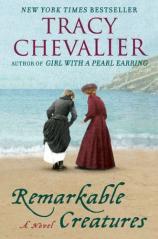
Remarkable Creatures


Review
Remarkable Creatures




I love when a book holds my interest so well that as soon as I finish, I need to know more. REMARKABLE CREATURES is one of those rare books for me. While all the characters are fictionalized, I wanted to know more about the real Elizabeth Philpot and Mary Anning, and their lives as fossil hunters and amateur paleontologists.
Elizabeth Philpot and her sisters, Louise and Margaret, are in need of a new home now that their brother is getting married. With no marriageable prospects --- they are not known for their beauty --- they take a tour of possible new homes and come to find they like Lyme Regis, a small coastal town known for its fossils. The town slowly becomes home to the sisters, especially Elizabeth, who finds she has a passion for fossils. During her walks on the beach, she meets Mary Anning, a local resident and fossil hunter, and the two become close friends. The odd pair can be seen walking the beach many days, heads down, looking for the small creatures they both love to search for.
When Mary comes upon a strange set of bones that she believes to be a crocodile, both Mary and Elizabeth are unprepared for the way their lives will change. The skeleton Mary finds turns out to be a complete ichthyosaurus skeleton, a creature unknown to science at the time and one that will change the way people think about the history of the world, what extinction means, and if it can, in fact, be a real concept. Mary's find sets off a bomb in the science world, and it becomes a boon for her. The Annings are a poor family, but the discovery of the ichie, as Mary likes to call the ichthyosaurus, brings in a little money for the family. She begins spending more time on the beach taking other collectors and hunters out and showing them what to look for. In the following years, she finds several more ichthyosaurus skeletons and a new creature that becomes known as the plesiosaurus.
During this time, Mary and Elizabeth find their lives colliding, oddly enough, over a man. Elizabeth, ever the one to voice an opinion, tells Mary what she thinks and knows will happen with this man. But Mary refuses to listen, hoping that the creatures she finds will not only change her family's fortunes but also her own. When things go badly, they stop speaking, but it is Elizabeth, stubborn to the core, who fights for Mary when most needed. When a well-known scientist hints that the plesiosaurus skeleton of Mary's may be a fraud, Elizabeth leaves Lyme Regis to confront the scientists in London and make sure that Mary is credited with the find.
REMARKABLE CREATURES is a wonderful story of two independent women who find themselves unlikely friends --- an educated lady from London and an uneducated town girl --- in the midst of one of the biggest scientific discoveries of their time. Elizabeth's willingness to speak up for Mary ensured that the world knew who Mary Anning was and that she was credited with the finds that changed science. Lyme Regis itself is much like Elizabeth --- cold, harsh and boney --- and is in fact a very fitting place for Elizabeth, whose personality matches that of her surroundings. Mary, on the other hand, is a gentle, trusting soul who has an amazing ability to find bits of the past and an endearing way of making them real.
The two women are out of place for their time and for what they choose to do with their lives. They seem almost as alien as the creatures they obsessively hunt and hold so dear. While reading, I'll admit that Elizabeth's character took a while to grow on me, but she becomes immensely likable once you see what she is capable of. In the end, I found myself happy to see her embrace her tough side and carry on the only way she saw possible. It is a sad story to a degree --- at times these two women spend days bemoaning their fate --- but it is a wonderful tale in terms of the bonds they forge and the barriers they move to become figures in history next to their own fossils. These two women and the creatures they hunt certainly live up to the book's title.
Reviewed by Amy Gwiazdowski on January 23, 2011


Remarkable Creatures
- Publication Date: October 26, 2010
- Genres: Fiction, Historical Fiction
- Paperback: 320 pages
- Publisher: Plume
- ISBN-10: 0452296722
- ISBN-13: 9780452296725