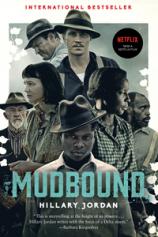
Mudbound
by Hillary Jordan
List Price: $13.95
Pages: 352
Format: Paperback
ISBN: 9781565126770
Publisher: Algonquin Books
In Jordan's prize-winning debut, prejudice takes many forms, both subtle and brutal. It is 1946, and city-bred Laura McAllan is trying to raise her children on her husband's Mississippi Delta farm --- a place she finds foreign and frightening. In the midst of the family's struggles, two young men return from the war to work the land. Jamie McAllan, Laura's brother-in-law, is everything her husband is not --- charming, handsome, and haunted by his memories of combat. Ronsel Jackson, eldest son of the black sharecroppers who live on the McAllan farm, has come home with the shine of a war hero. But no matter his bravery in defense of his country, he is still considered less than a man in the Jim Crow South. It is the unlikely friendship of these brothers-in-arms that drives this powerful novel to its inexorable conclusion.
The men and women of each family relate their versions of events and we are drawn into their lives as they become players in a tragedy on the grandest scale. As Barbara Kingsolver says of Hillary Jordan, "Her characters walked straight out of 1940s Mississippi and into the part of my brain where sympathy and anger and love reside, leaving my heart racing. They are with me still."
top of the page

1. The setting of the Mississippi Delta is intrinsic to Mudbound. Discuss the ways in
which the land functions as a character in the novel and how each of the other characters
relates to it.
2. Mudbound is a chorus, told in six different voices. How do the changes in perspective
affect your understanding of the story? Are all six voices equally sympathetic? Reliable?
Pappy is the only main character who has no narrative voice. Why do you think the
author chose not to let him speak?
3. Who gets to speak and who is silent or silenced is a central theme, the silencing of
Ronsel being the most literal and brutal example. Discuss the ways in which this theme
plays out for the other characters. For instance, how does Laura's silence about her
unhappiness on the farm affect her and her marriage? What are the consequences of
Jamie's inability to speak to his family about the horrors he experienced in the war? How
does speaking or not speaking confer power or take it away?
4. The story is narrated by two farmers, two wives and mothers, and two soldiers.
Compare and contrast the ways in which these parallel characters, black and white, view
and experience the world.
5. What is the significance of the title? In what ways are each of the characters bound ---
by the land, by circumstance, by tradition, by the law, by their own limitations? How
much of this binding is inescapable and how much is self-imposed? Which characters are
most successful in freeing themselves from what binds them?
6. All the characters are products of their time and place, and instances of racism in the
book run from Pappy’s outright bigotry to Laura’s more subtle prejudice. Would Laura
have thought of herself as racist, and if not, why not? How do the racial views of Laura,
Jamie, Henry, and Pappy affect your sympathy for them?
7. The novel deals with many thorny issues: racism, sexual politics, infidelity, war. The
characters weigh in on these issues, but what about the author? Does she have a
discernable perspective, and if so, how does she convey it?
8. We know very early in the book that something terrible is going to befall Ronsel. How
does this sense of inevitability affect the story? Jamie makes Ronsel responsible for his
own fate, saying "Maybe that's cowardly of me, making Ronsel's the trigger finger." Is it
just cowardice, or is there some truth to what Jamie says? Where would you place the
turning point for Ronsel? Who else is complicit in what happens to him, and why?
9. In reflecting on some of the more difficult moral choices made by the characters ---
Laura's decision to sleep with Jamie, Ronsel's decision to abandon Resl and return to
America, Jamie's choice during the lynching scene, Florence's and Jamie's separate
decisions to murder Pappy --- what would you have done in those same situations? Is it
even possible to know? Are there some moral positions that are absolute, or should we
take into account things like time and place when making judgments?
10. How is the last chapter of Mudbound different from all the others? Why do you think
the author chose to have Ronsel address you, the reader, directly? Do you believe he
overcomes the formidable obstacles facing him and finds "something like happiness"? If
so, why doesn't the author just say so explicitly? Would a less ambiguous ending have
been more or less satisfying?
top of the page

"A supremely readable debut novel... Fluidly narrated by engaging characters . . . Mudbound is packed with drama. Pick it up, then pass it on."
People, Critic’s Choice, 4-star review
"A compelling family tragedy, a confluence of romantic attraction and racial hatred that eventually falls like an avalanche... The last third of the book is downright breathless... An engaging story."
Washington Post Book World
"In Hillary Jordan's first novel, Mudbound, the forces of change and resistance collide with terrible consequences."
The New York Times
"Stunning... You are truly taken there by Jordan's powerful, evocative writing and complex characters."
Boston Globe