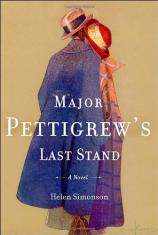
Major Pettigrew’s Last Stand


Review
Major Pettigrew’s Last Stand




For all readers, there is the hope of finding a writer whose work they have not read or a book by a debut author. Opening these first pages can be an experience fraught with anticipation or disappointment. But once readers discover a new writer who meets or exceeds their expectations, there is always a feeling of elation.
It was with this in mind that I began reading MAJOR PETTIGREW’S LAST STAND, Helen Simonson’s first novel. What a sense of delight and enjoyment with which to behold the turning of every page, right up to the very last. This charming novel, set in Edgecombe St. Mary, England in contemporary times, introduces readers to a small village in the countryside with rolling hills and thatched cottages, and features characters who pop right out of the story.
The retired Major Ernest Pettigrew lives a quiet life doing the proper things that an Englishman would do for his village and family. His understated manner underlies a will and perspective on life that makes a point over time and with the relationships and challenges that he faces. When his younger brother Bertie dies, the Major feels the loss deeply. As executor of the estate, he plans to unite the antique sporting guns that were left to each of the brothers from their father. His understanding was that whoever died first would leave his gun to the surviving brother. However, Bertie’s will does not mention this arrangement. Roger, Ernest’s son, and the rest of Bertie’s family hopes that by uniting the antique Churchill shotguns, they can be sold for more money.
Ernest buys his tea from a local shop and forms a friendship with Jasmina Ali, the widowed Pakistani shopkeeper. Regardless of their dissimilar cultural backgrounds, Ernest and Jasmina find they have common threads in their lives. Both have lost a spouse, and both love reading literature. Is a courtship between the two a possibility?
The villagers and country club ladies know that their predictable life may be undergoing some serious changes. The local lord is considering selling land to an American who will alter the village landscape and perhaps its charm. Meanwhile, Roger becomes engaged to a young American woman. “Two Americans in so many weeks in the village is approaching an epidemic,” says Ernest. As the townspeople learn about the changes to their village, some protest the whole idea.
The courtship between Ernest and Jasmina continues, which has some of the villagers perplexed. Jasmina’s nephew, Abdul Wahid, believes that women should not be storekeepers. In his mind, he should run the shop and she should go live with her loved ones. Will family responsibilities and village views bring an end to this budding romance? Only time will tell.
Helen Simonson has written a novel about remarkable people who endear the heart. Their stories, set against the backdrop of village life, foster tenderness toward each of these characters who charmed me all the way through the book, and beyond. If MAJOR PETTIGREW’S LAST STAND is any indication, readers will enjoy Simonson’s writing for many years to come.
Reviewed by Jennifer McCord on January 6, 2011


Major Pettigrew’s Last Stand
- Publication Date: March 2, 2010
- Genres: Fiction
- Hardcover: 368 pages
- Publisher: Random House
- ISBN-10: 1400068932
- ISBN-13: 9781400068937