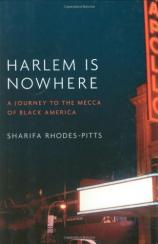
Harlem is Nowhere: A Journey to the Mecca of Black America


About the Book
Harlem is Nowhere: A Journey to the Mecca of Black America




For a century Harlem has been celebrated as the capital of black America, a thriving center of cultural achievement and political action. At a crucial moment in Harlem's history, as gentrification encroaches, Sharifa Rhodes-Pitts untangles the myth and meaning of Harlem's legacy. Examining the epic Harlem of official history and the personal Harlem that begins at her front door, Rhodes-Pitts introduces us to a wide variety of characters, past and present. At the heart of their stories, and her own, is the hope carried over many generations, hope that Harlem would be the ground from which blacks fully entered America's democracy.
Sharifa Rhodes-Pitts is a brilliant new voice who, like other significant chroniclers of places-Joan Didion on California, or Jamaica Kincaid on Antigua-captures the very essence of her subject.


Harlem is Nowhere: A Journey to the Mecca of Black America
- Publication Date: January 26, 2011
- Hardcover: 304 pages
- Publisher: Little, Brown and Company
- ISBN-10: 031601723X
- ISBN-13: 9780316017237