IndieBound Independent Bookstores

Barnes & Noble

Loading
Reading Group Guide
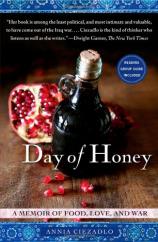
Day of Honey
A Memoir of Food, Love, and War
by Annia Ciezadlo

List Price: $15.00
Pages: 416
Format: Paperback
ISBN: 9781416583943
Publisher: Free Press

Click here to buy this book from Amazon.com.
Click here to buy this book from Amazon.ca.


About This Book

A luminous portrait of life in the Middle East, Day of Honey weaves history, cuisine, and firsthand reporting into a fearless, intimate exploration of everyday survival.

In the fall of 2003, Annia Ciezadlo spent her honeymoon in Baghdad. Over the next six years, while living in Baghdad and Beirut, she broke bread with Shiites and Sunnis, warlords and refugees, matriarchs and mullahs. Day of Honey is her memoir of the hunger for food and friendship --- a communion that feeds the soul as much as the body in times of war.

Reporting from occupied Baghdad, Ciezadlo longs for normal married life. She finds it in Beirut, her husband's hometown, a city slowly recovering from years of civil war. But just as the young couple settles into a new home, the bloodshed they escaped in Iraq spreads to Lebanon and reawakens the terrible specter of sectarian violence. In lucid, fiercely intelligent prose, Ciezadlo uses food and the rituals of eating to illuminate a vibrant Middle East that most Americans never see. We get to know people like Roaa, a determined young Kurdish woman who dreams of exploring the world, only to see her life under occupation become confined to the kitchen; Abu Rifaat, a Baghdad book lover who spends his days eavesdropping in the ancient city's legendary cafes; Salama al-Khafaji, a soft-spoken dentist who eludes assassins to become Iraq's most popular female politician; and Umm Hassane, Ciezadlo's sardonic Lebanese mother-in-law, who teaches her to cook rare family recipes --- which are included in a mouthwatering appendix of Middle Eastern comfort food. As bombs destroy her new family's ancestral home and militias invade her Beirut neighborhood, Ciezadlo illuminates the human cost of war with an extraordinary ability to anchor the rhythms of daily life in a larger political and historical context. From forbidden Baghdad book clubs to the oldest recipes in the world, Ciezadlo takes us inside the Middle East at a historic moment when hope and fear collide.

Day of Honey is a brave and compassionate portrait of civilian life during wartime --- a moving testament to the power of love and generosity to transcend the misery of war.

top of the page


rgg_discuss.gif (1294 bytes)

1. Day of Honey opens with an introduction, titled"The Siege," that takes place soon after 9/11 in New York City. Why do you think Annia begins her memoir here, with a taxi ride down Brooklyn's Atlantic Avenue? How does this introduction set the scene for the rest of the book?

2. One important theme of Day of Honey is the question of home. Do you agree with Annia that"home could be something you made instead of the place where you lived" (p. 24)? Is home a fixed location, or is it a movable feast?

3. Discuss the relationship between Annia's nomadic teenage years and her personal connection to food. Do you think Annia's travels through America influenced her experience in the Middle East?

4."How do you like Beirut?" (p. 34). It's the question everyone asks Annia during her first visit to her future home. What are Annia's first impressions of Beirut? Which of the city's pleasures does she discover right away, and which does she find later, as a resident?

5. Annia identifies what she refers to as a"shadow conflict" in times of war that she defines as"the slow but relentless destruction of everyday civilian life" (p. 8). Of all the everyday freedoms that are lost in Baghdad and Beirut, which loss seems the most tragic? Which of Annia's new friends and acquaintances fall victim to this"shadow war," and which manage to adapt during times of conflict?

6. Compare Annia's childhood to Mohamad's. How were their early environments different, and how were they similar? What challenges did each of them face growing up? What factors made each of them a"reluctant nomad (p. 25)"?

7. On page 265, Annia writes:"You are reading my account of one war --- my imperfect memories of what I saw and felt and did. Others had their own perceptions and their own realities." What does she mean by this? Is she writing as a journalist, or a human being, or both?

8. When Annia arrives in Baghdad, she finds that most outsiders describe Iraqi food as"the real weapon of mass destruction" (p. 66). Why does Annia take this as a personal challenge, and how does she prove them wrong? Why have outsiders misjudged Iraqi cuisine?

9. Discuss the theme of hospitality in Day of Honey. How does Annia react to this Middle Eastern tradition? Annia learns early on to"never, ever turn down a meal" (p. 113). What kinds of homes, meals, and dangers does Annia encounter as a result?

10. Consider the story of Roaa, Annia's translator who grew up in war-torn Iraq. How does Roaa feel about her country's history and its prospects for the future? Do you think Roaa and her husband, now living in Colorado, will ever be able to"make" themselves settle down, as Roaa puts it (p. 318)? Why or why not?

11. According to Annia,"My idea of paradise is more like Mutanabbi Street, in Baghdad's old city: an entire city street with no cars, just books and cafÉs" (p. 105). How does Mutanabbi Street demonstrate Iraqis' love for the written word? What solace does Annia find on Mutanabbi Street, and why must she eventually stop going there? Have you ever encountered a city, street, or place that felt like your idea of paradise?

12. Annia was living in Baghdad when Saddam Hussein was finally captured. How do Annia's Iraqi friends respond to this historical event? Annia writes,"The flavor of freedom was more complex, more bitter than we imagined" (p. 120). Did Annia's account of the United State's occupation of Iraq change your perspective or understanding of current events?

13. Discuss the unique challenges that women --- the"face of Iraq" --- must contend with (p. 140). Why is Dr. Salama, a popular female politician, a complicated spokeswoman for women's rights in Iraq? What does Annia learn about Iraqi women and politics from her conversations with Dr. Salama? How did you react to these events in the book?

14. Consider the strong personality of Umm Hassane, Annia's mother-in-law. What are Annia's first impressions of Umm Hassane, and how does Annia's opinion of her mother-in-law evolve over the course of the book? What can we learn about Umm Hassane's character from her cooking style? How does Annia find"the real story" of the war by cooking with Umm Hassane (p. 275)? Does Umm Hassane remind you of anyone you know?

15. Discuss the early years of Annia and Mohamad's marriage. What are the main sources of tension in their relationship? Were you able to relate to their everyday squabbles? Why or why not? Why do you think she includes these incidents in her accounts of historic events?

16. Why does Annia return to Beirut in the fall of 2007, after Mohamad finds a job in New York? What do you think Mohamad means when he says,"the war would never end... you ended it yourself" (p. 313)? How does Annia manage to end her dangerous attachment to Beirut?

Author bio

top of the page

 
Facebook Fan Page  Follow us on Twitter


Add Your Guide to ReadingGroupGuides.com!

Bookreporter.com Bets On...: Books We're Betting You'll Love


Privacy Policy | Contact Us | Advertising | About Us

© Copyright 2001-2012, ReadingGroupGuides.com. All rights reserved.
The Book Report, Inc. • 250 West 57th Street • Suite 1228 • New York, NY • 10107
Ph: 212-246-3100 • Fax: 212-246-4640

Bookreporter.comReadingGroupGuides.comGraphicNovelReporter.comFaithfulReader.com
Teenreads.comKidsreads.comAuthorsOnTheWeb.com