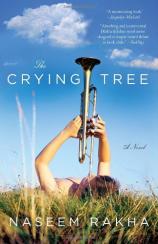
The Crying Tree
by Naseem Rakha
List Price: $14.00
Pages: 368
Format: Paperback
ISBN: 9780767931748
Publisher: Broadway
Irene and Nate Stanley are living a quiet and contented life with their two children, Bliss and Shep, on their family farm in southern Illinois when Nate suddenly announces he’s been offered a job as a deputy sheriff in Oregon. Irene fights her husband. She does not want to uproot her family and has deep misgivings about the move. Nevertheless, the family leaves, and they are just settling into their life in Oregon’s high desert when the unthinkable happens. Fifteen-year-old Shep is shot and killed during an apparent robbery in their home. The murderer, a young mechanic with a history of assault, robbery, and drug-related offenses, is caught and sentenced to death.
Shep’s murder sends the Stanley family into a tailspin, with each member attempting to cope with the tragedy in his or her own way. Irene’s approach is to live, week after week, waiting for Daniel Robbin’s execution and the justice she feels she and her family deserve. Those weeks turn into months and then years. Ultimately, faced with a growing sense that Robbin’s death will not stop her pain, Irene takes the extraordinary and clandestine step of reaching out to her son’s killer. The two forge an unlikely connection that remains a secret from her family and friends.
Years later, Irene receives the notice that she had craved for so long --- Daniel Robbin has stopped his appeals and will be executed within a month. This announcement shakes the very core of the Stanley family. Irene, it turns out, isn’t the only one with a shocking secret to hide. As the execution date nears, the Stanleys must face difficult truths and find a way to come to terms with the past.
Dramatic, wrenching, and ultimately uplifting, The Crying Tree is an unforgettable story of love and redemption, the unbreakable bonds of family, and the transformative power of forgiveness.
top of the page

1. Why did Irene believe that she could not tell anyone about having forgiven Robbin? What did she think would happen? What was she afraid of? Have you ever forgiven someone but been afraid to admit it?
2. Do you think that, like Irene, you could forgive someone who harmed your family?
3. Irene tells her sister that forgiving Robbin was not a choice. What do you think she meant?
4. Do you think it is necessary to have a belief in a God or a higher power to have made the choices Irene made? Do you think the ability to forgive can be learned?
5. In the first chapter, Tab Mason describes his reaction to seeing his first execution. Have you ever given much thought to how executions affect those who must carry them out?
6. Secrets --- Nate’s, Shep’s, Irene’s --- are the driving force behind the tragedy in this story. Do you think it is common for families to operate in such isolation from one another?
7. Nate says he moved his family west to help Shep. How did he think this would help?
8. How would you describe the novel’s central message or theme? And how does the ending of the book affect your understanding of the novel’s central message or theme?
9. Tab Mason has an unusual skin disorder. Why do you think I chose to mark him in such a way? What difference would it make, if any, if he were simply a black man? Or a white man?
10. Tab Mason is a man who offers “no surprises.” He is painstakingly in control of his words, his thoughts, and his emotions. And this has paid off, giving him the job, power, and resources to live a very comfortable life. Why then do you think he was willing to risk it all to help Irene Stanley?
11. Bliss recounts a time she found her father having an emotional breakdown while in the barn. The event was heart-wrenching for her. Bliss loved and cared for her father more than anyone, yet she does nothing to try to help. Does it make sense to you that Bliss did not try to step in and help her father?
12. Irene and Bliss had a difficult relationship. How was this transformed by Irene’s act of forgiveness?
13. Bliss feels compelled to forgo her dream of college so that she can stay in Carlton and help her parents. Have you had times in your life when you have given up your dreams to help others?
14. Why do you think Daniel Robbin refuses the offer to introduce new evidence that might overturn his murder conviction?
15. In the end, Nate is in a bus going to Shep’s grave. Why do you think he is doing this? Do you think Nate’s character changed over the course of the book? If so, how? If not, why not?
16. Irene’s relationship with her church and faith were challenged in this story. In the end do you think her belief in God was stronger or weaker?
17. Why, of all the people Irene had in her life, did she open up to Doris, the woman who owned the Hitching Post in Wyoming?
18. After Nate’s confession, Irene leaves her husband. As she drives across the country, how do her feelings about her son’s death, Nate , and herself change?
19. Irene had strong feelings about staying around her family (“You don’t leave family,” in chapter 2). Yet emotionally, Irene did leave her family. She was not there for her daughter through high school, she never turned to her sister for help, and she and Nate’s relationship was estranged. In the end, what did this belief in family mean? What conclusions about Nate and Irene’s future can you draw from this sentiment?
20. In the end, what do you think Irene, Bliss, and Tab Mason’s actions meant to Daniel Robbin?
top of the page

"Beautifully written, expertly crafted, forcefully rendered. Naseem Rakha lays bare all the ambiguities and nuances of our culture in a story that is compelling and deep. The Crying Tree is a story of forgiveness and redemption, but at its core it is a love story as well, and that is the most powerful story of all."
Garth Stein, author of The Art of Racing in the Rain
"In The Crying Tree Naseem Rakha uses grace and honesty to tell the gripping story of parents losing a son to murder and their desperate hope that an execution will provide closure, while allowing readers to consider the idea of forgiveness as a means of healing."
Randy Susan Meyers, author of The Murderer's Daughters
"Naseem Rakha writes with both clarity and sympathy about one of the most mysterious and evasive of human impulses: forgiveness. The Crying Tree is a memorable and deeply humane novel."
Jon Clinch, author Finn and Kings of Earth
"This complex, layered story of a family's journey toward justice and forgiveness comes together through spellbinding storytelling. Deputy sheriff Nate Stanley calls home one day and announces he's accepted a deputy post in Oregon. His wife, Irene, resents having to uproot herself and their children, Shep and Bliss, from their small Illinois town, but Nate insists it's for the best. Once they've moved into their new home, Shep sets off to explore Oregon's outdoors, and things seem to be settling in nicely until one afternoon when Nate returns home to find his 15-year-old son beaten and shot in their kitchen. After Shep dies in Nate's arms, the family seeks vengeance against the young man, Daniel Joseph Robbin, accused of Shep's murder. In the 19 years between Shep's death and Daniel's legal execution, Bliss becomes all but a caretaker for her damaged parents, and a crisis pushes Irene toward the truth about what happened to Shep. Most of the big secret is fairly apparent early on, so it's a testament to Rakha's ability to create wonderfully realized characters that the narrative retains its tension to the end."
Publishers Weekly