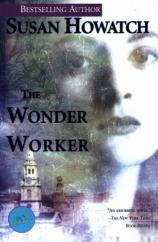
The Wonder Worker
by Susan Howatch
List Price: $14.00
Pages: 561
Format: Paperback
ISBN: 0449001504
Publisher: Fawcett Columbine
Young, lonely, and insecure, Alice Fletcher is on the verge of emotional collapse when she stumbles
into St. Benet's Church to dodge the London drizzle. There, she witnesses
a group of gifted healers led by the charismatic Nicholas Darrow. Gaining
refuge at last, Alice is drawn--inexorably, seductively--into the complex
network of relationships at St. Benet's healing center--as she falls immediately,
dangerously, in love with Darrow himself.
Yet Darrow and his cutting-edge clergy are not all what they seem. And while Nicholas's dazzling powers
now threaten to ruin all he attempts to save--including his own disturbed
marriage--Alice's devotion to him deepens. Then a devastating tragedy
transports her to the shocking center of truth. Yet fueled by her love
for Nicholas and a boldly emerging intuition, she will hold together the
lives spinning wildly out of control--as she herself is transformed forever.
top of the page

1. This book is told from the point of view of four different characters. Do you think the
author favors one character over another? If so, why and how? Which character
do you feel the greatest connection with?
2. Alice is a Cordon Bleu chef with an eating disorder, which means that her greatest talent
is linked to her greatest weakness. Do you see this as a theme with any
of the other characters?
3. Alice's aunt doesn't seem to have given her a good sense of self-esteem, and yet Alice shows
a very strong sense of duty in taking care of her. Do you see this as
admirable, or as something that deprives her of her own personal growth?
How would you act in a similar situation?
4. Rosalind refers to America enviously as "a culture where it was socially acceptable for angry
people to scream with rage" as opposed to the stiff-upper-lip tradition
of Britain. Do you think this is a fair characterization of either country?
If so, how do these differences affect women's lives in particular?
5. The friendship between Nicholas and Lewis seems more durable than any of the friendships between
women in this book; for instance, between Rosalind and Francie. Why do
you think this is so?
6. Why do you think Francie makes untrue allegations against her husband? Do you see her as
a victim or a perpetrator? Is she being manipulative, or do you think
her actions are excusable because she is disturbed?
7. What is the significance of Nicholas's toy bear? What does it mean for him as a child? What relevance
does it have for how he treats people as an adult?
8. Nicholas and Lewis are healers who, when they are troubled, turn to their own spiritual directors,
most notably in Nicholas' session with Clare (pages 318Ð332). Do Nicholas's
and Lewis's methods of healing differ from those of their own spiritual
directors? If so, how?
9. The novel differentiates between being an "honest Christian healer" and a "shady, manipulative
wonder worker," yet the title suggests that Nicholas might be more of
the latter than the former. Do you think this is true? What are the differences
you see between the two?
10. There is a lot of speculation about the reasons for Stacy's death. Why do you think he commits
suicide?
11. Who do you think is stronger--Alice or Rosalind? Why?
12. Traditionally, religious figures are expected to be above sexual temptation, but all of the men
of St. Benet's-by-the-Wall struggle with their sexuality. Lewis struggles
with his celibacy; Stacy struggles with his sexual orientation; and Nicholas
struggles with the attraction women have for him. What do you think the
role of sexuality in a clergyman's life should be?
13. Nicholas is portrayed as the highly charismatic center of a small religious community--a role
that has come to be viewed very suspiciously these days. Overall, do you
think Nicholas's depiction in the book is more positive or negative?
14. What experiences have you had personally with highly charismatic figures, religious or
otherwise? How did you react to them? Did you trust them as much as most
people seem to trust Nicholas?
15. What do you think the reasons are for the breakup of Nicholas and Rosalind's marriage? Do
you think it was inevitable? Is there anything either of them could have
done to prevent it?
16. Rosalind has kept important parts of her life secret from her husband, Nicholas, because
she feels he isn't really paying attention to her. Do you think she was
right to do so?
17. The book shows Nicholas using his psychic abilities three times--the first with Alice and her
aunt, the second when he hypnotizes his wife, and the third when he "exorcises"
Francie. In each case, he oversteps what might be considered proper behavior,
but with very different results. When and how are his uses of his psychic
powers beneficial? When and how are they destructive? What does this say
about the risks of charismatic healing? What are the ethical questions
involved in this sort of work?
18. What role do religion and spirituality play in the lives of the various characters? How does
their belief (or lack of it) in God affect their relationships with others?
top of the page

"What would life be without Nicholas Darrow, [his] sidekick, Lewis Hall, perennially unsettled Venetia
Flaxton?...Happily, all three are back in The Wonder Worker....Howatch is unsurpassed."
Newsday
"She does it again in The Wonder Worker.... By book's end, you care so much about these lives....One
hopes that this is the start of yet another great series."
The Cleveland Plain Dealer
"Combining romantic fiction with an exploration of both Christianity and the labyrinths of the human
spirit seems an almost impossible task, but time and time again Howatch has pulled it off.... She walks right into both the bedroom and the inner
sanctum of the soul."
Washington Post Book World
"Susan Howatch is back on familiar turf...[a] novel of emotional, psychological and spiritual exploration."
The New York Times Book Review