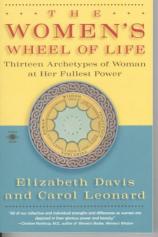
The Women's Wheel of Life
by Elizabeth Davis and Carol Leonard
List Price: $11.95
Pages: 256
Format: Paperback
ISBN: 014019505X
Publisher: Penguin USA
A New Look
at an Ancient Mystery
If you dig deep into the past,
before Christianity and the advent of science, you will discover a time
when women's Blood Mysteries the biological events of menstruation,
childbirth, and menopause accorded them great power and respect.
People once believed that conception was a culmination of some kind of
female magic that women conceived children on their own by withholding
their menstrual blood. During this time, women in menopause were also
revered for their ability to carry within themselves their magical, mysterious
blood and all its power. But as science became more sophisticated,
seeking to tame and dominate the forces of nature, the Mystery was lost.
Now, in The Women's Wheel of Life, the authors re-examine the
Blood Mysteries, creating new, empowering archetypes that guide women
towards greater self-awareness and self-respect.
The Thirteen Stages
of Women's Lives
Middle-aged women who have
turned to women's spirituality have struggled with the confining concept
of the triple Goddess found in many ancient religions. The image portrays
just three phases in women's lives: the Maiden, whose rite is menstruation;
the Mother, whose rite is childbirth; and the Crone, whose rite is menopause.
But where does the woman in her late thirties and forties fit in? For
the first time, the authors of The Women's Wheel of Life offer
a fourth phase which falls between the Mother and the Crone the
Matriarch: She is a woman at the peak of her sexual and professional power,
who, over the years, has developed a powerful sense of timing which compensates
for any loss of youthful energy. But the Matriarch is just one figure
in The Women's Wheel of Life. There are twelve archetypes around
the wheel residing in phases of innocence, power, nurturing, and wisdom.
Although the stages flow somewhat consecutively, women revisit certain
stages in their lives numerous times or leap ahead to stages further along
the Wheel. The means of movement among the stages relies on the thirteenth
stage and archetype the Transformer. Completing the women's wheel
of life, the Transformer is at the center, and whenever we cross the threshold
of a major life transition, we enter this stage.
The authors developed the Wheel
as a synthesis of forty years' work in women's health, spirituality, and
psychology, drawing on over a hundred interviews with women in all stages
of life. As you read The Women's Wheel of Life, look into your
own experiences, find your own truth and share what you learn with
others. A truly transformational experience awaits!
top of the page

1. Which archetype on the wheel do you feel best represents you now? Why? What are the events in your life that have led you to this stage?
2. Are there stages on the wheel you have visited again and again? Are there stages which you would like to enter, yet they elude you?
3. As the authors point out, many ancient religions represent women's lives in three phases: the Maiden, the Mother and the Crone. In this book, the authors have added the Matriarch phase to this trinity. What do you know about women at this time in their lives, either from your own experience or from the experiences of others? Does this fourth phase seem to you to be a valid addition to the trinity?
4. What are some of our society's misconceptions about older women? How do you yourself feel about growing older? What are some of the ways in which this book redefines a woman's aging process?
5.What do you think your grandmother's experience with her own Blood Mysteries was like? Your mother's? Your daughter's? Try to place these different experiences into a historical context which reflects the growth of the women's movement over the last few generations.
6.The thirteenth stage, the Transformer, represents the medium of change in women's lives. Some of the women interviewed describe this stage as a period of descent somewhat akin to depression. Describe your experience of change. How did other people treat you when you were in this stage? What has your relationship been to feminism? When and where did you first encounter the concept? How did that experience change the way you feel about yourself, other women, and men? Describe how this book has impacted your feminism, or femininity.
7.The media often portrays women before and during their periods as unreasonable, unhappy, and emotionally unstable. What actually happens to you at this time of the month? Has the media affected your perceptions of yourself? How has this book changed that perception?
8.What is it like for women at your place of employment? What are co-workers' expectations of you? One woman interviewed in the book noticed that "as you provide some women's knowledge in a male-based world, it feels right to both of you" (page 210-211). Are the people you work with willing to accept unconventional kinds of wisdom?
top of the page

"I love this book. I recognized myself thirteen times. "
Judy Grahn, author of Blood, Bread, and Roses
"Adds an insightful new formulation to our understanding of the stages of women's development. "
Starhawk, author of The Spiral Dance
"The archetypal descriptions...give us a new language for women's wisdom which feels absolutely right and very affirming. "
Christine Northrup, M.D., author of Women's Bodies, Women's Wisdom
"A long-awaited recognition of female diversity and development. "
Vicki Noble, author of Motherpeace andShakti Woman
"A tremendously useful book in defining women's experience of maturation. This book is a gem!! "
Brooke Medicine Eagle, author of Buffalo Woman Comes Singing
"I loved the book! Great, thought-provoking theories, excellent research... "
Zsuzsanna Budapest, author ofGrandmother of Time