IndieBound Independent Bookstores

Barnes & Noble

Loading
Reading Group Guide
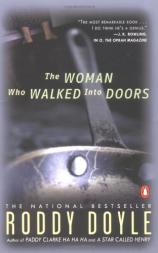
The Woman Who Walked Into Doors
by Roddy Doyle

List Price: $12.95
Pages: 240
Format: Paperback
ISBN: 0140255125
Publisher: Penguin USA

Click here to buy this book from Amazon.com.
Click here to buy this book from Amazon.ca.


About This Book


Paula Spencer is the narrator and unlikely heroine of Roddy Doyle's fifth novel, The Woman Who Walked Into Doors. The mother of four children, she lives in a working-class suburb of Dublin. She is also a battered wife and an alcoholic. Paula's husband, Charlo, has been killed while escaping the scene of a crime he committed. Though Paula threw him out a couple of years ago, she recalls their early times together, filled with joy and lust. She remembers her rebellious adolescence, boys she dated and fantasized about, family outings, and summers at the sea, and she reflects on the events in her life that brought her to where she is today.

Doyle's portrait of a working-class woman in contemporary Ireland illuminates many of the problems facing that country's working poor, yet Paula is a wonderfully unique character—honest about her feelings, fearless in her efforts to protect her family, subject to fits of anger and depression that threaten to undo all that she has accomplished. Doyle takes his time revealing Paula to us. This account of her life is not chronological but spiraling, driven by memory and recurring images that spark these memories. Roddy Doyle's lean prose and his uncanny ear for dialogue brilliantly offset the drama that unfolds as Paula tells her story. It is this restraint that makes his writing so compelling, that allows us to accept, understand, and champion Paula in her struggle to reclaim her dignity.

Roddy Doyle jokingly acknowledges that he might have titled the novel Paula Spencer Boo Hoo Hoo. However, there is no doubt that he has reached a new level of mastery in this deceptively complex portrait of a woman and a family in trouble.

top of the page


rgg_discuss.gif (1294 bytes)


1. The Woman Who Walked Into Doors
does not progress chronologically, but rather through a series of vignettes that dart back and forth in time. How does the "spiral" effect drive the story forward?

2. We don't get an objective introduction to Paula Spencer until midway through the novel, when she presents us with the "facts" of her life. Why does Doyle wait so long to give us information? How does the delay affect the novel and your view of Paula?

3. Paula replays scenes from her childhood and youth over and over in her head. Why do you think she does this? What is the function of memory in this novel?

4. What roles do fantasy and denial play in the novel? Is there a difference between Paula's romantic fantasies and her denial of family history? Is Paula doing herself any harm by not facing the truth, as Carmel would have her believe?

5. One of the most compelling scenes in the novel takes place when Paula goes searching for the key to the liquor cabinet. What makes this scene so riveting? How does Doyle convey an alcoholic's desperation?

6. What makes Paula visit the Fleming estate—the scene of Charlo's crime—and why does she mentally re-create the events that took place there?

7. "I keep blaming myself," says Paula. "After all the years and the broken bones and teeth and torture I still keep blaming myself. I can't help it. What if? What if?" Why does Paula blame herself? Does this make her more, or less, of a victim? How so?

8. Paula describes the dating scene when she was an adolescent as a cat-and-mouse game in which girls and boys became involved with each other without getting to know one another; without, in fact, both of them knowing they are involved. How does Doyle set up the story of Paula's marriage with this explanation? How do Paula's other adolescent and early experiences come into play in her later life?

9. How do Paula's and Charlo's families interfere with and dictate the marriage they will have? Paula admits the relief she felt giving up her last name for Charlo's. Do you think Paula would have been happier not marrying Charlo?

10. Paula repeatedly makes the comment that people "do not see her." What does she mean by this? How does this observation make you understand her actions and inaction?

11. In the novel's opening scene, Paula is informed of her husband's death by a young policeman. They have what appears to be a very casual conversation, and in fact, Paula doesn't find out how her husband died until much later. What does this tell you about Paula?

12. Paula finds herself forgiving Charlo: "He couldn't drive.... The poor eejit, he never got round to it. The kidnapper who couldn't drive." Do you feel any sympathy for Charlo? Do you think Doyle wants the reader to forgive him?

13. Paula finds solace in her children, yet she admits to occasionally striking them and neglecting them when she is drunk. Do you think that she is a good parent? The best parent she can be under the circumstances?

14. The novel ends with a hopeful scene which chronologically belongs somewhere in the middle of the story. Yet defeat and resignation are pervasive themes in the novel. Do you get the sense that Paula will triumph over her alcoholism? Do you think she'll find happiness in her life?

15. Roddy Doyle's first two novels, The Commitments and The Snapper, were made into critically acclaimed films, and the movie version of The Van will soon be completed. It is therefore interesting that the plot of The Woman Who Walked Into Doors originated in a teleplay about a troubled Irish family. What is it about certain novels that makes them great movies? What is it about Roddy Doyle's writing that adapts so well to the screen? Can you recognize dramatic elements in this novel that might have served Doyle in transforming spoken dialogue into written narrative?

top of the page

Critical Praise

"Astonishing... With this book, Doyle attains a new level of excellence. He writes about a woman's experience with a perception that is rare, a compassion that is scorching and an uncompromising frankness that splinters his heroine's suffering directly into the reader's heart. Doyle triumphs here, with a tough minded but deeply moving exploration of a wretched marriage, a microcosm of a pervasive situation in Ireland that few will acknowledge."
Publishers Weekly


"This is a powerful new novel once again reveals Doyle's extraordinary ear for capturing the rich, earthy speech of the Irish working class and his remarkable ability for creating vivid, unforgettable characters ... Paula, who never succumbs to self-pity, also triumphs in the readers' hearts. Highly recommended."
Library Journal


"A skillful mixture of bouyant farce and wrenching drama... Doyle's masterly use of jabbing, staccato sentences and emotional repetitions produces a nervous intensity that exactly reproduces how his heroine—and she is that, no other word will do—lives out her imperilled days."
Kirkus Reviews


"Extraordinary... . It is my belief that in the very finest fiction the author disappears, sometimes even along with his or her gender. It doesn't happen very often. But it does here. You don't see a man, telling a woman's story with an accuracy and sensitivity you might not have thought possible. You see a woman telling her own story. You only see her. Finally."
Elizabeth Berg, The Boston Book Review

 
Facebook Fan Page  Follow us on Twitter


Add Your Guide to ReadingGroupGuides.com!

Bookreporter.com Bets On...: Books We're Betting You'll Love


Privacy Policy | Contact Us | Advertising | About Us

© Copyright 2001-2012, ReadingGroupGuides.com. All rights reserved.
The Book Report, Inc. • 250 West 57th Street • Suite 1228 • New York, NY • 10107
Ph: 212-246-3100 • Fax: 212-246-4640

Bookreporter.comReadingGroupGuides.comGraphicNovelReporter.comFaithfulReader.com
Teenreads.comKidsreads.comAuthorsOnTheWeb.com