Reading Group Guide
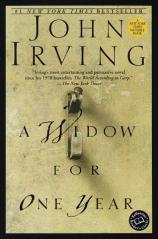
A Widow for One Year
by John Irving

List Price: $14.95
Pages: 576
Format: Paperback
ISBN: 0345424719
Publisher: Ballantine

Click here to buy this book from Amazon.com.
Click here to buy this book from Amazon.ca.


About This Book


Ruth Cole is a complex, often self-contradictory character--a "difficult" woman. By no means is she conventionally "nice," but she will never be forgotten.

Ruth's story is told in three parts, each focusing on a crucial time in her life. When we first meet her--on Long Island, in the summer of 1958--Ruth is only four.

The second window into Ruth's life opens in the fall of 1990, when Ruth is an unmarried woman whose personal life is not nearly as successful as her literary career. She distrusts her judgment in men, for good reason.

A Widow for One Year closes in the autumn of 1995, when Ruth Cole is a forty-one-year-old widow and mother. She's about to fall in love for the first time.

Richly comic, as well as deeply disturbing A Widow for One Year is a multilayered love story of astonishing emotional force. Both ribald and erotic, it is also a brilliant novel about the passage of time and the relentlessness of grief.

top of the page


rgg_discuss.gif (1294 bytes)


1. A passionate and complex theme throughout the book is the concept of a writer's imagination. "Eddie O'Hare, who was doomed to be only autobiographical in his novels, knew better than to presume that Ruth Cole was writing about herself. He understood from the first time he read her that she was better than that" (p. 204). What role does imagination, lack of it, even fear of it, play in the lives and careers of the central characters?

2. Ruth, as a novelist, sees books as inventions based on both borrowed and imagined experiences--not necessarily personal ones. However, her best friend, Hannah, a journalist, presumes that all novels are substantially autobiographical; she sees in Ruth's books a "Hannah" character, who is the adventurer, as well as a "Ruth" character, who holds herself back. Explore the ideas of fiction and imagination and the autobiographical ingredients of writing.

3. What is the meaning and symbolism of the "feet" photo? Why do you think it became kind of a talisman for Ruth? What emotions does the photo evoke in you as a reader?

4. Discuss the humor and the pathos of Ted Cole's oeuvre. What about the humor and pathos of Ted himself? Where does Ted's true imagination lie--if not in his writing? Is Ted's real talent--his passion, his art--the seduction of the prettiest and unhappiest of young mothers? Doesn't Ted pursue his seductions as passionately as his daughter will pursue her writing?

5. During that fateful summer, Eddie, the aspiring young writer, found his voice. Marion gave him his voice. "It was losing her that had given him something to say. It was the thought of his life without Marion that provided Eddie O'Hare with the authority to write" (p. 112). Discuss the life and writing career of Eddie O'Hare: his brilliance when being truly autobiographical, and his mediocrity when it came to believability in things that were "imagined."

6. When Ted tells Eddie the "story" of Thomas and Timothy's accident, he tells it in the third-person removed. "If Marion had ever told the story, she would have stood so close to it that, in the telling of it, she would have descended into a final madness--a madness much greater than whatever madness had caused Marion to abandon her only living child" (p. 154). Examine the madness. Discuss Ted's ability--and Marion's inability--to detach.

7. How is Eddie, who appears as the most benign of characters, often the most powerful? For example, beginning with the restaurant "fingerprinting" scene (p. 240), he gives Ruth the gift of her past, of her mother, of other realities. How does he open the door to her future?

8. Examine: "Ruth thought of a novel as a great, untidy house, a disorderly mansion; her job was to make the place fit to live in, to give it at least the semblance of order. Only when she wrote was she unafraid" (p. 267). Discuss the idea that the books in Ruth's life and the characters in them were more fixed in Ruth's life than the flesh-and-blood people closest to her--namely, her father and her best friend.

9. Why do you think Ruth decides to marry Allan? Why was he so safe? How was he different from her "type" of man--a type that disturbed her so?

10. Discuss the theme of humiliation in her novel-in-progress as well as Ruth's own unconscious quest for humiliation. Examine the themes of women, humiliation, and control. In Amsterdam, Ruth writes in her diary: "The conventional wisdom is that prostitution is a kind of rape for money; in truth, in prostitution--maybe only in prostitution--the woman seems in charge" (p. 338). What do you think of this?

11. Examine the scene after she witnesses the murder. "At last she'd found the humiliation she was looking for, but of course this was one humiliation that she wouldn't write about" (p. 375).

12. Examine the powerful car scene before Ted's suicide. As Ted is driving, Ruth reveals the shocking incident with Scott. Her tale is one of degradation. Does it have the desired effect on her father? What does she want? Was this scene about revenge--about giving back the hurt done to her? Can matters of families, of love and hate (her father is the one she most loves and hates in her life), ever really be understood? Of course this scene mirrors the driving scene where Ted tells Ruth the details of her brothers' death. Discuss.

13. What changes occur in Ruth after she becomes a widow? How do these changes finally free her to fall in love at last?

14. What kind of emotions do you feel at the ending of the book? How have the characters of Ruth, Marion, and Eddie found, in essence, their way back? How has Marion, through her books, come to terms with her grief? When she reveals to Eddie that "grief is contagious," is she effectively saying that her absence from her daughter's life was the only way she could love her or the only way she could not destroy her daughter?  

top of the page

Critical Praise

"Irving's most entertaining and persuasive novel since his 1978 bestseller, The World According to Garp. "
——The New York Times


"Deeply affecting ...The pleasures of this rich and beautiful book are manifold. To be human is to savor them. "
——Los Angeles Times Book Review


"Compelling ...John Irving is at the peak of his considerable powers in A Widow for One Year, his most intricate and fully imagined novel.... Irving's narrative spans 37 years in the life of Ruth Cole and the people around her.... By turns antic and moving, lusty and tragic, A Widow for One Year is bursting with memorable moments.... A testament to one of life's most difficult lessons: In the end, you just have to find a way to keep going. "
——San Francisco Examiner—Chronicle


"[A] sprawling, complex family history, A Widow for One Year will appeal to readers who like old-fashioned storytelling mixed with modern sensitivities. Wisely and carefully crafted, it's a novel about grief, the kind that lingers, and about families, the ones we're born into and ones we make for ourselves. Irving is among the few novelists who can write a novel about grief and fill it with ribald humor soaked in irony. "
——USA Today


"John Irving is arguably the American Balzac, or perhaps our Dickens--a rip-roaring storyteller whose intricate plot machinery is propelled by good old-fashioned greed, foolishness and passion. "
——The Nation


"Masterful ...Powerful ... Irving's best books are Dickensian in their rich characters, plotting and language--and of course, in moving the reader. On the final page of A Widow for One Year ...I literally burst out crying. "
——Orlando Sentinel


" [Irving's] characters can beguile us onto thin ice and persuade us to dance there. His instinctive mark is the moral choice stripped bare, and his aim is impressive. What's more, there's hardly a writer alive who can match his control of the omniscient point of view.... As it tracks protagonists Ruth Cole and Eddie O'Hare through 37 years of separate lives, A Widow for One Year lures us onto the terrain of irreparable grief and a little bit beyond.... No wonder the novel sent me looking for an imaginary children's book in my house. The likes of Ruth and Eddie, so comprehensively flawed and sweetly deserving, incline a reader to invite them in, to stay. "
——The Washington Post Book World


"Moving and memorable ...This novel marks a return to the deep but gentle examination of human nature that made Garp so successful. "
——San Diego Union—Tribune


"In the sprawling, deeply felt A Widow for One Year, John Irving has delivered his best novel since The World According to Garp.... Like a warm bath, it's a great pleasure to immerse yourself in. "
——Entertainment Weekly


"A Widow for One Year is as compelling as Garp. It might be even better. Which is to say it's terrific.... Filled with compassion and complexity ...A tribute to Irving's powers as a writer ...His most moving book. A Widow for One Year demonstrates, without a doubt, that John Irving is one of America's great storytellers. "
——San Jose Mercury News


"Wonderfully satisfying ...[Irving] tells this story with so much delight that it's difficult for the reader not to be infected with the same kind of joy in the reading.... With all the raunchy sex, delightful digressions on the contemporary literature scene, glimpses into the lives of gardeners and shopkeepers, schoolteachers and police officers, and a wonderful section set in the red-light district of Amsterdam, with a murder thrown in, there is an underlying sense of wonder that makes the novel seem almost like something written for the child in us. "
——The Dallas Morning News


"Enchantingly balances the haunting tug of grief with the lure of enduring love ...Irving's rich narrative and his sense of play result in a delicious collusion between author and reader. "
——Raleigh News & Observer


"[A] fast read that maintains its swift, entertaining pace ...Sorrow and sadness abound in this latest world according to Irving. But there is also much comic joy. Some of the maddest madcap scenes are the funniest, or at least the most surreal, since Peter De Vries, that great American Dutch Master, savaged suburbia. "
——Hartford Courant

 
Back to top.   


Privacy Policy | Contact Us | Advertising | About Us

© Copyright 2001-2008, ReadingGroupGuides.com. All rights reserved.