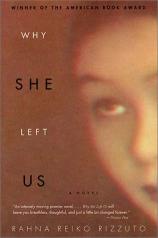
Why She Left Us
by Rahna Reiko Rizzuto
List Price: $13.00
Pages: 304
Format: Paperback
ISBN: 0060931825
Publisher: HarperCollins
While the internment of Japanese-Americans during the Second World War
is a central incident in Why She Left Us, Rahna Reiko Rizzuto feels that
this historical injustice is just the prism through which the events of
her first novel are refracted. "The book isn't about the internment,"
the author says. "It's about how we construct our lives in the face of
silence. On the grand scale, the silence surrounding the internment affects
the children in my novel. But there is a second silence-a missing explanation
for why a young girl gives up her child-and that is where the emotional
resonance in this book really lives." That girl is Emi Okada, the daughter
of Japanese immigrants, who brings shame to her insular family by bearing
two fatherless children. She gives the first child, a boy named Eric,
up for adoption, but her indomitable mother, Kaori, finds the boy and
brings him home. After the war and the time spent in a Colorado internment
camp, Emi moves to Hawaii with a new husband, taking her second child,
a daughter named Mariko, with her. But she leaves Eric behind with his
grandmother, and this seemingly callous rejection of the boy is the mystery
around which the novel unfolds.
Moving backward and
forward in time through much of the twentieth century, the story slowly
emerges from the mouths of four narrators with four very different perspectives-Kaori,
Emi's brother Jack, and her two children, Eric and Mariko. It is a story
rife with emotionally destructive secrets, diffused by the revisions of
time and memory. Family violence, the degradation of the wartime relocation,
the passive silence that simultaneously binds the Okada family and rends
it apart-these are the psychic burdens that, in the end, Mariko is left
to unravel. An intricate puzzle that unfolds with narrative assuredness,
Why She Left Us is the richly evocative and emotionally raw story of a
family torn apart by the conflicts of honor, shame, pride, and love.
top of the page

1. The story in Why She Left Us is told by different narrators, but we never hear from Emi herself. Why do you think the novelist made this narrative choice? Was it a good choice?
2. In the end, we never learn why Emi totally rejects her son, Eric. Does this omission make the story stronger or weaker?
3. Why does Rizzuto move back and forth in time when telling her story rather than use a more chronological narrative?
4. How well does Rizzuto create the different voices of her four narrators?
5. Kaori rescues Eric from his adoptive home because she feels that family ties cannot be severed, yet at the same time, the family spurns and alienates Emi for her actions. Discuss this seemingly contradictory, complicated response to the bonds of family.
6. Why do Emi's brothers so willingly become soldiers and fight for a country that is, at the same time, treating their people as prisoners of war?
7. Which generation seems to face the biggest obstacles-the Japanese immigrants Kaori and her husband; their children, Emi, Will, and Jack who are both Japanese and American; or the fully American generation of Eric and Mariko?
8. Are the events and secrets that fuel the novel a unique by-product of the war and the internment or could they have happened anyway?
9. Discuss the different ways the older generation of Japanese immigrants and the younger generation of their American-born children react and respond to the internment.
10. Rizzuto has said that she feels Emi's silence is believable because she does what many Japanese-Americans do-puts a painful event behind her and pretends it didn't happen. How might characters from other cultures have dealt with the events that take place in the novel?
11. Rizzuto's great-uncle once told her that the Second World War was "the best thing that happened to the Japanese-Americans" because it broke down the pre-war ghettoization. Because they had "proven" themselves during the war, the Japanese finally could become citizens, marry white persons, and fully integrate into American culture. What to you think Japanese-Americans might have gained and what might they have lost because of this change?
12. There is a painful moment in the novel when an old Japanese woman, forced to use the communal latrine at the camp, puts a paper bag over her head. How does this act serve as a metaphor for the confusion and shame the Japanese-Americans must have felt when they were interned?
13. Are the members of the Okada family swept along by the events of history, or do they have some control over their own fates?
14. At novel's end, do you come away with a clear idea of "why she left us?"
top of the page