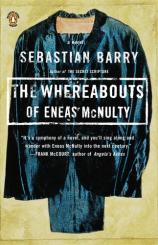
The Whereabouts of Eneas McNulty


About the Book
The Whereabouts of Eneas McNulty



In the years between 1916-1922, when southern Ireland was on the verge of gaining its independence, there were the nationalists—men and women who fought side by side to gain Ireland's freedom from Britain—and there were the Crown forces—made up of soldiers, the Royal Irish Constabulary, and, later, the hated Black and Tans. And there were also men and women who were ill-prepared or unwilling to live political lives: people who refused or were unable to take sides and, as a result, were shunned by their families, communities, and their country. Sebastian Barry's The Whereabouts of Eneas McNulty is the story of one such man, of good intentions and their sometimes disastrous effects, and the struggle between the personal and the political. And it is the story of a man exiled from a country that bewilders and rejects him, but which he loves nonetheless.
Eneas McNulty is born in the first year of the twentieth century in County Sligo in the west of Ireland. The earnest and hard- working McNulty family is caught up in the politics of their homeland. Eneas' sister, Teasy, prays on her knees for the Irish nationalist Michael Collins. Even his younger brother Jack—who will soon wear a British uniform—understands the unwritten code of politics around him. But in Eneas, Barry has created the ultimate innocent who becomes overwhelmed, perplexed, and finally accused by his surroundings and the people that inhabit them. In a world of hard men, he remains a kind of experienced child. It is this lack of guile that will be his downfall, but it is also the richness of Eneas's perspective, despite the harsh reality of the world around him, that will be his redemption.
After a stint with the British Merchant Navy, Eneas returns to a post-World War I Ireland that is—unbeknownst to everyone—poised on the brink of civil war. Desperate for work, Eneas finds there is little to be had and the only job open to him is as a policeman in the Royal Irish Constabulary: a catastrophic decision in the political climate of the times, where other men are becoming another kind of soldier, dark and intent on Irish freedom. Eneas's accidental proximity to the murderous Black and Tans puts him on the IRA's blacklist for the rest of his life. Jonno Lynch, Eneas's closest childhood friend who is now increasingly involved with the local revolutionaries, delivers the death sentence. When Eneas witnesses his sergeant's murder, he is abandoned on all sides, simultaneously let go from the police force and asked by Jonno to assassinate a key member of the Tans called the Reprisal Man. Refusing to kill a man and therefore giving up his only chance at getting off the blacklist, Eneas knows he must leave Sligo—and the people who love him—forever. He works on fishing boats in Northern England, fights after his own curious fashion in France as a soldier in the British Army during World War II, and finds his lowest days in Africa with his Nigerian friend, Harcourt. No matter how far he goes, however, at the back of his mind there is always the menace of the dark-coated men who would prefer him dead. Even so, he twice returns to Sligo, unable to resist the pull of home and the hope that time has erased his death sentence.
At the age of seventy, he heads for the last haven of sailors and wanderers, the Isle of Dogs, and opens a hotel with the self-exiled Harcourt. Northern Ireland's troubles have just begun, thereby reactivating old blacklists and old men. One final time, Eneas faces his childhood friend, Jonno Lynch, and the struggles and conflicts that have unwillingly shaped his flight. And so it is here that he ends his wanderings, "alone, hated, but human on the raveling road," neglected by history but redeemed by the tragic beauty of a final act of selflessness.


The Whereabouts of Eneas McNulty
- Publication Date: August 1, 1999
- Paperback: 336 pages
- Publisher: Penguin (Non-Classics)
- ISBN-10: 0140280189
- ISBN-13: 9780140280180