Reading Group Guide
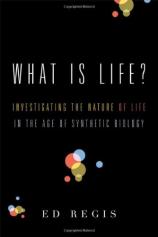
What Is Life?
Investigating the Nature of Life in the Age of Synthetic Biology
by Ed Regis

List Price: $22.00
Pages: 208
Format: Hardcover
ISBN: 9780374288518
Publisher: Farrar, Straus and Giroux

Click here to buy this book from Amazon.com.
Click here to buy this book from Amazon.ca.


About This Book


Taking its title from a landmark 1944 book by the Nobel Prize–winning physicist Erwin Schrödinger, What Is Life? propels the debate about the nature of life into the twenty-first century. Ed Regis offers readers an accessible and tantalizing tour of emerging technologies in genetic engineering, attempts to create synthetic life in laboratories, medical advances that prolong the existence of brain-dead patients, and other recent advances that have raised highly publicized debates about the definition of life in this era of cutting-edge science. What Is Life? informs and enlightens from a fresh philosophical perspective.

The discussion topics that follow are designed to enhance your reading of Ed Regis’s What Is Life? We hope they will enrich your experience as you explore these provocative questions about the essential nature of humanity and the universe we inhabit.

top of the page


rgg_discuss.gif (1294 bytes)


1. Chapter one, “Birth of a Cell,” describes Norman Packard’s realization that funding for far-fetched projects was easier to obtain in Europe than in the United States. How do cultural distinctions between Europe and the United States influence the ways in which research and development are supported? What rules should govern the intersection of commerce and science?

2. What similarities and differences did you observe when comparing John McCaskill’s microfluidic chips and human cells that develop organically?

3. What revolutionary perspective was embedded in Schrödinger’s proposal that genes were messages written in code? What makes the concept of a coded “language” as the basis for molecular biology, “even today... a radical, almost fantastic notion,” as the author describes it in chapter two?

4. “Unlocking the Three Secrets of Life” reminds us of the common fallacies “that DNA is a protein, that Watson and Crick discovered it, and that they did so in 1952.” What accounts for the lack of popular knowledge about Friedrich Miescher’s research on leukocytes, and the discoveries of such twentieth-century biologists as Avery, MacLeod, and McCarty? Does contemporary society require its scholars to be media savvy? What is the best way to bridge popular and scientific communities?

5. Did Schrödinger’s interest in mysticism refute or enhance his scientific claims? Does the ideal of free will mesh with scientific doctrines? How did you react to his assertion (expressed in the opening paragraphs of chapter four) that there is God, or the potential for God, in every conscious mind?

6. How did chapter five change your understanding of metabolism and the cyclical nature of nature itself? What did you discover about the notion of energy expressed in the Krebs cycle?

7. What did you discover in chapter six, “Origins,” regarding the relationship between religious beliefs and scientific beliefs among early researchers? How did Pasteur’s Catholicism influence his attitude toward matter’s ability to organize itself? Were you surprised to see Darwin quoted as stating that life had been “breathed by the Creator into a few forms or into one”?

8. The analogy of “The Spandrels of San Marco” was used by Gould and Lewontin to assert that not everything is an adaptation. Discuss the scientific turning point that is illuminated by this architectural metaphor, in which the spandrels are not designed to serve a specific purpose but instead simply arise as a byproduct. How could this approach --- looking beyond design or adaptation--- resolve intriguing quirks and mysteries you have observed about the natural world?

9. What is your explanation of self-sacrificial altruism in animals (human and otherwise)? Would you characterize the people in your life as altruistic?

10. Chapter eight, “The Twilight Zone,” addresses the issue of synthetic biology, in which an organism’s natural DNA may be partially replaced by one or more DNA sequences produced in a laboratory. At what point (if any) does such experimentation become unethical? How will the power of private-sector humanitarian organizations, such as the Bill and Melinda Gates Foundation, affect these debates?

11. In response to Niels Bohr’s wry statement that “prediction is very difficult, especially about the future,” discuss what the future may hold for the realm of biomedicine, technology, and other innovative fields. In one hundred years, what breakthroughs will surpass artificial hearts and the Internet?

12. What is your answer to the question posed at the end of chapter nine, “The Synthetic Cell Turing Test, ” regarding the creation of artificial chemical cells: “Are the creators, the scientists involved, ‘playing God?’” In the realms of medicine, agriculture, and beyond, what does it mean to “play God,” and what is the best way to weigh benefits versus philosophical and physical dangers?

13. How do you personally answer the book’s title question? Ultimately, how should we define “life”? What can we learn about ourselves and about the world around us simply by exploring the question?

top of the page

Critical Praise

“Ed Regis is always a careful researcher, always an independent thinker. In this subversive little book, he shows that the biggest of big questions is still worth asking --- more urgently now than ever.”
David Quammen


“Elegant, simple, clear, beautifully written. Regis takes up where Erwin Schrödinger left off and tackles the ultimate mystery of biology. This book is a scrumptious gem."
Richard Preston, author of The Hot Zone


“A comprehensive and elegant analysis of the physical basis of life: an up-to-date successor to Schrödinger’s 1944 book.”
Marvin Minsky, Toshiba Professor of Media Arts and Sciences, M.I.T., and author of The Emotion Machine

 
Back to top.   


Privacy Policy | Contact Us | Advertising | About Us

© Copyright 2001-2008, ReadingGroupGuides.com. All rights reserved.