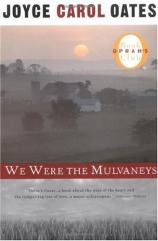
We Were the Mulvaneys


Review
We Were the Mulvaneys




In her twenty-sixth novel, WE WERE THE MULVANEYS, Joyce Carol Oates weaves an intricate and detailed story of a family growing together only to grow apart. It's a moving family saga that tracks nearly forty years of successes and tragedies.
Michael and Corrine Mulvaney are the parents of four glorious children: three boys, Michael, Patrick and Judd, and one girl, Marianne. They live on a picture perfect farm in upstate New York. Michael Mulvaney owns a successful roofing company, and Corrine is a bubbly, earthy mom who can always be counted on to do the motherly thing. For nearly twenty years the Mulvaney clan does nothing but blossom.
And then they don't.
On St. Valentine's night, 1976, after Marianne Mulvaney is named one of the "maids-in-waiting" at the prom, she goes to a party where she inadvertently drinks a great deal and is raped by an upperclassman.
When the rape is revealed, Marianne refuses to press charges against the student (whose father is a well respected businessman, and a friend of Marianne's own father). She feels she can't be her own witness because she had been drinking and the entire night had turned into a blur.
Marianne's rape is the beginning of an ugly spell of bad luck that does nothing but accelerate over a fifteen-year period. Her unwillingness to press charges leaves her father lost and angry. He can no longer look his daughter in the face and she is soon sent away to live with an aunt. Marianne spends years hoping that her father will ask for her. He never does. The circumstances of her life become haphazard as she moves from place to place, with virtually no support, economic or otherwise, from her family.
Back on the farm, things continue to get worse. All three of the Mulvaney boys leave home angrily, never to return. Michael Mulvaney's casual drinking increases and turns into full-fledged alcoholism. Gradually, his reputation as a respected businessman disintegrates: The Mulvaneys are cornered into bankruptcy and forced to sell the one thing that kept the illusion of family going for years --- the farm.
This is a long book, more than 450 pages, but it is by no means a slog. I stayed up till two in the morning turning pages as fast as I could, with tears streaming, to find out the fate of the Mulvaneys. I'm giving nothing away by saying that there is indeed a healing. The Mulvaney family comes full circle: anger subsides and love is restored.
Ms. Oates, who is childless, dedicates her novel to "my" Mulvaneys. But you don't need to have a large family to appreciate this emotionally charged story. For Joyce Carol Oates is a truly gifted storyteller who artfully handles multi-charactered and multi-layered pieces of fiction. An extraordinary woman of letters, Ms. Oates has also authored twenty-one volumes of short stories and more than a dozen works of non-fiction. This, combined with her twenty-five previous novels, adds up to more than fifty books by a fifty-seven-year-old woman.
WE WERE THE MULVANEYS is yet another example of her astounding literary presence.
Reviewed by Jain McCarroll on January 24, 2011


We Were the Mulvaneys
- Publication Date: August 8, 2012
- Genres: Fiction
- Paperback: 464 pages
- Publisher: Plume
- ISBN-10: 0452282829
- ISBN-13: 9780452282827