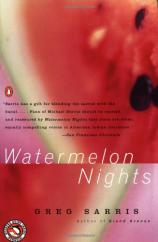
Watermelon Nights


About the Book
Watermelon Nights



"Each afternoon now, when I have finished my work, memory beckons me into the street, insists that I walk with her in the snow."
Wedged between a race track and a busy highway, South Park is the dreariest section of the Northern California town of Santa Rosa. The inhabitants—American Indians, blacks, and Mexicans—are worn down, cast aside by a society embarrassed by or simply indifferent to the poverty and the family struggles passed down from generation to generation. The Indians—Waterplace Pomo, a tribe so small that the Bureau of Indian Affairs does not recognize it—have a special connection to Santa Rosa. The town is named after their common ancestor, a woman abducted and raped by a Mexican general during the early years of California history, when soldiers vied for Indian lands and missionaries laid claim to their souls. But it is "the second Rosa," the daughter of this ill-matched pair, who lives on in the myths the Pomos of South Park share with one another. A proud, beautiful woman, the second Rosa fled her father's oppressive household and with two different Indian men conceived the children who became the new roots of the tribe. Members of the regenerated tribe found work on the dairy farms and in the orchards and canneries established by white settlers on ancient tribal lands and made their homes on a desolate reservation. The barely formed community, however, soon collapsed and eventually made their way to South Park's grim streets. There, in the last years of a century marked by dislocation and despair, long-remembered stories are retold, long-buried secrets revealed, and forgotten bonds of love and forgiveness re-established.
In Watermelon Nights, Greg Sarris weaves the voices of three Pomos—twenty-year-old Johnny Severe, his grandmother, Elba, and his mother, Iris—into a vivid tapestry. As he recounts the harsh history, as well as the rich traditions, myths, and dreams of the Pomos, Sarris illuminates the prejudices and misunderstandings that exist not only between Indians and whites, but within the tribe itself. Johnny, involved in efforts to gain federal recognition for the tribe, comes face to face with these undercurrents as he gathers genealogies from his neighbors. Even Johnny's beloved grandmother, an inveterate storyteller, falls silent when his questions probe too deeply.
Johnny has lived with Elba since the age of fourteen, forging a bond with her far stronger than the one he has with his mother, who has made a place for herself in the white world as an employee at the J. C. Penney in Santa Rosa. Like Elba, Johnny has the ability to see "a lot of things in this world special." His visions, which enable him to discern illnesses and predict behavior, connect him not only to his grandmother, but to generations of tribal visionaries and healers. The possibility of using his gift to escape South Park and pursue a career in legitimate retailing starts to intrigue him when Felix, a newcomer to the community, turns his world upside down. Seduced by Felix's easy-going charm and privy to his most intimate stories, Johnny is confident that they can help themselves and their tribe overcome the sins of the past. When Felix ultimately betrays him, the lessons of his grandmother's stories finally become clear. But these despairing stories echoing in his head are only part of the legacy Johnny takes with him as he leaves South Park. The night before his departure, a watermelon-eating festival transforms the neighborhood and the chorus of bitter voices is drowned out by words of kindness. They are, Johnny realizes, the songs of magic and love that have held the community together forever.
Elba has learned the importance of her tribe's oral tradition from Old Uncle, a legendary healer. An orphan raised on the reservation during the Great Depression, Elba was sold into marriage at eleven and survived five years, two miscarriages, and four stillborn babies before returning to the reservation to join her old friends at a hobo camp where they earn meager rewards for sexual favors. The birth of a son fathered by a kind, loving Filipino laborer brings Elba the first genuine happiness she has known since childhood; his death in a fire sends her spiraling into alcoholism. Ostracized by the self-righteous tribal elders and shattered by a horrific rape at a local bar that leaves her pregnant with an unknown white man's child, Elba sets out on the road to Santa Rosa where she eventually earns enough as a maid to buy a small house and works to preserve her ancestral culture and spiritual beliefs.
Elba's daughter, Iris, has little patience for her mother's interest in songs and visions. Smart, pretty, and eager to be accepted by the white world, she forms a fast friendship with Anna, another Indian, and together they defy Santa Rosa's long-standing social rules by going out with two well-to-do students from the local junior college. Anna, carried away by romantic fantasies, ignores a lifetime of stories about why white men seek out Indian girls and pays a dreadful price. Shocked and unsettled by Anna's experience, Iris tries to bridge the gap between her and her mother. In the end, her own son, forced to choose between his heritage and his future, reveals the true consequences of her renunciation of her roots: "He told me how I am one of the lost generation, that all my problems have to do with my being lost between two cultures, white and red."
As the story of the tribe unfolds in Watermelon Nights, the narrators' points of view play against one another, creating a compelling, finely nuanced portrait of the problems of cultural identity and assimilation at the heart of Native American history. As Patrick Sullivan wrote in The Sonoma County Independent, "Watermelon Nights has no easy answers to offer. But Sarris gives us something better—a powerful novel about deeply complicated human beings. It's easy to say that we live on Indian land. Sarris tells us what that means."
Sarris first introduced South Park and its inhabitants in Grand Avenue, a collection of linked stories that includes narrations by some of the characters in Watermelon Nights, their children, and their grandchildren. Hailed by Michael Dorris as "one of the very best works of fiction by and about Native Americans [and] one the most important, imaginative books of the year," Grand Avenue portrays with poignancy and humor the lives of yearning teenagers, jilted lovers, struggling parents, and elderly healers. Enchanted by a crippled old horse who magically responds to her touch and voice, a young girl performs a desperate act in a futile attempt to save him from the slaughter house. A mother, comforting her cancer-stricken child with stories of her ancestors, wonders if the ancient curse the tales speak of has come to claim them both. A teenage boy, goaded into entering a forbidden place, witnesses a scene that destroys his innocence. A father tries to make contact with the son he never acknowledged and finds himself caught in a neighborhood scandal.
The older generation, survivors of years of turmoil and betrayals, talk of the choices and the compromises they have made. Old Uncle has forsaken ancient teachings and now teaches a Bible class for Indians at the local YMCA. Others hold fast to the traditions of the tribe. Nellie, Elba's childhood friend, continues to weave baskets and to practice healing rites that still work wonders. Perhaps the greatest miracle in Nellie's life is Alice, a teen-aged neighbor who asks for lessons in |basket-weaving. As they work together at her kitchen table, Nellie passes on to Alice the secret that has sustained countless generations: "Talk. It's important to talk. . . Stories, the true stories, that's what we need to hear. We got to get it out. The true stories can help us."


Watermelon Nights
- Publication Date: November 1, 1999
- Mass Market Paperback: 432 pages
- Publisher: Penguin (Non-Classics)
- ISBN-10: 0140282769
- ISBN-13: 9780140282764