Reading Group Guide
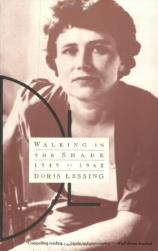
Walking In the Shade
by Doris Lessing

List Price: $15.00
Pages: 432
Format: Paperback
ISBN: 0060929561
Publisher: HarperCollins

Click here to buy this book from Amazon.com.
Click here to buy this book from Amazon.ca.


About This Book


1996 Finalist, National Book Critics Circle Award for Biography

Walking in the Shade opens in 1949 with Doris Lessing's resolute good-bye to Africa and her hopeful hello to England. In the second volume of her memoirs, Lessing traces her journey as a twice married mother of three in the British colony of Southern Rhodesia to her struggles as a writer and single parent in post-war London. If Under My Skin focuses on her childhood and various attempts to differentiate herself from her parents and the values and sacrifices they symbolized, then Walking in the Shade marks Lessing's development as a promising writer, cast in the shadow of her vexed relationship to the Communist Party in particular and organized politics in general. In fact, Lessing considered separating the description of her political life into a single chapter, so that disinterested readers could simply skip the section. However, Lessing soon realized that politics permeated her experience of these years so thoroughly that compartmentalization would not only be impossible, but inadvisable given her dedication to representing truthfully the age through which she lived and was shaped. Lessing devotes much of the second volume to the evocation of her creative process, her interactions with the literati of London and the many changes--economic, social and cultural--that occurred in England throughout the 1950s. Walking in the Shade concludes in 1962, the year she published her most famous and most influential work to date: The Golden Notebook.

top of the page


rgg_discuss.gif (1294 bytes)


1. In the middle of Walking in the Shade, Lessing remarks that "coming events cast their shadows before. But looking back from the perspective of those events, it is easy to be dishonest. Some tiny passing shade of feeling, a mere cloud shadow, may ten years later become a storm of revelation: about yourself, about others, about a time. Or may have dissolved and gone." Does this metaphoric reflection relate to the title of Lessing's second autobiographical volume? If so, how?

2. Lessing punctuates the second volume of her autobiography with commentary on "The Zeitgeist: How We Were Thinking." These sections, which include reflections on politics, class warfare, and feminism, seem to promote a common theme in Lessing's work: people cannot act outside the parameters of their particular histories, of which they are a direct product. Yet, Lessing also insists that "if acceptance of social ills is a sign of maturity, what becomes of progress?" Are these philosophical positions in conflict or do they represent a productive paradox about history and change?

3. Throughout the book, Lessing suggests that all formally organized social groups, regardless of original intention, eventually become religious and frequently turn into their polar opposite. What does religion mean in the context of this hypothesis? How does Lessing describe this process of group transformation in relation to her experience with the Communist Party?

4. In England, Lessing became involved with many Americans. She concludes that "Americans are a people of extremes." Although the British and the Americans share the English language, Lessing says their "national temperaments" form a barrier to substantive communication and understanding, a contention that "may hardly be said aloud in the United States, because of political correctness." What characterizes these "national temperaments" in Lessing's opinion? How do these different dispositions manifest themselves in Walking in the Shade?

5. In England, Lessing became involved with many Americans. She concludes that "Americans are a people of extremes." Although the British and the Americans share the English language, Lessing says their "national temperaments" form a barrier to substantive communication and understanding, a contention that "may hardly be said aloud in the United States, because of political correctness." What characterizes these "national temperaments" in Lessing's opinion? How do these different dispositions manifest themselves in Walking in the Shade?

top of the page

Critical Praise

"You can't help but admire her independence of thought and feeling and her willingness to ovberturn all the precepts upon which her very existence has been predicted. "
Los Angeles Times Book Review


" Justifies by her extraordinary variety of her achievements, her exceptional memory and her facility as a writer. "
New York Times Book Review


" The life she describes is heroric...yet astonishingly full, with political work, writing, friendships, lovers and travel. "
San Francisco Chronical


" The story couldn't be better told. She is there, marvelously urgent, translucently sincere--Doris Lessing in person. "
Washington Post Book World

 
Back to top.   


Privacy Policy | Contact Us | Advertising | About Us

© Copyright 2001-2008, ReadingGroupGuides.com. All rights reserved.