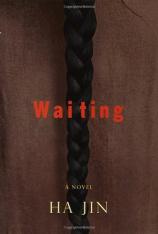
Waiting
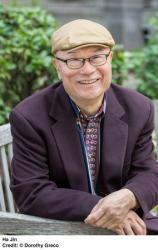
by Ha Jin
List Price: $13.00
Pages: 308
Format: Hardcover
ISBN: 0375406530
Publisher: Pantheon
Winner of the 1999 National Book Award for Fiction!
In Waiting, PEN/Hemingway Award-winning author Ha Jin draws on
his intimate knowledge of contemporary China to create a novel of unexpected
richness and feeling. This is the story of Lin Kong, a man living in two
worlds, struggling with the conflicting claims of two utterly different
women as he moves through the political minefields of a society designed
to regulate his every move and stifle the promptings of his innermost
heart.
For more than seventeen years, this devoted and ambitious doctor has been
in love with an educated, clever, modern woman, Manna Wu. But back in
the traditional world of his home village lives the wife his family chose
for him when he was young--a humble and touchingly loyal woman, whom he
visits in order to ask, again and again, for a divorce. In a culture in
which the ancient ties of tradition and family still hold sway and where
adultery discovered by the Party can ruin lives forever, Lin's passionate
love is stretched ever more taut by the passing years. Every summer, his
compliant wife agrees to a divorce but then backs out. This time, Lin
promises, will be different.
Tracing these lives through their summer of decision and beyond, Ha Jin
vividly conjures the texture of daily life in a place where the demands
of human longing must contend with the weight of centuries of custom.
Waiting charms and startles us with its depiction of a China that remains
hidden to Western eyes even as it moves us with its piercing vision of
the universal complications of love.
top of the page

1. Ha Jin has said that the
idea for Waiting came to him when he read a newspaper story about
a woman who described her husband as loveless: "She wished her husband
could have an affair with another woman.... At least that would prove
he was capable of love" Atlanta Journal, 15 Nov 1999, E1]. When
late in the novel Lin realizes that "he had never loved a woman wholeheartedly
and that he had always been the loved one" (p. 296), do you think Ha
Jin is calling attention to an individual problem -- his protagonist's
passive temperament -- or a universal one?
2. Lin Kong is a man who seems
to want to move beyond the values of traditional village life, with
its familial bonds and rootedness. If marrying Manna Wu will bring him
the more modern life he desires, one based on self-fulfillment and independence,
why does he have such difficulty obtaining his divorce? Is he undecided
as to what he wants? What does he stand to lose in giving up Shuyu?
How do the choices he faces relate to similar ones faced by men and
women in America today?
3. Geng Yang tells Lin, "You're
always afraid that people will call you a bad man. You strive to have
a good heart. But what is a heart? Just a chunk of flesh that a dog
can eat. Your problem originates in your own character, and you must
first change yourself" (p. 167). How insightful is this remark? Should
Lin try to be more heartless with regard to his wife? How is the remark
tempered by what you know of Geng Yang's character?
4. Ha Jin does not present
Manna and Lin as perfect characters; what are their weaknesses? Could
anyone, no matter how strong and forceful a personality, fare better
than they did in the coercive social system in which they live? Does
Ha Jin imply that people like Geng Yang can thrive only because they
have no conscience?
5. In Western culture and in
Freudian psychology, the goal of true adulthood is individuation, as
well as the ability to realize one's desires through will and action.
In the world of this novel, such ideals are considered corrupt and bourgeois.
Is it possible for readers raised in this Western way of thinking to
find Lin's passivity admirable? Do you find both Lin and Manna too childlike?
Or are they simply trapped in a no-win situation?
6. Why is the situation so
much more difficult for Manna Wu than for Lin? Should she have pursued
other possible mates more aggressively? At the beginning of the novel,
we're told that Manna is "almost twenty-six, on the verge of becoming
an old maid" (p. 19). How sympathetic are you to her difficulty in finding
a mate? The narrator has said that "Men and women were equal" in Maoist
China (p. 37); do you find this to be the case in the novel, or is Manna
Wu at a serious disadvantage?
7. How does the character of
Manna Wu compare with that of Shuyu? Does Shuyu's traditionalism protect
her from suffering the tug of neurosis that affects Manna Wu as time
grinds on? Would you say that, especially after moving to Muji City,
Shuyu is more free to enjoy her life than either Lin Kong or Manna Wu?
Do both women really love Lin Kong?
8. Why does Ha Jin choose Walt
Whitman's Leaves of Grass as the book given to Manna by Commissioner
Wei? Does the book, which celebrates democracy and the self, indicate
that Commissioner Wei is not a model revolutionary? Do you accept the
idea that Manna's handwriting wasn't up to his expectations, or do you
think that her "report" on Whitman was too cautious? What do you find
most comical about Manna Wu's date with the commissioner?
9. While the political background
of the novel underscores the reality of an ongoing Marxist revolution,
the personal issues focus more upon what might be considered "bourgeois"
concerns, like the desire for a fulfilling domestic life with its attendant
personal and sexual comforts. Do the personal desires of Lin and Manna
necessarily conflict with the ideals that Mao Tse Tung's revolution
has thrust upon the Chinese people? How do you respond to the description
of their wedding ceremony, in which they bow three times to a portrait
of Chairman Mao?
10. It is a romantic notion
that true love will survive all sorts of trials and separations. While
Manna and Lin are together in a sense, the fact that their relationship
cannot be a sexual one surely constitutes quite a long trial and separation.
Are you surprised at Lin's feelings when they finally are married? What
do you find comical about the long-awaited sexual encounters between
Manna and Lin?
11. When Lin leaves the house
in a rage after Manna scolds him for burning the rice, a voice in his
head tells him, "Actually you never loved her. You just had a crush
on her, which you didn't get a chance to outgrow or to develop into
love.... In fact you waited eighteen years just for the sake of waiting"
(p. 294). Is this a moment of real insight in the novel, devastating
as it is?
12. What is most remarkable
about the scene in which Lin, standing in the snowy darkness outside
their window, watches as Shuyu and his daughter prepare dumplings (p.
301)? Why is this sight both nostalgic and painful for him?
13. The narrator doesn't reveal
much about Shuyu's feelings; why not? What does Shuyu most desire? Why
does she seem to be in such control of her own emotions, as contrasted
with Manna? Is it surprising that she remains generous toward Lin even
after he is married to Manna?
14. Ashamed of the things he
said to Shuyu while drunk, Lin tells Hua, "Tell her not to wait for
me. I'm a useless man, not worth waiting for." She responds, "Don't
be so hard on yourself, Dad. We'll always wait for you" (p. 308). Does
Lin deserve this unwavering loyalty from his first wife and daughter?
Do the traditional values which he tried to escape in divorcing Shuyu
triumph after all?
15. Many critics have commented
on the affinity between the work of Ha Jin and that of such nineteenth
century Russian writers as Turgenev and Chekhov, who also wrote about
ordinary people caught up in times of wrenching change, and about communities
in which simple peasants come into conflict with more sophisticated,
modern and complex characters. How are the peasants in Waiting
represented, and how are they different from those who are more educated
and ambitious?
16. Much of this book is given
up to what happens while its characters are waiting. How does Ha Jin
overcome the danger of stasis, and the reader's impatience, in constructing
the novel? How would you describe the structure and pace of the plot?
17. What do you notice about
the way Ha Jin describes the physical details of everyday life like
food, housing, clothing, people's bodies? How does the material culture
of this novel differ from that of America? Do you feel that, because
Ha Jin is consciously writing for an American audience in his adopted
country, such details have greater resonance?
18. Ha Jin has not returned
to China since he left in 1985; in 1990, he made a commitment to write
and speak solely in English. Speaking of that decision, he says, "There
was a lot of fear. It's like changing your body, to write in a different
language. And it wasn't just a matter of finding an audience, it was
a matter of survival -- I have a family to support. Finally I decided
to write in English, absolutely uncertain of whether I could do it.
I'm still uncertain! In the end, though, every project is a risk, not
just the language. And that's true for every writer" [From "A conversation
with Ha Jin," by Mary Park, amazon.com]. How would you characterize
the style in which this novel is written? If you have read the work
of Vladimir Nabokov or Joseph Conrad, two other emigré writers
who adopted English as their literary language, how would you compare
Ha Jin's use of the language?
top of the page

"Compassionate, earthy, robust, and wise, Waiting blends provocative allegory
with all-too-human comedy. The result touches and reveals, bringing to
life a singular world in its spectacular intricacy."Gish Jen, author of Who's Irish?
"A remarkable love story. Ha Jin's understanding of the human heart and
the human condition transcends borders and time. Waiting is an
outstanding literary achievement."
Lisa See, author of On Gold Mountain