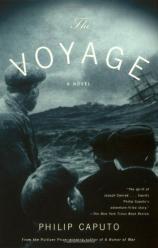
The Voyage
by Philip Caputo
List Price: $14.00
Pages: 432
Format: Paperback
ISBN: 0679768394
Publisher: Vintage Books
In the tradition of great seafaring adventures, The Voyage is an intricately
plotted, superbly detailed, and gripping story of adventure and courage.
Pulitzer Prize-winning author Philip Caputo has written a timeless novel
about the dangerous reverberating effects of long held family secrets.
On a June morning in 1901, Cyrus Braithwaite orders his three sons to set sail from their
Maine home aboard the family's forty-six-foot schooner and not return
until September. Though confused and hurt by their father's cold-blooded
actions, the three brothers soon rise to the occasion and embark on a
breathtakingly perilous journey down the East Coast, headed for the Florida
Keys.
Almost one hundred years later, Cyrus's great-granddaughter Sybil sets out to uncover the
events that transpired on the voyage. Her discoveries about the Braithwaite
family and the America they lived in unfolds into a stunning tale of intrigue,
murder, lies and deceit.
top of the page

1. Is there a hero
(or are there heroes) of The Voyage? What is the concept of hero
in the novel? If not heroes, are the boys brave? Who is the bravest?
What is bravery?
2. The "voyage" of
the title could symbolize many things--the literal sailing trip, the
journey from boyhood to manhood, and Sybil's journey of discovery. How
do you interpret it? Does the concept of "voyage" take on different
meanings throughout the novel? How does the author blend the different
meanings of "voyage?"
3. How are the American
North and South portrayed in the novel? How does Havana compare to the
United States? How does the geographical journey of the Double Eagle
allegorically retrace in reverse the history of the United States?
4. The Voyage
is narrated by an old friend of Sybil's (who makes her debut on p. 20),
and the story itself is "imagined" by Sybil as she reconstructs the
past. Is this double layer of narration effective as a literary device?
Does the narrator's presence detract from or promote the retelling of
the story? The narrator explains, "Sybil has had to fill in the vast
empty spaces in the chronicle by making things up . . . " [p. 20]. Does
knowing Sybil "imagined" the story detract from the believability and
realism of the tale? How, if at all, is the reader affected by learning
in the epilogue that the narrator is a female college roommate of Sybil's?
How do Sybil's personal circumstances and her relationship with her
family color her "retelling" of her ancestors' story?
5. How does the epigraph
attributed to Joseph Conrad foreshadow the events on the sea? Is the
sea a friend or foe to Nathaniel and his brothers? To Cyrus?
6. What is the significance
of the names the author selected for the boys' vessel, Double Eagle,
and that of Cyrus, Main Chance?
7. What did Cyrus
mean when he said "It's a new century, boys. Yes, indeed, a brand-new
century" [p. 19]? Or, what did Sybil mean when she "imagined" Cyrus
saying this? The "new century" motif appears four more times in the
novel in different contexts (p. 170, 191, 232, and 273). How does this
motif weave the themes of the book together? How is the twentieht century
contrasted with the nineteenth century in the novel?
8. As Sybil describes
it, "[T]he Braithwaites were more a tribe than a family, and more than
a tribe, a consanguineous commonwealth of patriarchs, and matriarchs,
aunts, uncles, first, second, and third cousins" [p. 22]. The concept
of family takes on almost mythic proportions in the beginning of the
novel--how are these myths simultaneously shattered and upheld along
Sybil's path to discovery? How is this image of a family and the subsequent
deconstruction of this image a metaphor for the deconstruction of American
history?
9. Compare and contrast
the personalities of Eliot, Drew, and Nat. What are their likes and
dislikes? How does the author portray each of the brothers' characters
via their relationships with each other? With Will? With the sea?
10. Prior to their
trip, Nat "could not conceive of anything bad happening to him, simply
because nothing ever had" [p. 143]. Later, Nat is filled with "self-loathing"
as he is overwhelmed by his multitude of failures on the voyage [p.
321]. What "bad" things happen to Nat on the voyage? How is The Voyage
a coming-of-age story for Nat? For the other boys? Does that necessitate
a loss of innocence? Does it result in a loss or gain of confidence
for each of the boys? What are the lessons learned by the boys, if any?
11. What is the significance
of the subplot involving the wreck of the Annisquam to Sybil's
family history? To the explanation of Cyrus's behavior towards his family?
12. Nat uses a nearly
biblical metaphor recalling the creation story to describe the creation
of a sailing vessel as "more even than art. . . . It was as if the men
who designed and built her somehow endowed her with aspects of themselves,
their various traits seeping with their sweat into her ribs and knees
and bowels . . . " [p. 54]. The boys view Southern Cross at the site
of the Annisquam. [p. 273] Cyrus quotes the Bible in his cryptic
telegram to Havana [p. 375]. How do the religious and biblical overtones
build a sense of moral inevitability in the novel's conclusion, i.e.
"the sins of the fathers. . . ."? At the same time, along their journey,
the boys incant seafaring superstition, and Caputo peppers The Voyage
with sea shanties. Does superstition undermine the religious tenets
of the novel? Upon which, religion or superstition, do the boys rely
more? Are religion and superstition compatible on the sea? In the novel?
13. How would you describe
the mood of the novel? Does it change from land to sea?
14. In the character
of Gertrude Williams the reader gets a glimpse of the women's emancipation
movement brewing at the turn of the nineteenth century. How are the
situations of other female characters (the boys' mother, Aunt Judith,
Elvira) symbolic of women's emancipation and the theme of emancipation
in American history in general?
15. After weathering
the lengthy battle with the sea along with the boys, how is the reader
affected by the contrasting subplot of Will's illicit romance with Elvira
[Chapter 24]? How does this subplot serve as a microcosm of the mysterious
history of the Braithwaite family?
top of the page

"The spirit of Joseph Conrad . . . haunts Philip Caputo's adventure-filled story."The New York Times Book Review
"A high seas classic combined with a mystery."San Francisco Chronicle
"A sea story in the grand tradition of Conrad and Melville, this shamelessly salty and unbearably
exciting novel is a welcome reminder that imagination transports us where facts cannot, that adventure created by a master storyteller can make
reality seem tame."Daily News