IndieBound Independent Bookstores BRC Facebook Fan Page
Coming Soon
Reading Group Guide
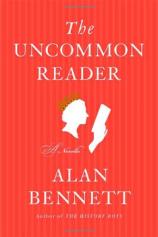
The Uncommon Reader
A Novella
by Alan Bennett

List Price: $15.00
Pages: 128
Format: Paperback
ISBN: 9780374280963
Publisher: Farrar, Straus and Giroux

Click here to buy this book from Amazon.com.
Click here to buy this book from Amazon.ca.


About This Book


The author of the Tony Award winner The History Boys, Alan Bennett is one of Britain’s best-loved literary voices. With The Uncommon Reader, he brings us a playful homage to the written word, imagining a world in which literature becomes a subversive bridge between powerbrokers and commoners. By turns cheeky and charming, the novella features the Queen herself as its protagonist. When her yapping corgis lead her to a mobile library, Her Majesty develops a new obsession with reading. She finds herself devouring works by a tantalizing range of authors, from the Brontë sisters to Jean Genet. With a young member of the palace kitchen staff guiding her choices, it’s not long before the Queen begins to develop a new perspective on the world—one that alarms her closest advisers and tempts her to make bold new decisions. Brimming with the mischievous wit that has garnered acclaim for Bennett on both sides of the Atlantic, The Uncommon Reader is a delightful celebration of books and writers, and the readers who sustain them.

top of the page


rgg_discuss.gif (1294 bytes)


1. What play on words did you detect in the novella’s title? In the world of literature, how are commoners defined? What ironies exist in the mobile library’s intended purpose?

2. Early on, the Queen tells Norman that she reads because “one has a duty to find out what people are like.” The Queen later says to Sir Kevin, “One reads for pleasure. It is not a public duty.” What accounts for this transformation? Do you read because of a sense of duty, or purely for pleasure (as Norman does)?

3. What books were you reminded of as the Queen’s literary obsession began causing her to shirk her royal duties and pay less attention to her family? When have you preferred to lose yourself in fiction rather than confront reality?

4. Many critics and scholars have debated the “correct” way to interpret literature, ranging from those who scorn any political or sociological interpretations to those who scorn interpretation itself. How does the Queen seem to interpret what she reads? What determines whether she likes a book?

5. The Uncommon Reader contains references to dozens of authors and characters, including Joanna Trollope and Harry Potter, writers affiliated with the University of East Anglia (such as Kazuo Ishiguro and Ian McEwan), Alice Munro and Henry James. How did the Queen’s entourage discuss such a broad range with her? What are the implications of name games designed to judge a person by his or her taste in books? What does one’s reading list say about oneself?

6. Would this tale have been as effective if the public leader at its center were not a monarch? Could a democratically elected ruler have generated as much humor? What makes the English Queen ideal for this scenario?

7. What comic elements are at work in the friendship between Norman and the Queen? What sort of literary adviser is he? What would you have advised her to read?

8. What is the effect of reading a novella—more substantial than a short story but not as lengthy as a novel? How did the author’s triumphs as a playwright and television writer shape the storytelling in The Uncommon Reader?

9. What is the effect of reading a book about reading books? How might the fictional Queen respond to The Uncommon Reader?

10. In her conversation with the university vice-chancellor and the creative writing professor, the Queen debates whether reading softens a person up while writing does the reverse. Do you agree that writing makes us tough but reading makes us soft? How does the Queen handle her transition from reader to writer?

11. A main premise of the novella is that the Queen has no hobbies of any kind; hobbies, we are told, imply preferences, which must be avoided because they can lead to the exclusion of various populations. Is this an accurate portrayal of public life in general? Can you name any public figures who not only admit to being avid readers but who also engage in public dialogues advocating books, or who advocate controversial books or books written by marginalized populations?

12. In the closing scenes, the Queen begins to describe herself candidly as the kingdom’s “deodorant,” forced to passively oversee or tout dreadful public-policy decisions. In what ways did reading help her arrive at this realization? Is her final decision regarding the throne necessary to launch her career as a writer?

13. In what ways does The Uncommon Reader enhance your previous reading of works by Alan Bennett? How might the novella’s Queen have responded to the students in The History Boys, and vice versa?

top of the page

Critical Praise

“One of the greatest living English writers.”
David Thomson, The Nation


“Bennett’s deadpan, self-deprecating humor translates perfectly.”
David Gates, O, The Oprah Magazine


“There is probably no other distinguished English man of letters more instantly likable than Bennett.”
Michael Dirda, The Washington Post Book World


“A prose stylist of disarming grace and sly humor.”
The New York Times Book Review


Privacy Policy | Contact Us | Advertising | About Us

© Copyright 2001-2010, ReadingGroupGuides.com. All rights reserved.
The Book Report, Inc. • 250 West 57th Street • Suite 1228 • New York, NY • 10107
Ph: 212-246-3100 • Fax: 212-246-4640

Bookreporter.comReadingGroupGuides.comGraphicNovelReporter.comFaithfulReader.com
Teenreads.comKidsreads.comAuthorsOnTheWeb.comAuthorYellowPages.com